



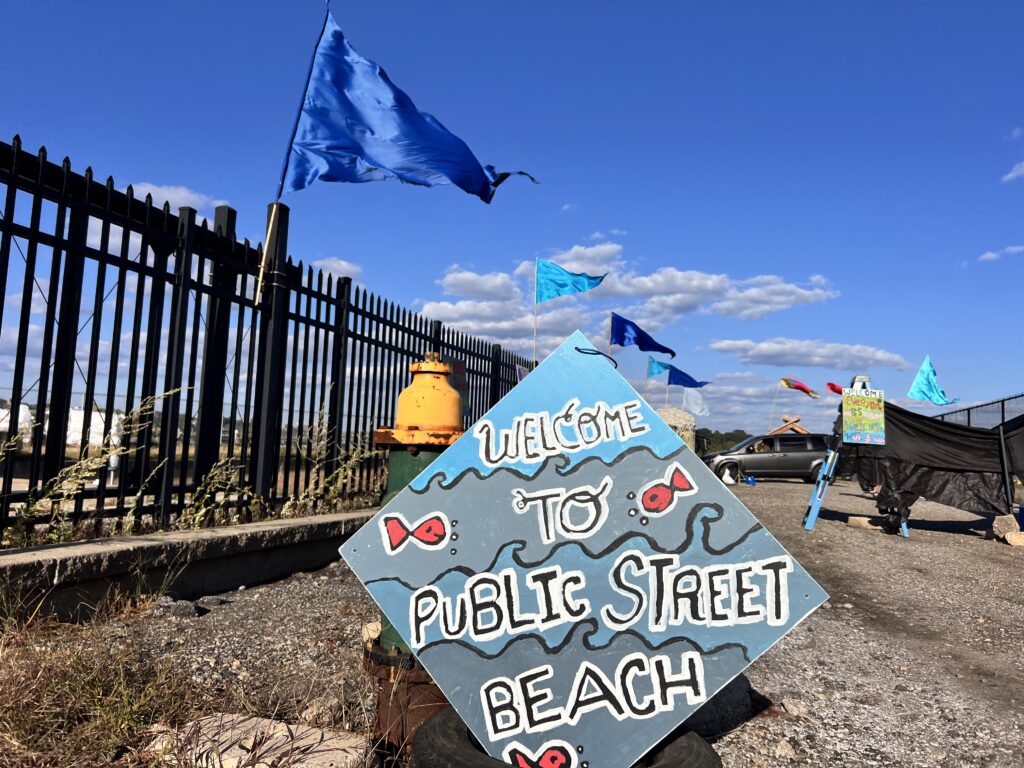
In South Providence, a stormwater pipe is leaking oil into the bay and draining momentum from efforts to clean up the neighborhood’s only public right-of-way to the shore, located on Public Street.
“We were doing a cleanup down there and noticed that there was this oily sheen on the water,” said Jed Thorp, director of advocacy with Save The Bay. “At a relatively low tide, we could see an oily sheen on the water, and some sort of bubbling up, or movement of water in that area, indicating that there was some sort of discharge below the water.”
Activists and locals reported the oily substances to the Rhode Island Department of Environmental Management four years ago, but the path to resolving the issue remains murky.
The City of Providence argues the pollution leaching into the storm water pipe comes from neighboring properties owned by Rhode Island Energy (RIE). RIE refuses to take responsibility for the contamination before the city cleans out the pipe for a complete inspection. While DEM moderates an agreement between the two parties, further delays could threaten funding to build a park on Public Street.
Oily Discharges Entering Narragansett Bay
The section of pipe in question is a 38” masonry pipe built in 1898 running from Allens Avenue towards the waterfront. It used to be connected to the city’s sewer system as recently as 2010, but now, it only channels stormwater.
As early as April 2022, authorities documented regular evidence of petroleum releases from the Public Street pipe into the Providence River. An environmental report from consultants Fuss & O’Neill commissioned by the City of Providence found the samples in the pipe were very similar to fuel oils such as diesel.
“It’s safe to say that whatever is coming out of that pipe is not good for the river or the health of the bay,” said Thorp. “Any sort of petroleum or petroleum byproduct has negative environmental impacts.”
Crews inspected the pipe with cameras in July of 2022, but sediment build-up blocked the team from assessing the entire pipe. Authorities agree that the first step to addressing the oily water is cleaning out the sediment for a proper inspection. Clearing out the pipe will cost approximately $100,000.
However, officials from the City and Rhode Island’s biggest utility company disagree on who should pick up the bill.
City of Providence and Rhode Island Energy Negotiate Cleanup Cost
The source of the petroleum is the key question holding up the process. Stormwater collects a variety of contaminants as it runs through city streets, including petroleum products used by cars, gas stations and other gas-powered machinery operating in an urban environment. On Public Street, Providence officials say the pollution comes from neighboring property owned by Rhode Island Energy.
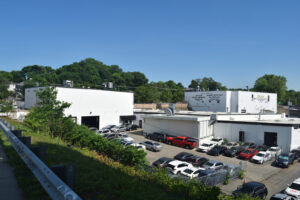
The sites to the north and south of Public Street were used for bulk petroleum storage and distribution for approximately 80 years, between 1920 and the early 2000s. Aerial photographs show storage tanks surrounding Public Street until at least 2003.
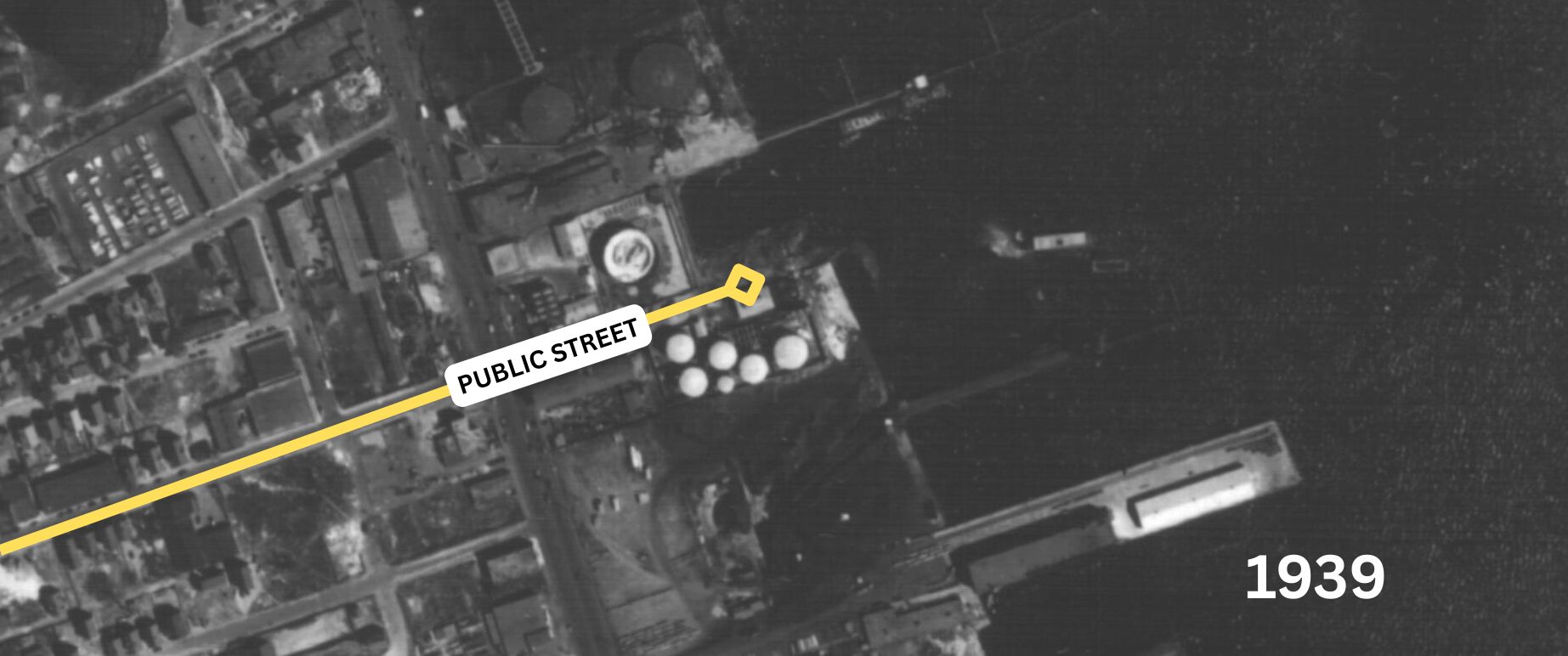
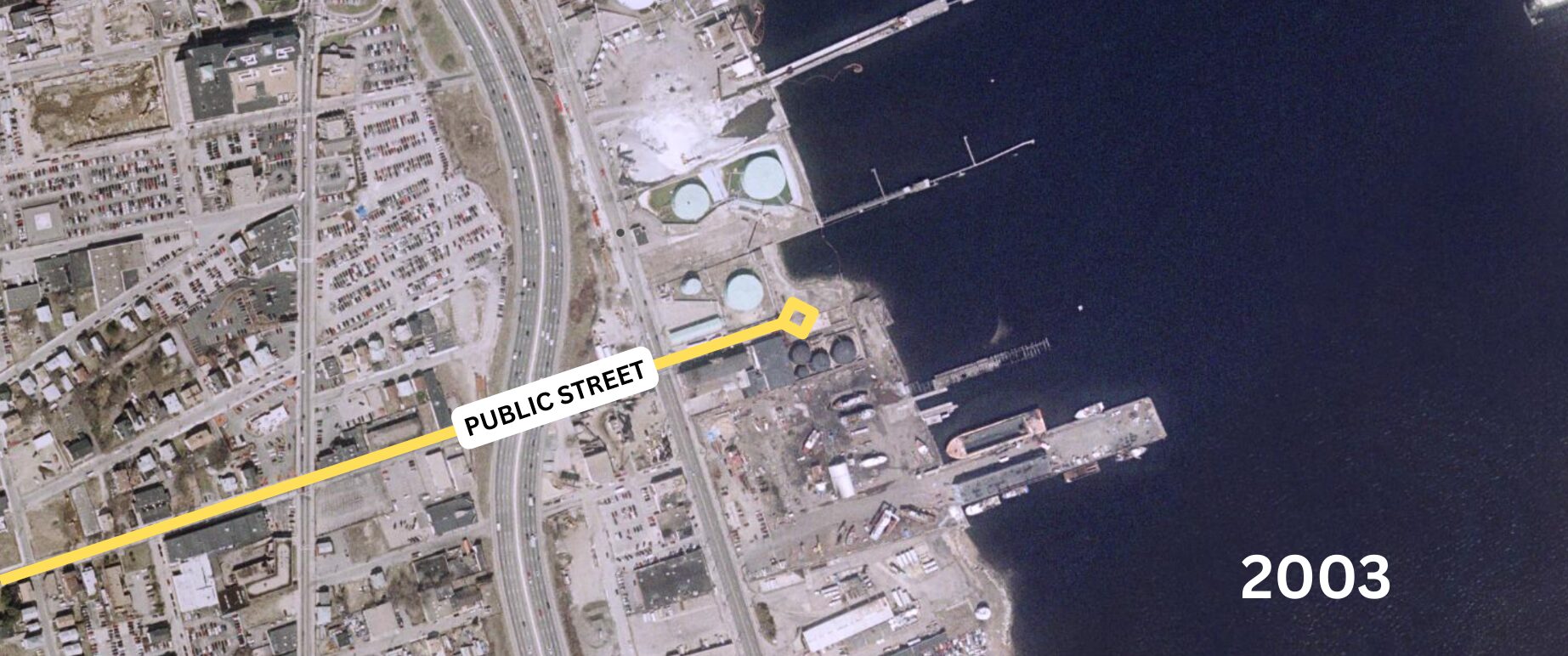
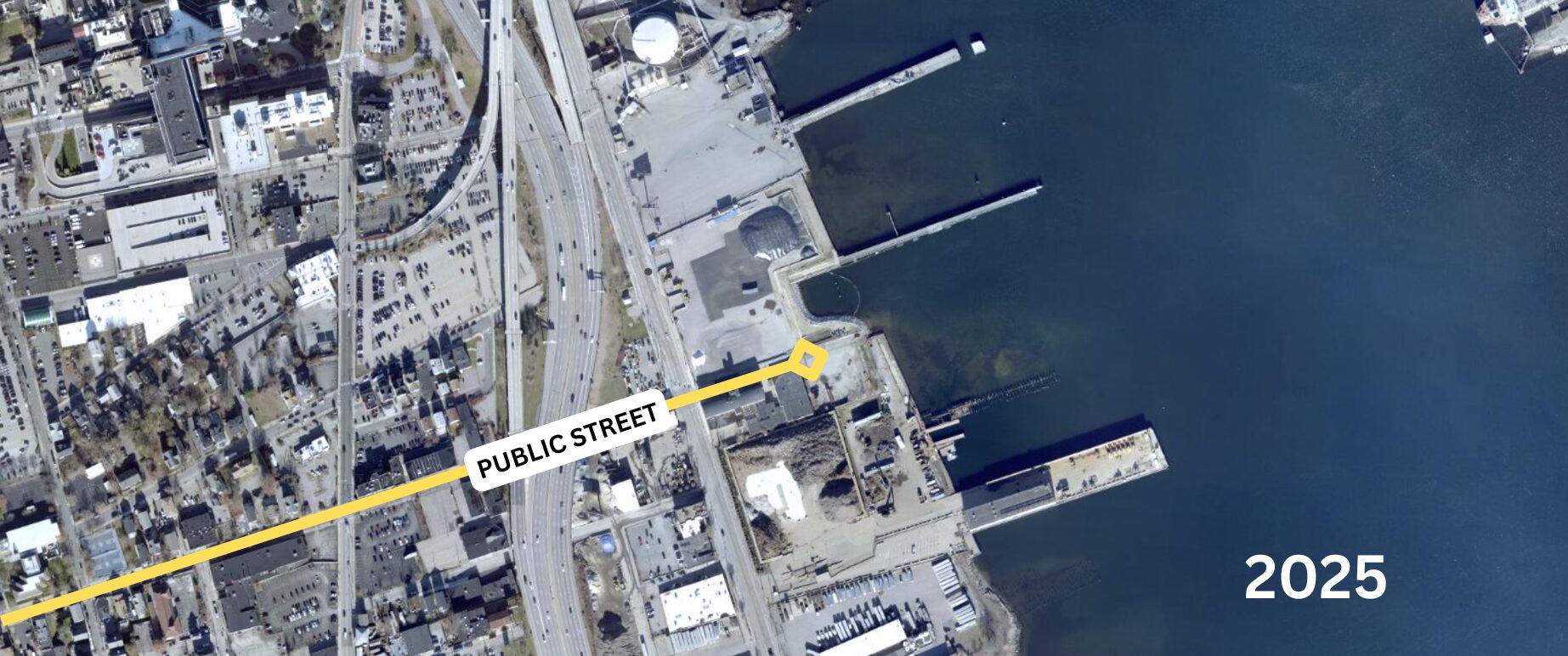
Aerial photographs. Photos: RIDEM. Annotations made by The PVD Eye.
RIDEM approved an environmental land usage restriction for the sites in 2014 with the former owner, National Grid. A remedial action work plan for the area required capping the contaminated soils, conducting regular monitoring, installing a containment wall and removing non-aqueous phase liquids (NAPLs) from a network of recovery and monitoring wells.
NAPLs are a category of liquid contaminants that are similar to or dissolve in water. Light non-aqueous phase liquids (LNAPLs) are contaminants that float on water, such as oil products that leak from storage tanks or pipelines into the permeable ground.
The city’s report concludes the LNAPLs found in the Public Street pipe and the samples found in the monitoring wells on surrounding properties “have a similar composition and are likely from similar sources.”
“The porous nature of the brick pipe mortar joints and the elevation of the line below the water table suggests that the line may be acting as a subsurface trench drain, receiving groundwater and LNAPL due to the presence of these contaminants at and near the groundwater/soil interface in areas adjacent to the pipe,” reads the analysis.
Fuss & O’Neill also observed water infiltration documented in a video of the pipe recorded by RIE. The video reveals water dripping into the pipe and white staining streaks of calcium deposits indicative of water infiltration.
Based on the video and oil samples, the City blames Rhode Island Energy for polluting the Public Street pipe.
“RI Energy is the responsible party for the former brownfield sites that the City maintains are contributing to the petroleum discharges,” said city spokesperson Josh Estrella. “The City, through RIDEM, is negotiating with RI Energy to come up with a resolution to the issue.”
However, Rhode Island Energy maintains that the pipe must be cleaned and thoroughly inspected before they accept responsibility.
“We have consistently told the City and RIDEM that we are ready to complete the remaining assessment work once the sediment inside the drain line is removed by the owner (the City) or another party, as this is necessary for further inspection,” said Michael Dalo, manager of external communications for RIE.
RIE’s own annual monitoring report from consultants GZA completed in May 2025 makes note of the oily sheen floating from the pipe but says the source is undetermined.
“The evaluations completed to date are not conclusive relative to the source of the observed sheening,” said the report.
Since Providence blames RIE for the pollution, the City is asking the utility company to pay for half of the approximately $100,000 needed to clean up the pipe.
“Talks have stalled over the issue of responsibility,” said Evan LaCross, from RIDEM. “DEM remains in contact with representatives from both sides to reengage the parties and resolve the current stalemate.”
As Oil Runs, Community Waits on the Sidelines
RIE’s parent company PPL reported $1.18 billion dollars in earnings last year. The City of Providence’s $624 million dollar budget includes $35,023,866 anticipated expenses for public works, including sewer maintenance. Until the petroleum pipe gets cleaned up, the cost is being paid in South Providence.
“Up until now, there’s been no political will to get it fixed,” said Linda Perri, president of the Washington Park Association. “The pipe is holding up the development of Public Street.”
The Coastal Management Resource Council officially recognized the road as a right-of-way to the shore in 2021. Now, the City’s Office of Sustainability is finalizing designs for a small park on Public Street with a walkway, park benches and native plants.
The project’s construction is relying on funding from the Narragansett Bay Estuary Program, the Rhode Island Infrastructure Bank grant and a Watershed Implementation Grant from the EPA’s Southeast New England Program (SNEP). The SNEP grant deadline was already extended to the end of March, but the City said “additional extensions [are] contingent on significant progress made on resolving the issue” of pollution on Public Street.
To secure the funding and a permit from the CRMC, City officials are under pressure to clean up the pollution.
In recent weeks, negotiations over Public Street included RIDEM Director Terry Gray, Providence’s Chief of Policy and Resiliency Sheila Dormody, and the City’s Chief of Operations Courtney Hawkins for the first time. Officials close to the project said it’s a good sign that leadership is getting involved in the process.
“It is still slow and bureaucratic,” said Kevin Proft, deputy director of the Office of Sustainability to a community meeting at Knight Memorial Library on March 9. “The people that get to make decisions about these things or have the most influence… are talking about it.”
“Cause we’re pushing them,” replied Monica Huertas, executive director of the People’s Port Authority, who helped organize the meeting with the Washington Park Association and the South Providence Neighborhood Association.
Someone from the crowd asked Proft why DEM wants collaboration rather than enforcing the law around pollution. Both Proft and Thorp said the enforcement process can take a very long time.
“Sometimes enforcement can slow things down considerably because they lawyer up, and then you’re stuck in a court for God knows how long,” said Thorp. “Sometimes if you’re trying to get fast resolution, enforcement can help, and sometimes, it can hurt you.”
Just down Allens Avenue, scrapyard Rhode Island Recycled Metals operated for more than a decade without the proper permits, and it was finally, temporarily, shut down by the Rhode Island Superior Court in 2024. But the business reopened later that summer.
This week, RIRM applied for a license with the City of Providence. Community activists are calling for the Board of Licenses to reject the application based on the business’ long history of environmental issues and fires at the property.
A group working on the Public Street pollution—with staff from the City of Providence, RIDEM, RI Energy, the Narragansett Bay Commission, Hinckley Allen, Fuss & O’Neil, and GZA—is scheduled to meet and discuss the issue further on March 31.
While authorities negotiate over the polluted pipe behind closed doors, the community waits for a resolution almost four years after RIDEM was alerted to the issue.
“The wheels of justice in this area move extremely slow,” said Richard Stang, senior attorney of the Conservation Law Foundation. “The community constantly pays for that problem.”
Eric Halvarson is a City News Reporter for The Providence Eye.


Want to comment? Click!