




Build, build, build—that’s been a common refrain around the rising cost of housing in Rhode Island. While policymakers and constituents have major disagreements around regulating the price of housing, leaders at the State House and Providence City Hall are passing policies designed to increase construction. In 2025, Providence welcomed 727 new units to the market, but the city still has the oldest housing stock in the state—the median age of a housing unit in Providence is 85 years old, being built in 1939.
To keep the city’s aging housing stock safe and livable for residents, Providence’s new budget continues investing in code enforcement and low-cost financing for home repairs. City government is looking to hire a new code inspector and a clerk for code enforcement. In addition, $500,000 from the sale of city-owned property will re-invest in a revolving fund for major repairs if a landlord falls below certain income levels. While new buildings pop up in Providence, program administrators said enforcing and financing repairs are “important parts of affordable housing.”
City Increases Code Enforcement
Providence City Council will vote on the 2026-27 city budget on June 15 and June 18, before it heads to the Mayor’s desk for approval. Mayor Smiley proposed hiring two additional code enforcement personnel—one inspector and one clerk—to respond to complaints about housing issues through Providence’s 311 system.
“Due to the growing number of registries, state legislation and the ability to respond in a timely manner, an additional inspector is needed,” said Press Secretary Carl Austin Miller Grondin. “The clerk was added due to the additional volume this inspector will generate, along with picking up other duties.”
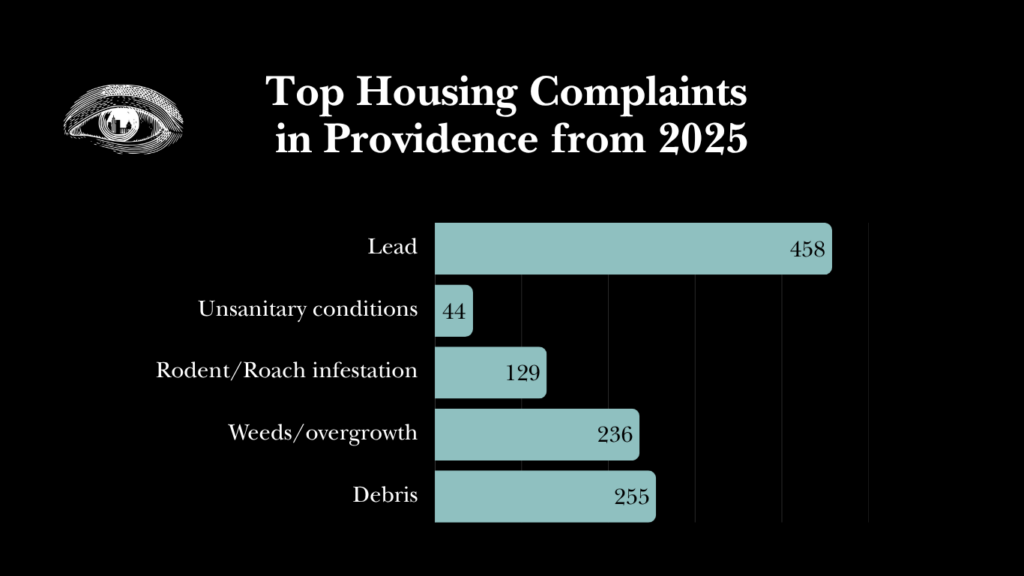
Providence currently employs six inspectors to respond to complaints about minimum housing code issues, most of which are submitted by the public. In 2025, Providence saw 1,630 code cases with the majority centered around lead, debris, weeds, pest infestations and unsanitary living conditions. Providence officials said the Wards with the most complaints and code violations were Wards 5, 6, 12 and 14.
Tenant lawyers pointed out that these reported cases represent a small amount of the code issues in the city.
“People don’t just, as a general rule, call up the phone call code right away. They usually will have some back and forth,” said Rhode Island Center for Justice Executive Director Jennifer Wood. “And then when they do call code enforcement, then that, like all government processes, is a lumbering process.”
After a complaint is filed, city inspectors visit the site. If they determine the issue violates code, a warning notice is sent to the property owner. After 30 days, a first notice of violation is issued. After another 30 days, a second notice is sent. Only after another 30 days of the violation persisting, the case is sent to prosecution. Meanwhile, non-payment of rent could lead to an eviction hearing in just over one month’s time.
“If your building might burn down, that’s okay. They got 90 days to fix it,” said CFJ Staff Attorney Kristen Billings. “But if you didn’t pay rent, you better figure that out quick.”
Of the 906 warning notices sent last year, 600 were mitigated before being sent to prosecution. However, code enforcement can at times push tenants into difficult positions alongside the landlord.
“One of the perverse outcomes is that if the conditions in a rented home are so bad that when you go to code [and] they determine that there’s an immediate health and safety disaster, then it becomes a condemnation proceeding,” said Wood. “And then you’ve essentially evicted yourself by calling code.”
The City collected roughly $440,000 from enforcing code violations in 2025. These funds are used to support smaller landlords who may not be prepared to pay large amounts of money on property repairs.
Revolving Fund Finances Repairs for Smaller Landlords
In 2023, Providence’s Department of Inspections and Standards (DIS) partnered with the Providence Revolving Fund to administer five-year forgivable loans to landlords that own 1-4 units who earn below 100% of the area’s median income (including 75% of the landlord’s income from the rental properties). The housing prosecutor will refer cases from municipal court when it becomes apparent the property owners cannot pay.
“This is very often older individuals who purchased their homes, have either paid off their mortgages or have come close to paying off their mortgages, are now retired and are living on a significantly lower income than they might have when they were working,” said PRF Executive Director Carrie Zaslow. “Being able to stay in their home is the most affordable housing they could possibly have, and yet being able to keep up with a $25,000 paint job or getting a new roof is just outside of their reach.”
In the past year, PRF’s program with DIS worked with 58 properties, with an average cost of $48,023 per property. Out of those loans, 45% of the property owners earned 50% or less of the area median income—what the federal government would describe as “low income.” The program also offers low-interest loans of 3.25% to landlords who are over 100% AMI but under 140% of AMI.
“With a lot of owner-occupied properties, they’re not raising the rents necessarily the way you might see a formulaic process. So they are often keeping rents very, very stable for the renters that are living there,” said Zaslow. “And so what is left to cover a major repair may be very slim.”
The fund received $3 million dollars from the American Rescue Plan Act in 2024, and Providence plans to invest another $500,000 into the program using money from the sale of the old Asa Messer School building and the Humboldt Avenue Fire Station. But demand for this type of program remains high.
The PRF administered a similar statewide program for home repair to 45 different properties in Providence, but when they opened the program applications on November 15th, they received 250 applications in the first ten minutes. For Zaslow, investing in repairing Providence’s aging housing stock is not only a cost-effective tool for local ownership but a way to preserve the city’s character.
“We have beautiful older homes throughout every single neighborhood in the city. Keeping those homes well-maintained, having them be safe and healthy for the people that live in it is part of housing,” said Zaslow. “We’re not going to do well consistently building new if we’re not making sure that we’re preserving and protecting the housing we already have.”
Eric Halvarson is a City News Reporter for The Providence Eye.


Want to comment? Click!