



I wonder about the nature of “community” in our fractured society and our segregated city, still so dominated by the geographies, assumptions, and expectations of racialized capitalism. Lines of demarcation are carved across Providence by interstate 95, Brown University, slave tunnels, urban renewal, gentrification, and masked ICE agents popping out of SUVs.
Community seems to be so much easier for many of us to define in the aftermath of a specific tragedy. At a specific moment, when violence gets too close, when it’s described as “senseless,” or “random,” we’re able to activate “community.” It’s so much harder for us to activate “community” in the face of long-standing, gradual tragedies, like climate change, poverty, criminalization, and radical white nationalism.
Now that the shooter has been found dead from his own bullet in a storage unit in New Hampshire, I wonder about the slow-moving violence of his life and what brought him to last week, murdering three people, wounding ten, and forever altering hundreds more. Where was “community” as he grew into a mass shooter? What were the small interactions, setbacks, burgeoning resentment, humiliation, and rage that created that person?
No doubt investigators will build out a story about him, and ideologues and politicians will adjust that story to suit their pursuit of power and to manipulate folks into following them.
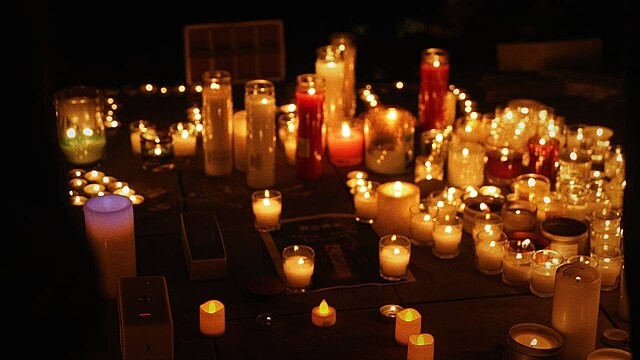
Parallel to the story of Claudio Manuel Neves-Vallente, the stories of Ella Cook, Mukhammad Aziz Umurzokov, Nuno Loureiro, the others shot, and the hundreds connected to them, is the story of Providence, Brown University, and our shared “community.” In the wake of these murders, the fear and frustration of a week-long search, and the collective longing for “justice,” and “security,” we allegedly came together in community. Folks showed up to candlelight vigils and mourned together and promised to be better to each other, provide more accurate and timely information across the city if (when?) this all happens again.
What assumptions do we make about violence, about “community?” Who do we expect to die violently, who of natural causes following a fulfilling life? Who is in our community, and who isn’t? Who deserves a violent death, why? Who deserves to be honored in death, who vilified? Who is granted the benefits of “community,” when, and in what form?
Aimé Césaire described the “imperial boomerang” in the mid twentieth century, wherein the murderous practices of colonialism eventually boomerang back to afflict the populations of colonial powers who, explicitly or implicitly, supported their use in the colonies. I think of this “boomerang” as I reflect on this most recent murder spree, which occurred so much closer to home than the other, regularly occurring mass murders. I think about the metal detectors that were so quickly set up in my middle school in Warren, RI following the Columbine shooting; the casual way my teenager reacted to last week’s news; the way I have more anxiety about my kids getting the flu this winter than a shooter on Providence’s streets.
Because, after all, aren’t there armed, masked, middle-aged men roaming the streets of our city every day? Between newly recruited ICE agents; seasoned, violent beat cops; and the heavily armed secessionists who live twenty minutes away, we’re surrounded by imperial boomerangs.
I think about my proximity to violence, as a resident of this city, as a parent of Palestinian children, of my step-son, whose family has experienced innumerable acts of contemporary and historical violence. No violence is random, however convenient it is for the agents of empire to convince us otherwise. We will all try to piece together a narrative that explains these killings, just as we do every day living under the hyper-violent regime of capital, white supremacy, and patriarchy.
I am equally guilty of accepting the “random act of violence” story and abdicating my own responsibility for building a truly “beloved community.” But my aspiration is that when we tell ourselves this story again in the coming weeks, at the close of the year, at the solstice, the many holiday gatherings, that we tell it in context, imperial boomerangs and all, and that the story doesn’t end with Claudio’s suicide and the canned narrative of gun rights or gun control. I need this story to not only have a new ending, but an honest grounding in history, a commitment to the never-ending work of building “community,” and an agitation to reconnect and do the work necessary to save ourselves and the world.
Christopher Samih-Rotondo is a community organizer, writer, and father of three dynamic kiddos living and working in Providence. Born and raised in Rhode Island, Christopher spent 12 years as an organizer and director at Direct Action for Rights & Equality (DARE), and currently supports immigrant and educational justice organizations in Rhode Island and across New England.
¿Quieres dejar un comentario? ¡Haz clic!