



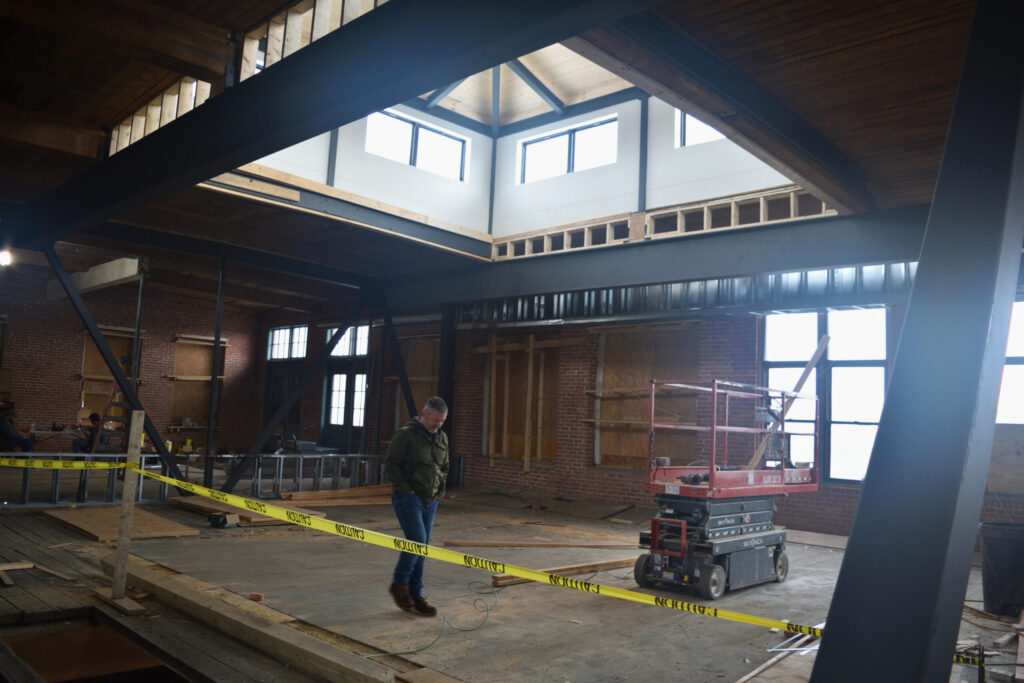
A new cupola sits on top of a large brick building on Kinsley Avenue, and on the inside, the shape looks like a cross. The structure lets light shine down into the second floor, which will soon open up into a new mezzanine that looks down onto a pulpit. This will be the new worship space for one of the largest evangelical churches in the area, located in the middle of Providence.
Grace Harbor Church is investing over $7 million to make a former manufacturing building in Central Providence’s Valley District the new home for over 300 worshippers. The project aims to be completed by the end of 2026, and will join several other developments reshaping this corridor along the Woonasquatucket River from Olneyville to Downtown. The investments are taking legacy industrial buildings and renovating them for new ventures, but some manufacturers, local artists and tenants are worried the new developments will come at a steep price.
Grace Harbor Church’s History: From Plant to Powerhouse
The North American Mission Board (NAMB) set up Grace Harbor in 2002 as a “planter church,” where pastors are tasked with establishing a new independent Baptist church. Lead Pastor Kevin McKay arrived in Providence in 2008 to re-establish the church and grow its membership of 35 members. Two years later, Travis Rymer became the Protestant minister for students at Johnson and Wales University, and Grace Harbor soon grew to include more than 100 people.
“We’re an independent church. That’s a Baptistic value,” said McKay. “In comparison to the rest of the country, [New England] is not as Bible-minded.”
In 2012, Grace Harbor began leasing the church at 47 Fenner Street from the Roman Catholic Diocese of Rhode Island, in the shadow of St. Peter and Paul Cathedral. In the Ocean State, 63% of adults are Christian, and more than a third of those Christians are Catholic. Only 12% of Christians reported they are evangelical. A third of Rhode Island does not affiliate with a religion, and Grace Harbor’s website claims “New England soil is among the most spiritually dry in the United States.”
“It’s been slow, steady growth over 17 years,” said McKay, who said Grace Harbor grows through word of mouth, with some members of the church moving to Providence from out of state for the community, or staying in the city after finishing college. “When they come and stick around, they find people following Jesus and a community that is encouraging to them and life-giving.”
Today, the church has over 200 members and hosts up to 350 people at Sunday worship services, reaching their building’s capacity. The pastors described the church as mostly young families and students from Johnson and Wales, Brown, RISD and Providence College. Grace Harbor also planted three new churches, including Mount Hope Church in Bristol and Grace Harbor New Bedford, as well as a now defunct church on Cape Cod.
Church Growth Leads to New 500 Seat Building
To accommodate their growth, the church started looking for a building in Central Providence close to Downtown with plenty of parking.
“A realtor initially said, ‘So you’re looking for a unicorn?’” said McKay. “We were committed to be in Providence.”
Grace Harbor saw the property at 430 Kinsley Avenue for sale in 2022, and bought the building in 2023 for $2.6 million dollars. It sits between Farm Fresh Rhode Island’s parking lot and Nicholson File Studios along the Woonasquatucket River. The building used to be the home of Eagle Tool, a metal stamping company that made a variety of metal components used in jewelry and novelty items, like pieces used in toy cars manufactured by Hasbro. The company stopped operations in 2017.
“It was tough to compete because of imports,” said Bradley Bento, who worked at Eagle Tool for 23 years. Bento said he’s seen many buildings in the Valley area transform after landlords sold them to conglomerates. “It was tough to manufacture from beginning to end when a lot of those buildings around there, real estate conglomerates were turning them into high end lofts.”
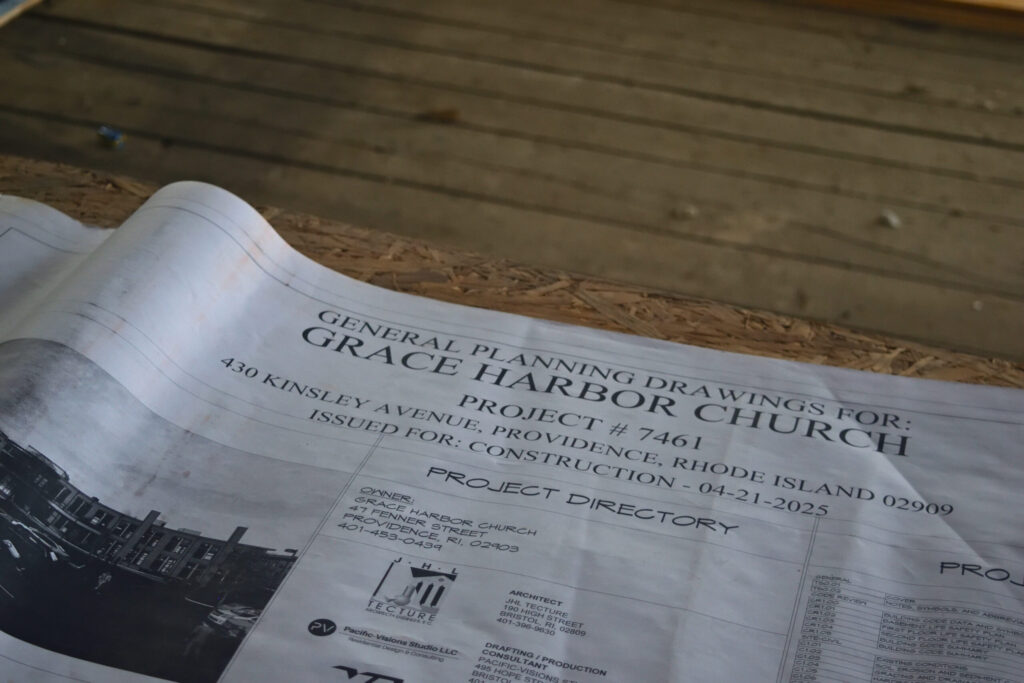
The new Grace Harbor space is being funded by over $5 million dollars in donations, and will be able to host 500 people for worship. The space will also build rooms to do youth ministry, plan more church planting and host Bible studies. Grace Harbor also plans to host regional conferences, pastoral training workshops and seminars for evangelicals from across the country. The influx of people to the area is expected to bring traffic to local businesses.
“We’re excited to have more community in the neighborhood,” said Morgan Snyder, founder of Buttonwoods Brewery located on Sims Avenue. “Developing this part of the city along Harris and Valley is beneficial; these vacant industrial spaces could use a purpose.”
Development Changing the Valley Neighborhood
The new development is squarely in the Woonasquatucket Corridor, spanning Olneyville, Valley and Smith Hill. Many of the massive mill complexes that once relied on the river for power and transport were left vacant and environmentally contaminated after World War II. However, the empty spaces were affordable for several small businesses and local artists.
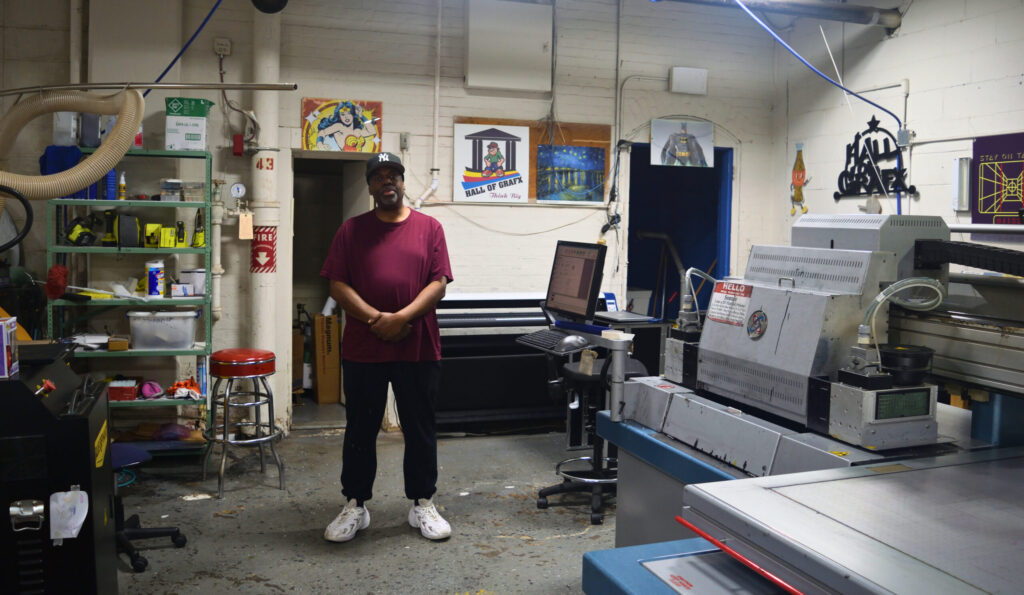
“The rent here is good, the management here is excellent,” said Gary Wallace, founder of Hall of GraFX. His printing shop has been on that block since 2012 because the buildings have loading docks for heavy machinery. Although Wallace had to fix flooding damage and redo the floors when he moved in, he plans to stay long-term and just signed a five year lease. “It’s definitely going to get more expensive around here.”
In 2018, the City of Providence under Mayor Jorge Elorza created a Woonasquatucket Vision Plan for economic development in the corridor stretching from Olneyville to Downtown along the river. Many of those plans, like establishing the Gotham Greens facilities and building a mixed pedestrian pathway along the river, have been completed.
“This corridor presents an unprecedented opportunity for economic growth,” wrote former Mayor Jorge Elorza and his Director of the Department of Planning and Development Bonnie Nickerson. “Guiding that growth in a thoughtful and environmentally- and socially-responsible way is essential to ensuring that our neighborhoods and the diverse community of people who live and work in Providence continue to thrive.”
Past examples of new development in the Valley Neighborhood have pushed out independent groups with mixed results. On one side of the corridor, Providence Place Mall opened in 1999. In Eagle Square, artist collective Fort Thunder was pushed out of their building when it was demolished in 2001 to make way for a shopping complex. Both plazas have struggled to keep tenants, and the mall is in receivership with over $250 million in debt. Now on the far end of the corridor in Olneyville, artists and businesses in Atlantic Mills are holding their breath under new management.
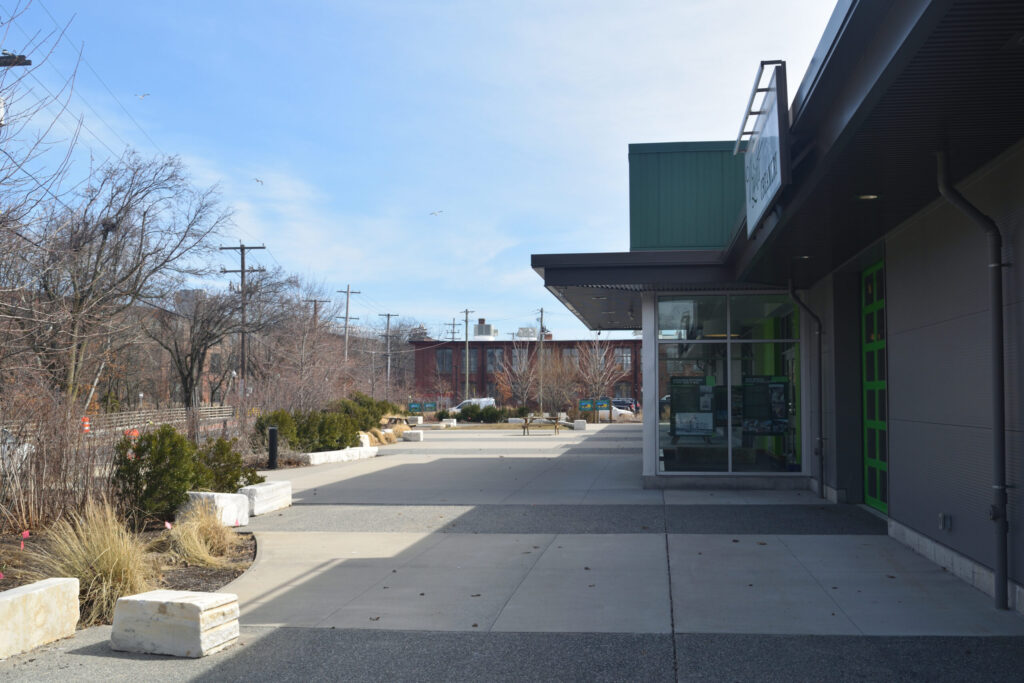
The area has also been dubbed the Valley Arts District with several arts organizations located between Valley Street and Harris Avenue. Large buildings host artist studios like Make Do Studios and rented studios in the Ajay Land building, and the area is home to The Steel Yard and WaterFire Arts Center, both landmark art organizations in the Creative Capital.
“The Valley Arts District is a naming convention for the neighborhood that predates the founding of the WaterFire Arts Center,” said Tim Blankenship, director of special projects & human resources director for WaterFire Providence. Blankenship said WaterFire has spoken with Grace Harbor about their plans. “We are excited to continue seeing many of the neglected former industrial spaces in the Valley Arts District revitalized as new multi-use and community spaces.”
Gary Wallace’s daughter Asya, who works at the printing shop, hoped Grace Harbor’s building would be used for artistic purposes as well.
“It would have been cool for a theater, or a performing art center, another place where people can go and express themselves,” said Asya Wallace. However, she is hopeful Grace Harbor’s large following will be looking to purchase banners, signs and posters from their print shop. “With the Baptist church comes many families, and those families have birthday parties, have weddings, have baptisms and communions.”
Pastors McKay and Rymer said they are looking forward to being connected to the neighborhood, even if people do not agree with their faith. In a largely LGBT-friendly city with an openly gay mayor, Grace Harbor’s faith statement says God makes all people male or female, and that marriage is between a biological male and a biological female. Rymer said they are “not trying to hide anything.”
“LGBT things are not our primary or even secondary goals of talking to anybody— Our goal is to help people come to know Jesus,” said Rymer, who said Mayor Brett Smiley visited the building about a year ago at the pastors’ invitation and bonded with them over Providence College basketball. “We’re gonna still try to be good neighbors,” said McKay.
Correction: An earlier version of this article referred to Make Do Studios by its previous name, The Wurks.
Eric Halvarson is a City News Reporter for The Providence Eye.


Want to comment? Click!