






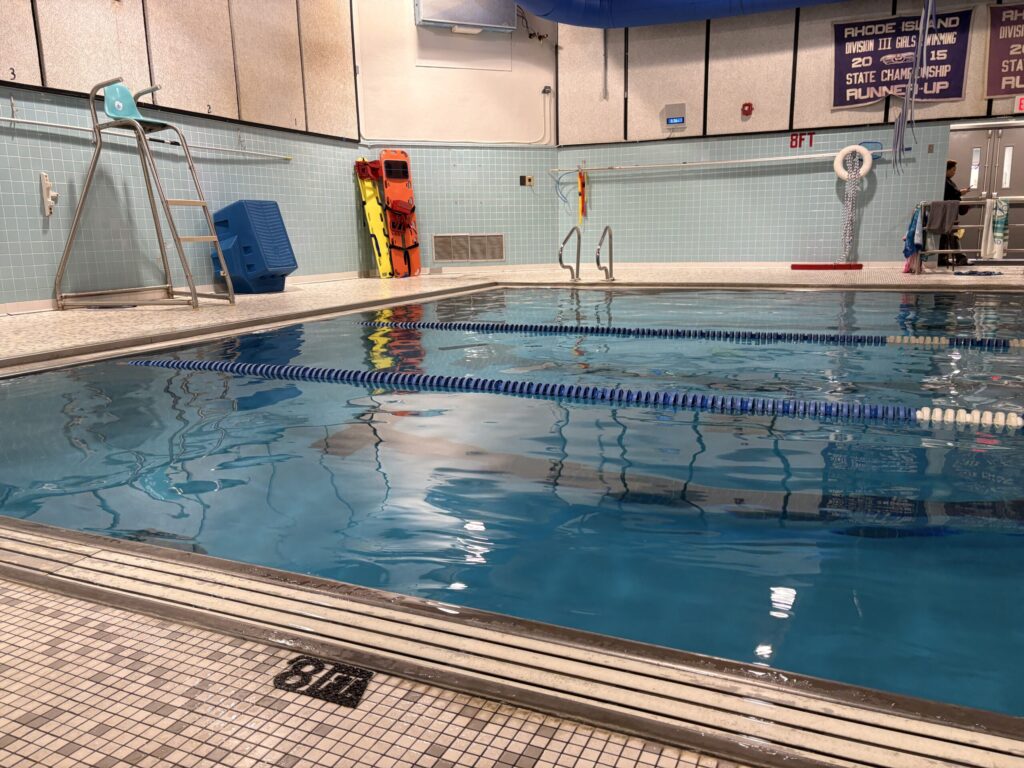
Tuesday night, Batastini Recreation Center is bustling with energy in the early evening hours. The building hosts after school activities with amenities that include basketball courts, a playground, and a swimming pool. The swimming pool is the busiest of the amenities on Tuesday and Thursday nights, when the recreation center hosts three classes of swimmers in three consecutive hours: starting with the youngest students, who range in age from five to 10-years-old; followed by the teen group who are 11 to 17-years-old; and finally, adults over the age of 18.
The swim classes are part of an inaugural, five-week program administered by Providence Recreation. The program is novel in two ways: the City’s rec department has not previously provided swimming classes outside of summer programs and the Batastini pool is being used for instruction during after-school hours. Classes began on October 21, and meet twice a week through November 20 at an affordable rate of $5 per class, with the goal of establishing water safety in the community.
The pool at Batastini starts at four feet and goes to eight feet deep, but there is no one in the deep end for the earliest class. Starting at 5:30, there are promptly 15 kids in the pool. The children break into smaller groups of three or four, with a dedicated instructor for each group. Lane lines section off relatively equal portions of the shallow end to create a contained space in which instructors can keep a watchful eye over the children in their charge.
Class begins with some kids in the instructor’s arms, face down in the water, blowing bubbles. Others kids lie on their stomachs, the top half of their body beached at the pool’s edge, while just their legs dangle into the water, fluttering rapidly and rhythmically to a practiced beat.
“We want to be able to provide a service that’s affordable and accessible,” says Olivia Perryman, assistant director at Batastini Recreation Center, and one of the swimming instructors.
Perryman says many of the people in the program are Hispanic, mirroring the community of the Malden neighborhood where Batastini is tucked quietly off the street on the Pleasant View Elementary School campus. Additionally, the scope of the program casts a much wider net of identities, including students with special needs, like autism.
For Perryman, the program touches on something personal. As a kid she had access to environments where she learned how to swim, but many of her friends didn’t. She remembers how strange it felt to be in the pool without her best friend, who couldn’t swim.
“As an African-American woman, it’s rewarding to see my community be able to learn this way, in a safe environment. And to see other kids that look like them also doing it, empowers them to keep doing it,” said Perryman.
Her conviction that empowerment is the key to success is shared by another Providence-based swim program. Swim Empowerment, a program of Stages of Freedom, has been providing free swim lessons for kids at participating YMCAs in Providence for the past decade. In 2013, Swim Empowerment released a report that surfaces harrowing evidence that learning to swim is not just a hobby, but a life saving skill. Drowning is the second leading cause of death in children, and Black children in the Ocean State die from drowning at five times the rate of white children. The goal for Swim Empowerment is to increase the number of children of color who know how to swim in the state of Rhode Island, and as a consequence, reduce the number of children who drown because they do not have access to the water safety education that is afforded to many of their white peers. It is a worthy cause that has struggled to gain traction in the Black community.
”Swimming is not in the Black culture at all. Swimming is something that white people do,” said Ray Rickman, program director at Swim Empowerment.
The lack of Black representation in swimming began with slavery, when swimming was prohibited for African Americans. White slaveholders intentionally repressed the lifesaving skill of swimming as a means of control, convinced that the ability to swim could be used as a way for enslaved people to escape. After slavery had been abolished, segregation continued to keep Black people out of many public pools. Unfortunately, racism did not end with segregation, and as a result, Black people continued to have fewer opportunities to swim.
”Even decades later, it’s still in people’s brains,” said Rickman. “There are things you do that you have done all your life, and that is who you are.”
Elizabeth Hernandez has both of her children and her niece enrolled in swim classes at Batastini. She said she has noticed that, since being enrolled in classes, their confidence has increased both in and out of the water. The pool at the recreation center is the only place where her son, 13, and daughter, 10, are able to practice their swimming skills. Hernandez recognizes it is much more than a fun pastime.
“I’m not a strong swimmer either, so God forbid, if something were to happen, I need to know that they can survive.”
The classes focus on survival. Children learn to breathe in the water, how to kick their legs to propel themselves forward, and how to use their arms to carve a path through the water to safely make their way to their destination.
“Eventually, they can swim all the way down to the deep end, but first it’s just about making them comfortable, and understanding how to do things safely, while maintaining a fun environment,” said Perryman.
Enrollment for Providence Recreation swim classes varies by age group. Children under 10 have the highest enrollment rate, followed by teens. Adult classes have the fewest students. Confidence tends to wane as people grow older without learning to swim, but the first step is providing access. Programs like Providence Recreation and Swim Empowerment can then begin to build confidence one student at a time.
“One of the trainers here certifies kids as lifeguards. My son is not old enough yet, but it would be great if the experience he is building could get him a job as a lifeguard later on. Or, he could even run these classes, and help the next generation of swimmers,” said Hernandez, seeing hope for others in the ripple effect cast by her own children’s presence in the water.
Andrea Gutierrez is originally from California and she traversed much of the country before finding home in Providence. She worked in hospitality for 20 years, and finds joy in dining al fresco on a perfect summer evening. She is interested in places where food, art, history, and the natural world intersect to create an aesthetically rich environment, which makes the Creative Capital a perfect fit. She’s eager to shine a light on the city’s greatness, and to be a community builder that contributes to what makes the city great.


Want to comment? Click!