






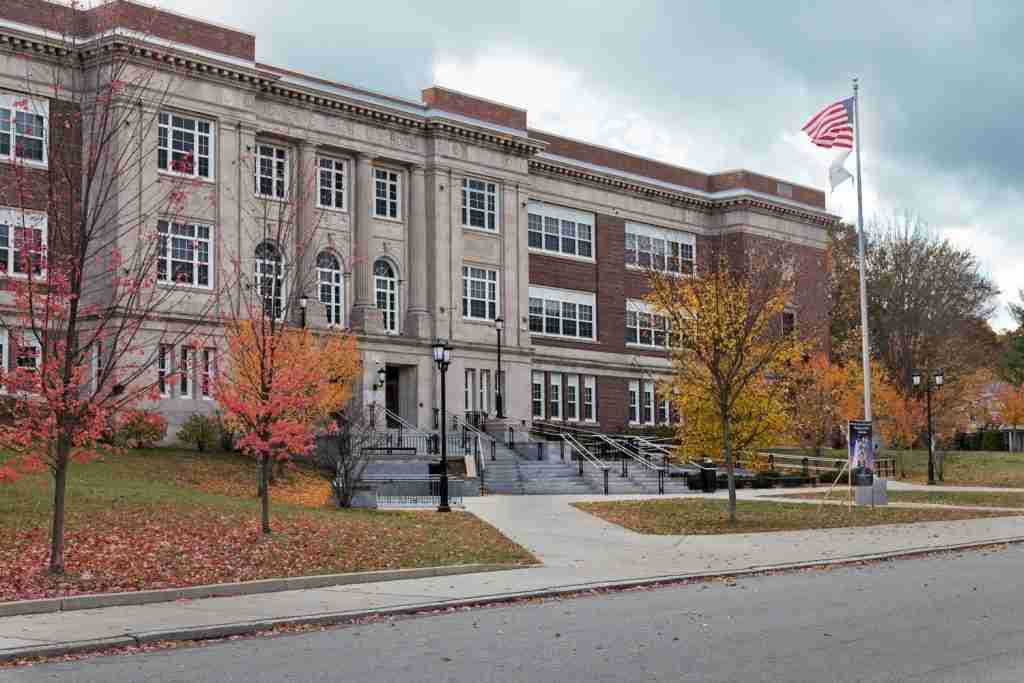
Searching “Nathan Bishop” to understand why Providence decided to name a school for him in the 1930s, one might find an Englishman who briefly played goal for soccer team Manchester United, or a Toronto-based singer-songwriter, but also the fascinating, modest, hard-working man after whom Nathan Bishop Middle School is named. One might be surprised, however, to find that schools in Providence were but one chapter in the life of an amazing man.
Bishop, who lived from 1808 to 1880, was the eldest son in a large and prosperous farming family in upstate New York. He was born in Vernon, a tiny hamlet roughly halfway between Syracuse and Utica, and as a child and adolescent he helped on the farm, kept his father’s accounts, and read widely from a neighbor’s personal library. When he was eighteen, he decided that he needed a more formal education and therefore enrolled in Hamilton Academy, some fifteen miles south of Vernon. He paid his way by teaching school which was, very conveniently, downstairs in the same building.
After six years in Hamilton, he wished to complete his education with a college degree, but Madison, the local institution (which was later renamed Colgate University), only admitted those who were training for the Baptist ministry. Although Bishop was and remained throughout his life a devout Baptist, he didn’t want to limit his options, so he enrolled at Brown University in Providence. Most higher education at that time was centered on classical (Latin and Greek) and religious texts. Brown was Baptist but had a broader liberal arts curriculum. At twenty-four Bishop entered Brown, considerably older than the other undergraduates. In the nineteenth century, boys as young as fourteen went to college.
Just as he had at Hamilton, Bishop paid his way through college by keeping school in the vacations, tutoring fellow students and helping the professors. He was also the college bellringer. One winter vacation when Brown’s president Francis Wayland was traveling to raise funds for the college, Bishop house-sat for him, provided he milked the cow, chopped the wood and cleared the snow.

Bishop was twenty-nine years old when he finally graduated. One year, when he ran out of money, he took a leave and taught school. Wayland hired him as a tutor, but a year later, in 1839, when Providence was anxious to reform its schools, Bishop was appointed to the newly-created position of superintendent of schools at the enormous (for then) salary of $1,250 a year.
He never forgot his ties to Brown, however, and served as a Trustee, and later a Fellow. In 1850 he became one of the principal fundraisers when Wayland was trying to introduce his “new curriculum.” Wayland decreed that “the various courses should be so arranged that, insofar as practicable, every student might study what he chose, all that he chose, and nothing but what he chose.” (This structure predates Brown’s 1969 “new curriculum” by almost 120 years.) When the total raised fell short of the $125,000 required, Bishop was among those giving his personal guarantee for the funds.
Over his twelve years as Providence school superintendent Bishop supervised the construction of seventeen new schools, including ten primary schools, six grammar (middle) schools and the city’s first high school which opened in 1843. There had been loud opposition to a public high school, some argued it was “too aristocratic”—others believed “it would educate children above working for their support.” In the 1830s, the age of Jacksonian Democracy and the “Common Man, “some still felt the Common Man shouldn’t try to rise too far above his station. Bishop nonetheless won, with the support of Brown professor William Goddard, and the high school curriculum included arithmetic, algebra, Latin, English grammar, ancient history, medieval history, modern history, and bookkeeping. Both boys and girls attended, and for a while, a few students of color.
Bishop was not just an administrator—he taught in the schools and worked with all the staff and teachers. He took up a similar post in Boston in 1851 where he became their first school superintendent (and where Harvard gave him an honorary degree), and then moved to New York in 1858.
He began the second half of his adult life by marrying a young widow almost twenty years his junior. She was not rich, but certainly comfortably off and he intended to work with one of her relatives in his publishing house. The financial panic of 1857 put paid to that plan, but he discovered that having earned an excellent salary for the previous twenty years, lived frugally and saved and invested the surplus, he had plenty to live on, so he started a life of public service.
He immediately started visiting the poor in New York and involved himself in a society for protecting the Sabbath, but his principal efforts over the remaining twenty years of his life focused on the physical and spiritual welfare of Union soldiers during the Civil War, work with the Board of Indian Commissioners, the establishment of a college for women and the creation of a college for African Americans in Texas. He was even part of a delegation to Czar Alexander II of Russia to plead for religious liberty for Lutherans in the Baltic territories.
During the Civil War as chair of the Executive Committee of the Christian Commission he worked tirelessly for the Union soldiers’ welfare—sending food packages, reading matter, medicines for the men, and organizing public meetings and publishing informative leaflets to rouse support for the war effort—even when he was exhausted, he was seen lying on a pile of army blankets giving orders to his assistants.
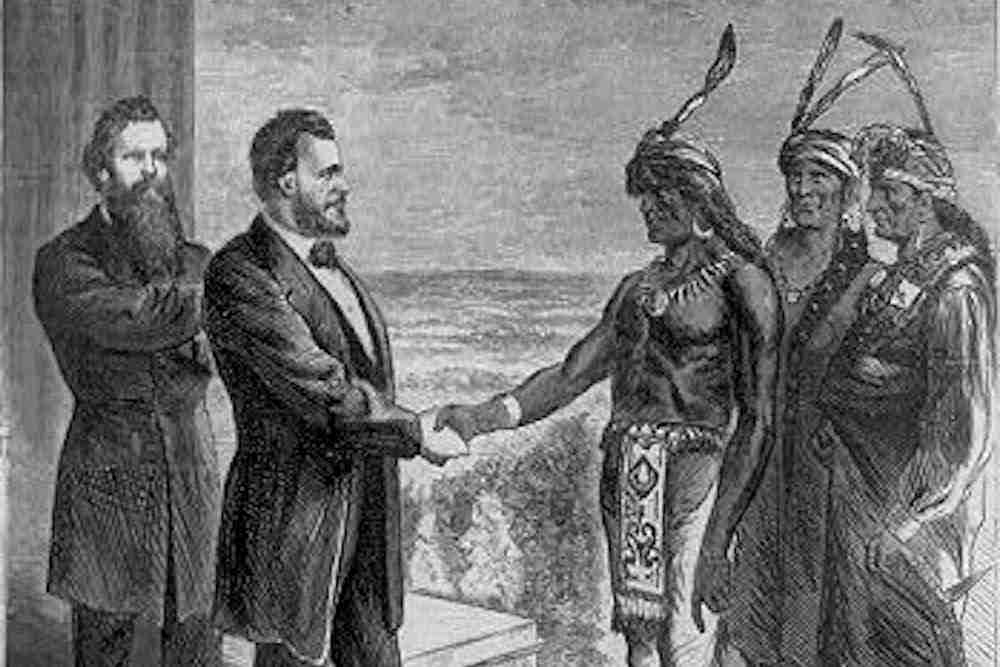
A little later he was involved in President Ulysses S. Grant’s Indian policy, which was to try to protect the tribes from incursions by white settlers, while simultaneously assimilating them into Euro-American culture. Grant sent representatives from all the major religions to deal with the tribes, find out what they wanted, and try to avoid exploitation. Nathan Bishop was part of a Baptist group that went to the Southwest in the summer of 1869 to meet with the Apache, Arapaho, and Comanche. The destruction of the buffalo and the relentless pressure from settlers and the railroads meant any efforts by the Native Americans to preserve their culture were doomed, and Grant’s policy, however well-meaning, was a failure; Bishop resigned but not before he’d contracted malaria, from which he was to suffer for the rest of his life.
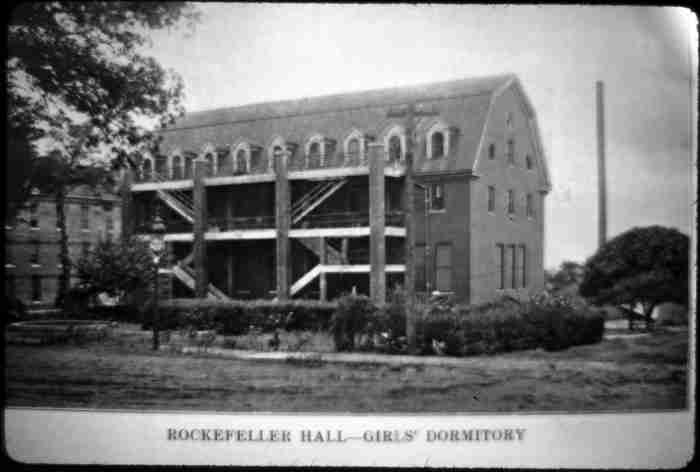
Back in New York he was a founding and very active Trustee of Vassar College, the women’s college in Poughkeepsie, New York, and made it his business to travel the seventy miles there every two weeks. He was also a Board member of the American Baptist Home Mission Society, under which he pushed for the creation of a college for Freedmen in Texas. He pledged $25,000 towards its foundation, explaining to a friend “I expect to stand side by side with these men on the day of Judgment. I am determined to be ready for that meeting.” It opened in East Texas the year he died; his widow gave a further $10,000 and it was named Bishop College in his honor.
In the late 1870s Bishop was frequently ill and his recurrent malaria weakened him. He had to slow down. He resigned from most of his Boards and moved to a summer cottage in Saratoga Springs in May 1880 where, possibly because he was resting for the first time in his life, he recovered somewhat. He knew his days were numbered, however, and spent the last weeks of his life giving away much of his property. Beneficiaries included the YMCA, Calvary Baptist Church, the Orphans Asylum, and many more. Asked once by a friend (who found him waiting for an omnibus in the pouring rain), why he didn’t keep a carriage, he replied “If I kept a carriage, I should not have so much money to give away.”
He died on August 7, 1880, five days before his seventy-second birthday, having, according to his plan, died relatively poor. His wife died the day after.
Although Bishop College closed in 1988, the middle school named for him in Providence survives. Nathan Bishop’s was a life well-lived, and he deserves to be remembered, as someone able to achieve more with less noise than most of us. He was a modest man who did not want a memorial. Nathan Bishop Middle School is a memorial, but only if its students and the city of Providence know the amazing story of his life.
Much of the information for this biography came from: A Layman’s Ministry: Notes on the Life of Nathan Bishop by Norman Fox, 1883
Jane Lancaster PhD is a historian and former public school teacher (in the UK) who lives in Providence. She is an award-winning historian and has taught at RISD and Brown, and even (once) in Taiwan.
¿Quieres dejar un comentario? ¡Haz clic!