



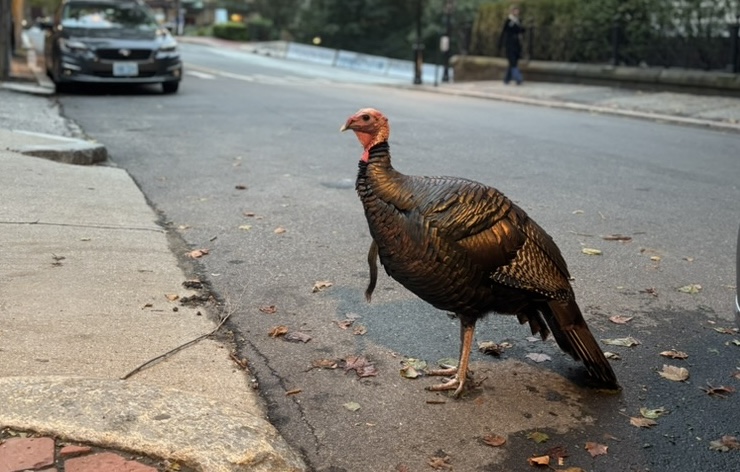
Over the summer, College Hill got a new, very visible resident. He goes by various aliases: Esquire, Marcel, Mo, the College Hill Turkey. Nobody knows exactly where he came from, but it’s clear he is here to stay. His territory spans from Brown’s quad to Prospect Park and the crosswalks of North Main Street. For some reason, he loves hanging out in the middle of Waterman Street, much to the consternation of rush-hour drivers. At the Providence Athenaeum, he can often be found in the parking lot, staring intently at patrons trying in vain to leave; he also enjoys kicking back in the library’s garden bed.
It’s not surprising that Esquire has quickly become an East Side mascot of sorts. WPRI profiled his rising star quality in a prime-time news segment, and the Brown Daily Herald characterized him as “infamous.” Several students mentioned having to get out of their cars to chase him out of the road.
While not large as turkeys go (males can weigh up to 25 pounds), Esquire has a regal bearing and a swathe of lustrous chestnut feathers. His beard — a whisker-like plume of feathers sprouting from his chest, similar in texture to horsehair — is quite long and full. Turkey beards grow roughly five inches a year, indicating that Esquire may be about a year and a half old.
I first noticed Esquire over the summer while driving past RISD. He ambled casually in the middle of the road, looking decidedly unruffled. Cars were slowing down and cutting a wide berth around him. His apparent sense of urgency? Zero.
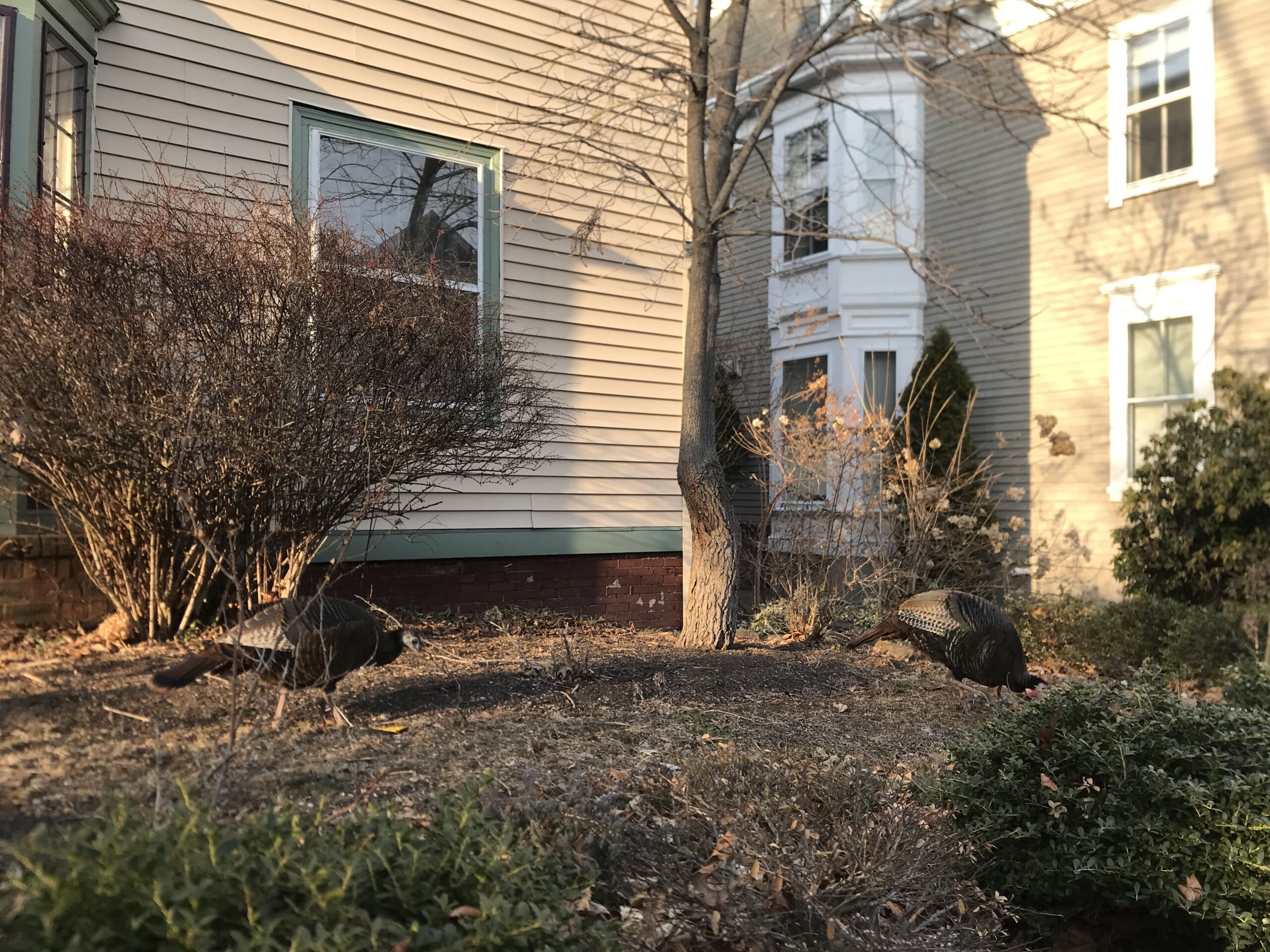
Over the course of his summer-into-fall residency, he seems to have grown thoroughly acclimated to the presence of people. His seed-foraging routine is barely interrupted by RISD students fawning over him and snapping photos. Overall, his wattle retains a healthy red color, indicating a calm demeanor. A bluer tinge, by contrast, can be a sign of fear or panic.
Esquire may have gotten used to hanging out in the middle of Waterman Street, but that doesn’t mean he belongs there. Although he seems to have found spots to forage and roost in relative safety, his high visibility is a reminder of how fragmented our urban environment has become for wildlife. Green space is at a finite premium. Fences, hardscapes, roads, and buildings act as an omnipresent obstacle course.
Thousands of miles away, one of the most grotesque examples of human disruption is the ongoing border wall construction that is actively blockading already fragile migration routes along the Southwestern United States and northwestern Mexico. A 2024 study assessing wildlife crossings at 36 separate sections of the wall concluded that focal species, including white-tailed deer, American black bears, wild turkeys and mountain lions, appeared unable to cross through the narrow interstitial spaces in the walls. This inability to move freely is likely to impact their reproductive rates, genetic diversity, ability to react to adverse weather events, and overall survival.
Of course, Rhode Island is not the Sonora desert. But everything in our environment is connected. And while we don’t have a hideous border wall, we do have deforestation, dwindling biodiversity, rapid land conversion, coastal erosion, aging forest habitats, and a host of other human-accelerated environmental issues.
On a more positive note, our state is blessed with a wealth of native and non-native wildlife species — more than 800, including 90-plus mammals and 400 species of birds. Opossums, white-tailed deer, rabbits, squirrels, raccoons, weasels and bats are the most common — only some of which populate our urban zones. Of these, wild turkeys almost disappeared from the state by the early 1900s before being reintroduced in the 1980s; they can now be found statewide.
Esquire isn’t the first wild turkey I’d spotted roaming the East Side. Back in March, I saw a pair sauntering casually down the middle of Keene Street, before they stopped in a slightly overgrown front yard with a tiny pool to drink and graze. Turkeys are opportunistic foragers that eat just about anything, including grains, seeds, bugs, berries, and leaves.
(And no, I am hardly a turkey expert. Thankfully, there is a wealth of material out there, like this Audubon Society listicle, explaining the quirks and behaviors of our largest game bird.)
A few nights later, I was driving my mom to her East Side home when a mother raccoon darted across the street, a tiny baby clutched between her teeth. I narrowly avoided hitting her. Think of the stress of living your life in constant peril, dodging cars, poison, and garbage just to survive.
Whether or not they are naturally nocturnal, most creatures have adapted to stay out of human sight, to forage under cover of darkness. If you stay alert when driving or walking late at night, when it’s quiet and less populated, you may be rewarded by seeing a fox, skunk, or even a bobcat. Once relatively rare, they are now being spotted all over the state, leading URI to start a Rhode Island Bobcat Study.
The California-based wildlife photographer Suzi Eszterhas recently visited several San Francisco Bay Area wildlife rehab centers as part of a photo assignment. Alongside her Instagram post documenting baby raccoons, tiny squirrels, and a stressed deer with an outsized cast, she asked the urgent question, “Why don’t we protect animals until they are threatened with extinction?… Wouldn’t it be a different world if we loved our backyard animals as much as we love elephants and tigers?”
To put this another way: Wildlife is repeatedly forced to adapt, often under extreme duress, to our actions. Isn’t it time to adapt to them?
Even small changes can make a big difference. Right here in Providence, you can plant a small patch of native plants, which can quickly become an oasis for birds, bees, bats, and butterflies. The Xerces Society, which promotes pollinator-friendly, pesticide-free gardening, has a helpful planting guide.
As summer turns to winter, it’s also beneficial to “leave the leaves,” to use the Xerces Society’s motto. Brush piles and dead branches provide nesting spaces and overwintering habitats, particularly for native bees, moths and caterpillars.
And with Halloween around the corner, the Wildlife Clinic of RI recently posted an Instagram reminder for a safer season: Only display organic, unpainted (and unbleached) gourds; choose natural materials like straw and burlap over stringy fake cobwebs, which can entwine birds and bats; and use solar lights over bright spotlights, which can disorient nocturnal animals.
Our modern lives have largely separated us from nature. We watch endless internet cat videos and take bets on the winner of “Fat Bear Week,” but spend far less time actually communing with open green spaces. At a time when our federal administration is intent on rolling back environmental protections on multiple fronts (and going so far as to deny the very existence of climate change), working together to protect our state’s natural resources — and those of our immediate community — is more crucial than ever. This includes our “backyard animals,” to borrow Suzi’s phrase, from the birds to the bats to the opossums and, yes, turkeys. Rather than thinking of them in terms of utility — are they food, friend or foe? — we might do well to think of them as our allies in preserving our shared home.
So, the next time you see Esquire loping amiably around the East Side, slow down, give him a respectful amount of space — and let him be wild.
Andrea Feldman is a web editor and writer who lives in Providence. She attends a lot of music shows and occasionally writes about music, art, and culture at warpedrealitymagazine.com. She is grateful to Stephanie Ovoian of the Athenaeum and Olivia Harrington of the Wildlife Clinic of RI for their help in the early stages of this essay.
¿Quieres dejar un comentario? ¡Haz clic!