






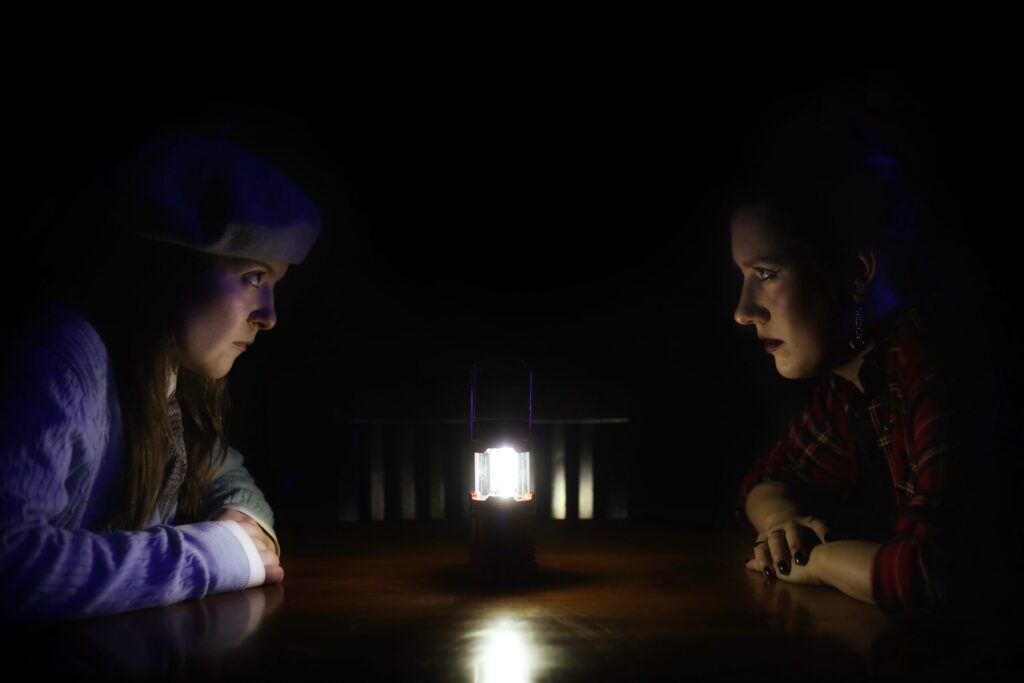
Reverie Theatre Company’s new production of A Girl in School Uniform (Walks Into A Bar) lands with a jolt of eerie timeliness. Written in 2016, Lulu Raczka’s dystopian thriller imagines a society plagued by unexplained blackouts—moments when the lights fail, systems collapse, and women vanish. Today, ten years after it was written, the play’s vision of a world sliding into irrationality feels less like speculative fiction and more like a mirror held up to our present anxieties.
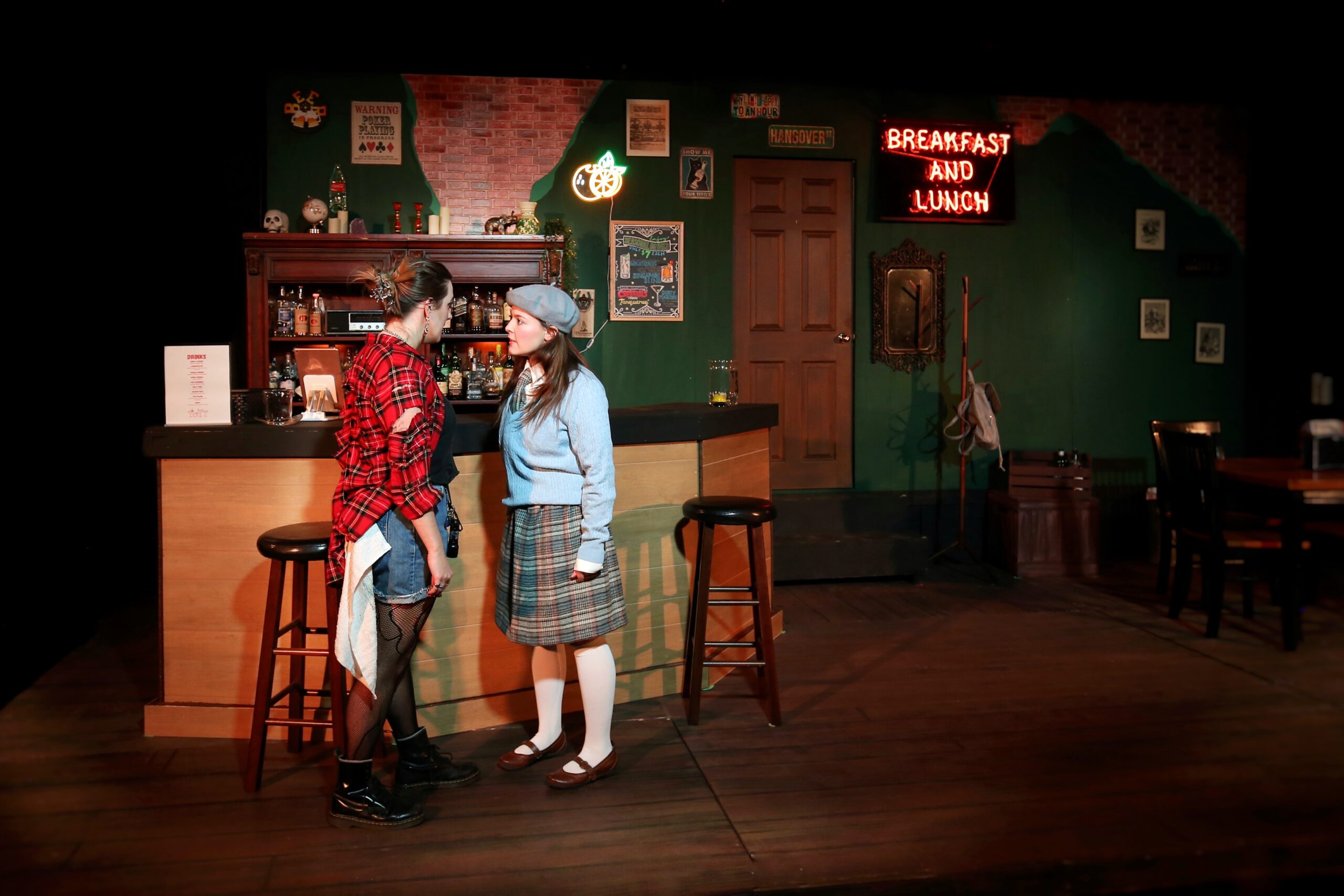
The story follows Steph, a private-school student searching for her missing friend, and Bell, the barmaid who reluctantly becomes her ally. Their dynamic is part competition, part uneasy alliance. Their class divide is immediately apparent. The school uniform signals class privilege; whereas, the bar apron signals working-class pragmatism. Bell has a no-nonsense attitude that grows out of her older, wiser ways derived from her position in life. What advantages Steph has in material resources, Bell has in lived experience that has made her wise to the ways of the world.
What begins as a wary standoff, evolves into a tense, competitive dance of two women trying to out-narrate, out-maneuver, and one-up each other as the world outside grows increasingly hostile.
Director Riley Nedder’s debut is strikingly confident. The production embraces the play’s jagged rhythms, the start-stop exchanges, the sudden tonal shifts, and the moments when the narrative seems to double back on itself with looping conversation. Rather than smoothing those edges, Nedder leans into them, showing the characters move in ways that emphasize the constant jockeying for position, and allowing the audience to feel the same disorientation the characters experience. The effect is intentionally destabilizing, placing the audience inside the same cognitive fog that the characters inhabit.
Emma Dunlop (Bell) and Madeline Brown (Steph) deliver sharp, committed performances. Brown captures the bravado of a teenager masking fear with certainty, while Dunlop grounds the play with a slow-burning emotional depth. Together, they navigate the play’s “brain-teaser” quality making it feel purposeful rather than obscure. Raczka uses the contrast as a way to explore how two women navigate fear, power, and the need to be believed.
What makes this play resonate now is not simply its dystopian premise, but its recognition of how quickly the unthinkable becomes normalized. Raczka’s script captures that shift with eerie accuracy. There is a brief moment near the end where the characters break the fourth wall appealing to the audience, desperately seeking to come out on top—since neither of them are even close to the top, they seem to think the audience might save them. However, the appeal is not rooted in any kind of philosophy or ideology, but merely desperation to be validated.
The production honors the play’s intelligence and its urgency. A taut, thoughtful staging that invites the audience not just to watch, but to question what we accept as inevitable, and to consider what happens when the lights go out and the truth becomes harder to see.
Reverie’s production succeeds because it trusts the audience to think. It’s unsettling, intelligent, and perhaps most disturbingly, timely. The play is a puzzle by design, and this staging trusts viewers to assemble its pieces. When the lights go out in this world, the darkness feels familiar.
Performances are at 7:30 p.m. on February 19-21 and February 27-28; and one at 3 p.m. on March 1. The theater is located at 134 Collaborative at 134 Mathewson Street, Providence, Rhode Island. For tickets and information, click here.
Judith Clinton is a playwright, producer and author, whose work explores myth, and transformation. Her plays and stories reflect her belief that storytelling can both heal and ignite change. She is Co-Executive Director of the Rhode Island Theatre Makers Roundtable.


Want to comment? Click!