



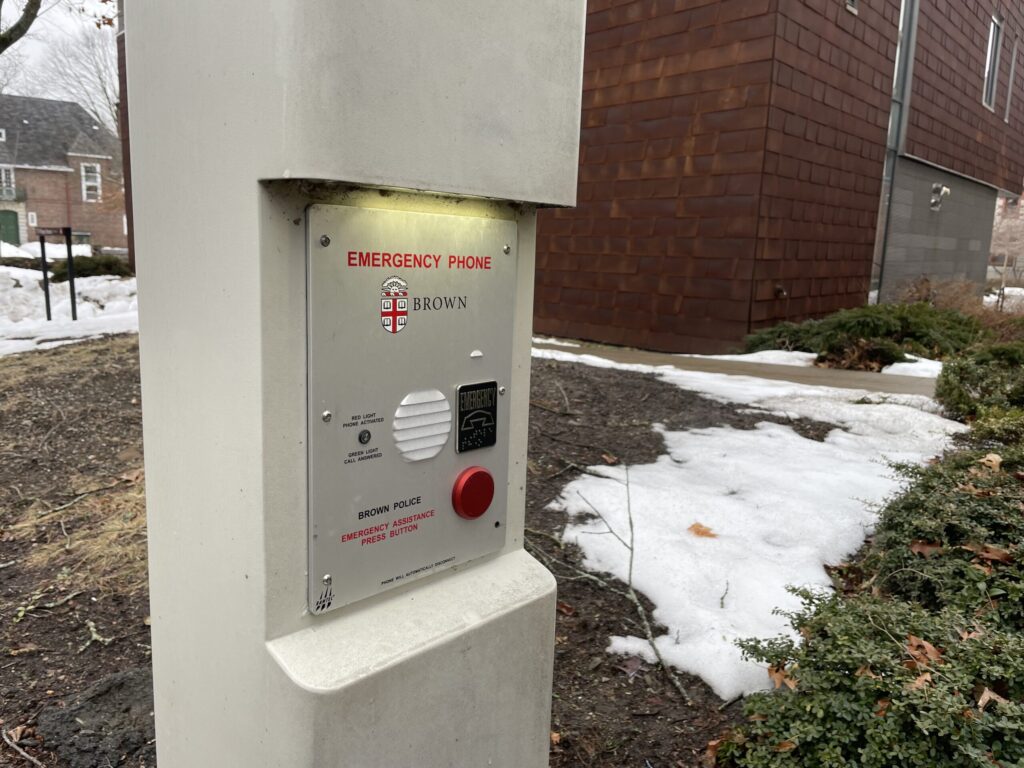
This semester, Brown University doubled the number of school police officers assigned to each shift. The school also hired private guards from Allied Universal to bolster campus security. Even police vehicles from numerous cities patrol the streets around campus. A Brown spokesperson said this “enhanced public safety presence is intended to support a secure and reassuring environment.”
For some students, the security forces remind them of danger.
“It’s a tough reminder to just walk into class and have to swipe into the building where once someone could hold the door open for you,” said Lily Luby, a sophomore who was in the lobby of Barus & Holley when the shooting occurred. “Now, you see a police officer in the dining hall while you’re trying to get breakfast.”
This semester, Brown University students, faculty and staff are grappling with the aftermath of a December shooting that killed two students and injured nine more. With the school doubling security forces on campus, students are living under the watchful eyes of security forces and asking if a similar investment is going toward mental health services. All of College Hill is questioning what it takes to feel genuinely safe.
A Student’s Reflection on Safety Efforts
“Some students are like, ‘I do feel safer. This was necessary.’ And some students are like, ‘I don’t feel safer. I feel like I’m living in a police state,’” said Annie Johnson, a student and staff writer for the College Hill Independent. “Some students are just like, ‘This is annoying. I don’t like having to swipe my ID to have to enter my building now.’”
In the wake of the shooting, Johnson’s newest essay in the Indy offers a detailed reflection on the new campus experience of heightened security at Brown. In “The Costs of Feeling Safe,” she explores the university’s efforts to mitigate future dangerous shootings as well as reassure the campus community through “security theater.” This concept coined by Bruce Scheier describes security measures that appear to offer safety and comfort regardless of their effectiveness.
Johnson acknowledges the need to rebuild trust on campus, but her essay questions the school’s approach to creating that sense of safety, especially for students who witnessed the attack firsthand.
“I felt that my perspective was somewhat unique and somewhat valuable as someone who was in the room that day and someone who was really close to the violence,” said Johnson. “If it isn’t making me feel safer, then what’s sort of the point of it all?”
Has Brown Increased Mental Health Services for Students?
Johnson, along with other students in the room on December 13 and those who were close friends with victims of the attack, asked the school for an official support group. She said the school at first was positive about the idea, but simply referred them to the Counseling and Psychological Services (CAPS) office.
“One of the biggest student demands has been more mental health support,” said Luby. Going home to Connecticut after the shooting, Luby could only access telehealth counseling. “If you’d already left Rhode Island, there was nothing that they could do to get you in-person health support.”
The school expanded some mental health services after the shooting by offering BetterHelp— an online therapy service—to students outside the U.S., but the CAPS office regularly reaches capacity each semester. Johnson said TimelyCare—another virtual therapy provider—only offers 12 sessions to each student with a given provider, far from what would be required to meet her goals.
“I feel like there have been a lot of students who have sort of fallen through the cracks,” said Johnson, who said students in the past were turned away from CAPS and referred to TimelyCare in moments of crisis. “I was shocked, personally, when I heard they weren’t going to be expanding their mental health resources for the semester.”
Brown University did not directly respond to a question about if they hired more mental health providers for CAPS after the December shooting.
“We have fundamentally removed barriers to care to ensure students don’t have to wait for support,” said school spokesperson Brian Clark via email, who also referred to Brown’s Ever True initiative as the comprehensive program to restore campus well-being. “For us, recovery isn’t just about individual psychotherapy appointments, but about building community-wide resilience.”
Clark said students can meet with a CAPS provider during business hours without an appointment, call a 24/7 “on-demand” support line or access “unlimited virtual therapy sessions” through TimelyCare. However, multiple places on Brown’s website still say TimelyCare offers 12 free sessions per year.
The Brown Daily Herald also reported faculty and staff will be offered 20 free counseling sessions through Spring Health, twice as many as 2025. The school’s website still advertises 10 therapy sessions.
Dr. Amy Nunn, an adjunct professor of public health and medicine health at Brown, said there is a “huge marketplace shortage” that makes it difficult to hire mental health workers.
“We’ve had trouble at our own clinic doing that,” said Dr. Nunn, who is the chief executive officer of OpenDoor Health. “It’s very, very, very difficult to hire behavioral health professionals right now.”
In contrast, armed police and private security guards will continue to be present at Brown until the University completes a safety & security assessment. The assessment is being co-led by former NYPD commissioner William Bratton. Bratton championed the “broken windows theory” of policing, which has since been widely criticized for targeting low-income communities of color. Bratton’s previous consulting work at Brown led to the arming of campus police officers.
This spring, the school is soliciting feedback from campus community and local leaders to inform the assessment.
“From a security standpoint, I have not seen demands from students asking for the university to be doing more,” said Lucy Kaplan, a sophomore studying International and Public Affairs. “From the mental health support side of things, that is a different story.”
Eric Halvarson is a City News Reporter for The Providence Eye.


Want to comment? Click!