





City Council members are moving forward with a policy to slow down Providence’s soaring housing costs. Led by City Council President Rachel Miller, a new ordinance would limit annual rent increases at four percent. However, a new report commissioned by the Providence Foundation argues that rent stabilization might provide short-term relief for tenants, but it discourages private developers from building and maintaining housing.
Here in Providence, tenants saw rents skyrocket 16%, then 12%, over the last two years—some of the highest rates in the nation. While renters are demanding the city slow surging housing costs, a new report by local researchers argues rent control will create more problems than it will solve.
Researchers debate rent control
The analysis from the Rhode Island Public Expenditures Council (RIPEC) compiles evidence from other cities in the United States and applies it to Providence’s housing market. The report was commissioned by the Providence Foundation, a nonprofit steered by some of Providence’s largest businesses and property owners.
The paper argues municipalities that restrict rent hikes see lower housing production and a decline in rental unit maintenance. While acknowledging the policy “delivers immediate, tangible stability for incumbent tenants,” the report says limiting a property owners’ abilities to increase rent would chill investment in the local housing market.
“The primary mechanism of the policy—a price cap—fails to solve the underlying housing shortage and instead discourages the production of new supply,” said RIPEC in the report. “Price ceilings fundamentally alter the incentive structure for property owners, frequently leading to deferred maintenance and the conversion of rental units to owner occupancy, which shrinks the rental pool.”
The report says rent stabilization could also have negative impacts on local homeowners. If lower rental values for landlord buildings sink tax revenues for the city, then RIPEC suggests politicians could raise taxes on other properties. In addition, the paper said possible disrepair of rent-controlled units could lower valuations of neighboring properties in the area.
Instead of rent stabilization, RIPEC recommends the city focus on zoning reform that encourages housing density and rental assistance for vulnerable groups, such as people experiencing homelessness or domestic violence.
“The solution is not to replace the market with expensive government mandates, but to let the market build while the government subsidizes the individual renters who are struggling,” said RIPEC Senior Policy Analyst Jeff Hamill. “Sustainable affordability requires a healthy private market that produces a robust supply, supplemented by targeted, means-tested rental assistance for the most vulnerable.”
However, a local researcher at the University of Rhode Island challenged RIPEC’s conclusions.
“The report overstates these risks by relying on selective examples and ignoring a growing body of evidence showing that moderate, modern rent stabilization can protect tenants without negative impacts to housing production,” said Dr. Molly Richard, a professor at URI’s Department of Public Health. Richard said that modern rent control policies learn from earlier versions. “My understanding is that the Providence proposal will reflect these lessons, including allowing for higher increases for documented improvements or tax hikes, and exempts new construction for 15 years.”
City Council To Consider Rent Stabilization Legislation
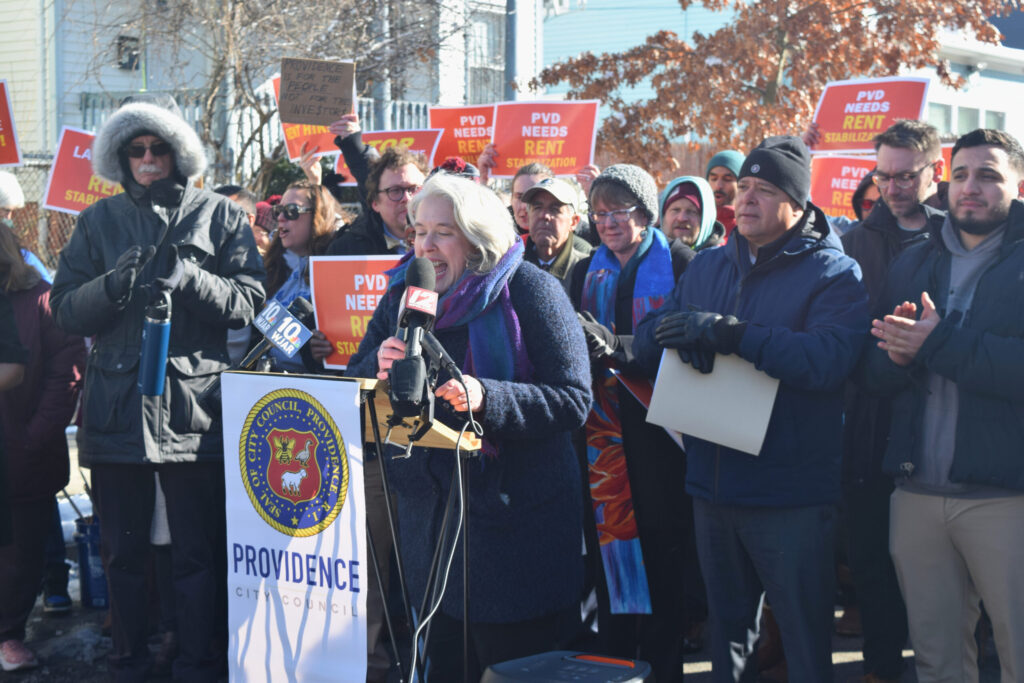
On Tuesday January 20, Councilor Rachel Miller officially announced a plan to limit annual rent increases in Providence to 4%. The ordinance exempts small owner-occupied buildings and automatically exempts property owners facing large tax increases. The proposal also would install a rent board that could consider exceptions in the case of extenuating circumstances or significant capital improvements to the property.
“It’s about giving renters the ounce of breathing room that we need, while ensuring that property owners can achieve a fair rate of return,” said Miller, who signaled she is open to adjusting the policy. “Far too often a rent increase, even with the 60 days mandated by state law, is an eviction notice by another name.”
Tenants rights groups welcomed the announcement and called for city leaders to make rent stabilization a major plank of housing reform in Providence.
“Letting private developers and corporate landlords have free rein over the housing market is what got us into the crisis,” said Siraj Sindhu, Executive Director of housing justice group Reclaim Rhode Island. “Rent stabilization isn’t a magic silver bullet, but it’s a key part of the solution.”
The ordinance is expected to receive pushback from Mayor Brett Smiley, who said he is taking an “all of the above” approach to housing policy options but is opposed to rent control.
“Some have proposed rent control as a solution, and I understand why: because of the pressure that so many tenants are feeling,” said Mayor Smiley at a press conference in October. “But the reality is that evidence from around the country shows that rental caps make the problem worse, not better.”
Eric Halvarson is a multimedia journalist based in Providence, Rhode Island.


Want to comment? Click!