



Providence lies more than 5,500 miles away from the ongoing Israel-Hamas conflict. Despite this geographic distance, images from civilians suffering from the conflict are now on display at Brown University’s Ruth J. Simmons Center for the Study of Slavery & Justice, documenting the experiences of those living through extreme violence and destruction.
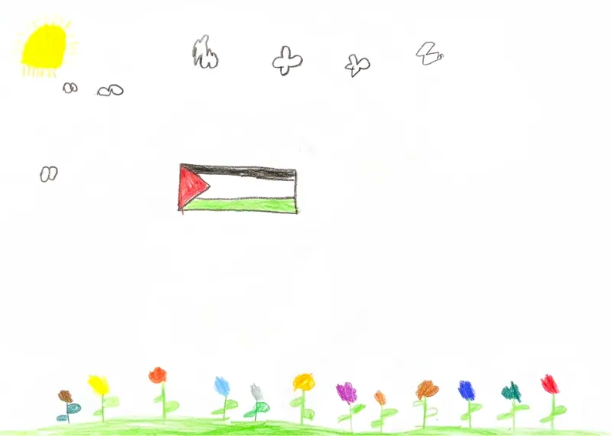
These are the youngest of witnesses — the exhibition displays drawings made by children aged five to 14. The children who participated live in 15 communities across the Gaza Strip, the West Bank, and Israel. All artworks were created between October 2024 and June 2025. According to the project’s website, these works offer “a rare and intimate glimpse into how young people experience a deeply fractured and unequal landscape,” while creating “a shared archive of witness and imagination, created by children who rarely cross borders in life, but whose images can’t help but do so.”
The idea for Innocent Knowledge came from Brown undergraduate Canaan Estes, an American Jew who happened to be studying in Israel during the Hamas attack on October 7, 2023. He was soon joined by another Brown student, Taher Vahanvaty, who had studied in Jordan in high school. Other Israeli and Palestinian students then joined these two. Professor Katarina Galor, the Hirschfeld Associate Teaching Professor of Judaic Studies, proposed the idea to the Ruth J. Simmons Center and has worked with the students since its beginning. The project, which has been termed an “almost impossible endeavor” due to its implementation during a time of great instability in the region, is now on view until February 20.
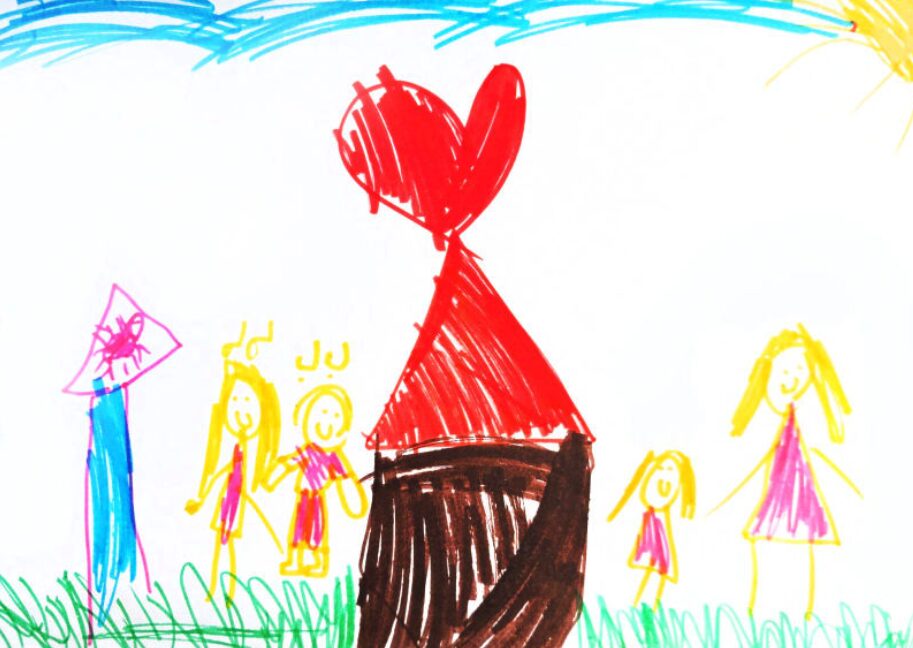
On Sunday, February 8, I attended a reception and concert at the Center. Like many events, I was required to register in advance. However, this was the first event I have attended in this country where I was required to present a government-issued ID. I entered a building that was full to capacity. The walls were covered with the children’s artwork, all arranged not by nationality, religion, or geography but rather thematically: Innocence & Knowledge, Family & Home, Violence & Loss, Hope & Resilience, Identity & Belonging, and Butterflies & Dreams. The children’s identities were protected. A bar code scanner revealed the artists’ ages, genders, schools or community organizations, and their places of residence.
Many of the works seemed as though they could be on display in my granddaughters’ classrooms at the nearby Wheeler School, depicting scenes of homes and families.
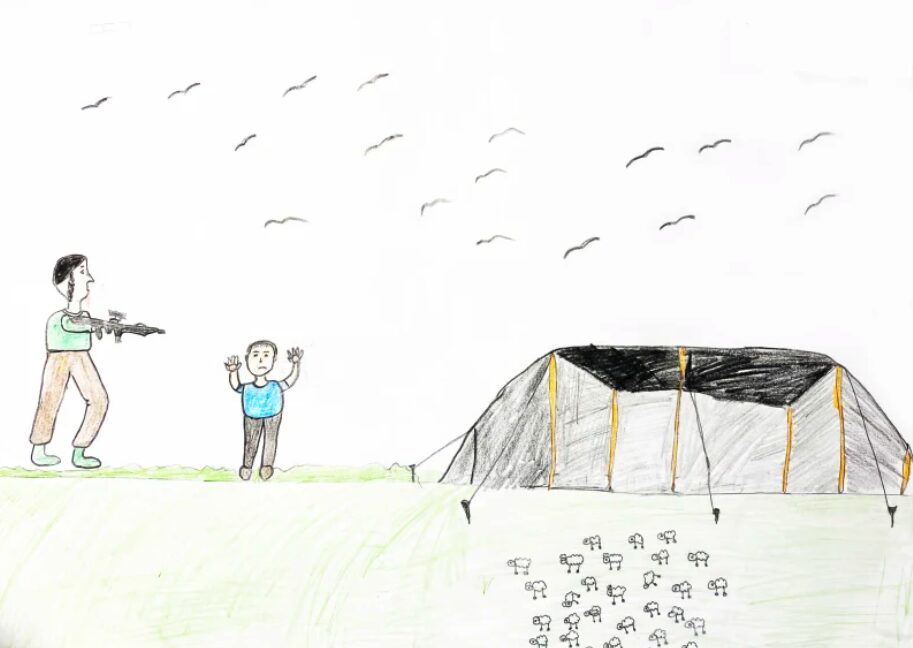
Others, depicting weapons and violence, were truly heartrending.
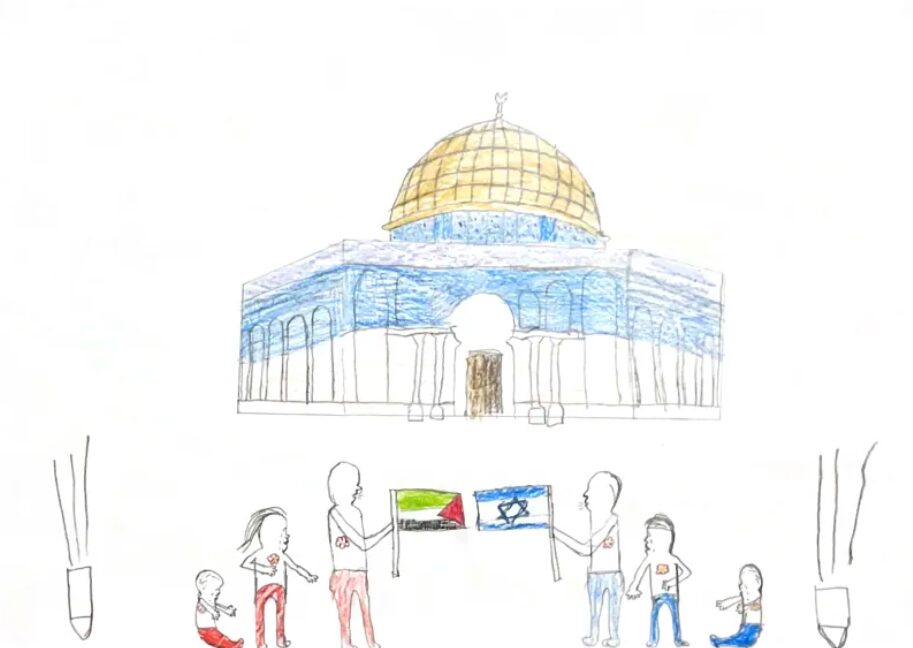
Some drawings might be interpreted to reveal hope for unity between the warring parties, such as this work that shows figures bearing the Israeli and Palestinian flags in front of one of Islam’s most holy sites, the Dome of the Rock in Jerusalem.
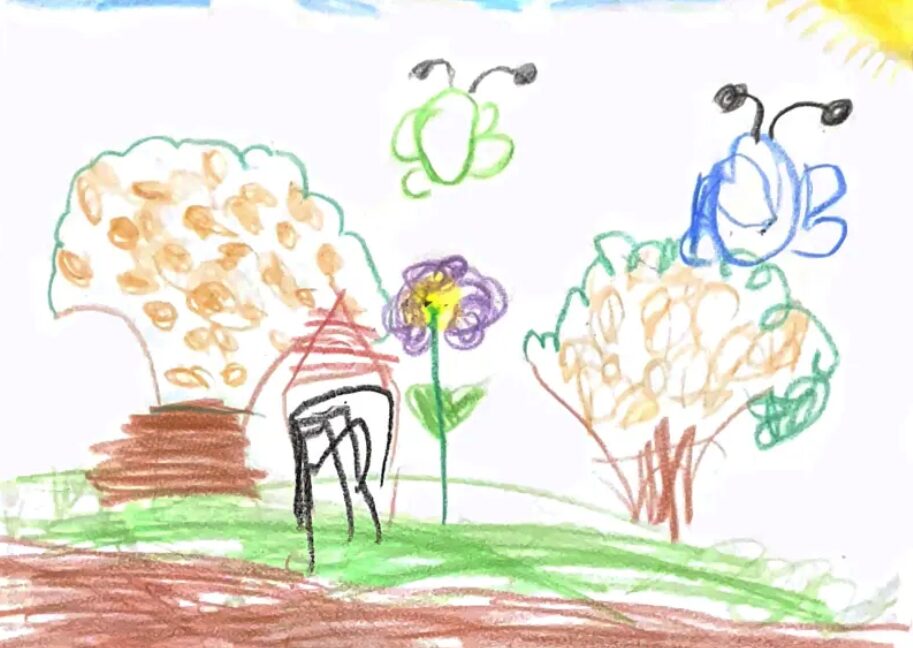
And the rubric with the butterflies? Well, those figures seem to have appeared in many of the artworks, demonstrating a child’s capacity to focus on nature’s beauty, even in times of enormous tragedy.

The exhibition also included several mobile installations created by the students in Professor Galor’s class at Brown, with fabrication help from faculty at RISD. The installations are made by using images directly from the children’s artwork, printed on acrylic paper and mounted on recycled wooden rods, creating kinetic structures that “do not follow a specific geometry as if they were assembled in a condition of urgency.”
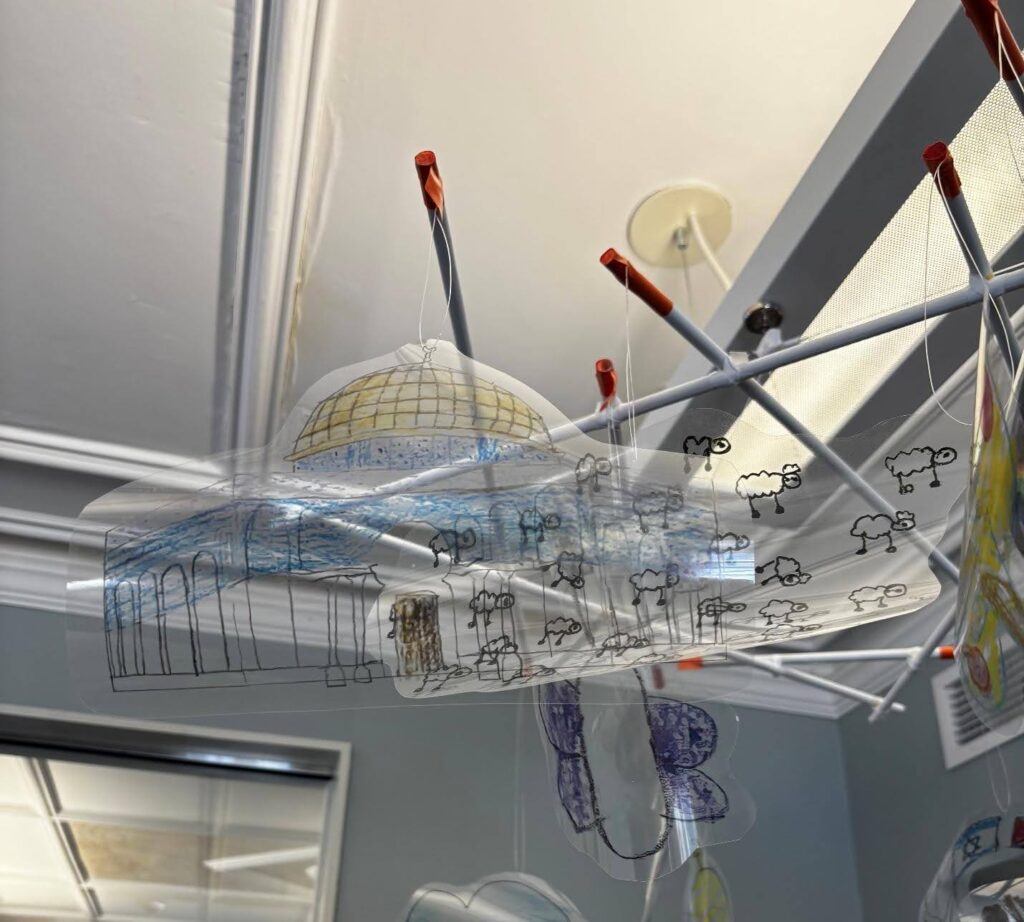
The Sunday event at the Center also featured a concert. The musicians were Berklee College of Music student Layan Hawila from Haifa on the oud and violinist Yuval Gur, a Berklee graduate who is now studying for an advanced degree at RISD. They played and sang an Arabic lullaby called Yalla Tnam (Let’s Go to Sleep) and the Hebrew lullaby Pizmon Layakinton (Hymn to the Hyacinth) and together composed the improvisational part.
Like the butterflies, the project has taken on wings. Providence is actually its second stop. It opened at the Central Synagogue in New York City last September. On April 4, it will be exhibited at RISD for a workshop related to Palestinian and Israeli children. It will then head to the American University in Washington, DC. Additional exhibitions are now being arranged in Ottawa, Brussels, Berlin, and Bari.
The exhibition, located at 94 Waterman Street, is open to the public until February 20, 2026. Remember to register at the Brown University website and don’t forget to bring either a Brown ID or a government-issued form of identification. You can also find additional information on the project online at innocentknowledge.com
Lynn Holstein lived for 16 years in Israel where she worked on various projects to foster understanding between that country and its Palestinian neighbors and its various internal sectors.
Editor’s Note: An earlier version of this article misattributed the mobile installations. The Providence Eye regrets this error.


Want to comment? Click!