



Much about the future of transit in Providence relates to whether or not the bus hub in Kennedy Plaza is moved.
Having failed to get support for several other sites in the past, RIPTA and its contractor for the transit-hub project, Next Wave, are now considering Station Park, a grassy area just west of the train station. For many reasons, I think the move is a mistake. And so do Providence-based State Representative Enrique Sanchez and Senator Sam Bell, who have co-sponsored legislation – H7464 and S2680 – that would mandate RIPTA stop spending money on planning for such a move.
To encourage passage of these bills, and to keep the bus hub in the Plaza, transit advocates are planning a rally on Tuesday, June 2 starting outside the Smith Street entrance to the State House at 3 pm, and winding up at the Plaza.
For folks who have not been following this issue as closely, it may sound reasonable to put the bus hub next to the train station. But, please consider these objections:
- It’s a less desirable location. Kennedy Plaza is closer to where most riders may want to go: City Hall, the post office, banks, the Public Library, downtown residences being developed, Trinity Square, the skating rink, hotels, restaurants, and more. Putting a bus hub on Station Park is also bad news for those who don’t want to lose downtown’s limited green space.
- The move would further constrain nearby streets. Because of the railroad corridor, the State House lawn, Waterplace Park, and the river, the streets accessing the railroad station site are already congested. Adding a lot more buses will inevitably slow all the traffic there, including the buses.
- Building over the tracks is limiting. Currently, the railroad tracks pass through a tunnel under Station Park. Adding the weight of a terminal and buses is likely to require expensive reconstitution of the tunnel. Amtrak is now being consulted on what that would entail, but it seems likely that a larger building with residences, offices, and/or parking – which have been discussed as options to help pay for a new bus hub – cannot feasibly be built over the tracks.
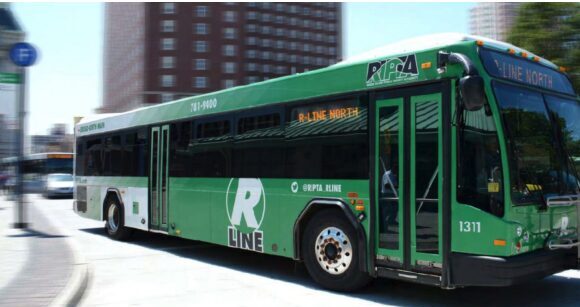
- Many buses already go there. Even though we know, anecdotally, that not that many people actually transfer between buses and trains, there is already frequent RIPTA service to the train station on lines R, 3, 4, 50, 51, 54, 55, 56, 57, 58, 66, 72. This means that there are already 300 buses going to the train station, per day, each way.
- The move would increase RIPTA’s operating expenses. Making all the buses go to a new hub on the slow roads to the train station area will add to costs. Important through-lines such as Route 1 (Hope-Eddy) and 92 (RIC-East Side) would either have to take a slow detour to the railroad station adding to rider trip times, or skip the hub. Routes from the south, west, and east that now terminate in Kennedy Plaza would have to make a slow back-and-forth trip to the train station. Higher operating expenses lead to reduced service or needing higher levels of funding.
- Moving out of Kennedy Plaza raises questions of equity. We know from a lawsuit filed in 2019, that at least part of the push to move the bus hub out of the Plaza comes from politically connected downtown real estate interests that want the disproportionately low income bus riders away from their property. They have a right to that view, but riders have a right to insist on a hub that works for them. And we all could benefit from a successful transit system that can help us meet environmental, economic, and mobility needs.
- It’s too expensive. Estimated costs for a large development including a bus hub were reportedly well over $200 million, according to an estimate cited at RIPTA Finance Subcommittee meeting in 2022. But even if only a bus hub is built the costs are reported to be in the $50 million range. There is only about $14 million left of the $35 million bond voters approved in 2014, and RIPTA, having a hard enough time finding the capital it needs to match bus purchases, cannot afford such a move.
- RIPTA’s contract with New Wave puts the agency and taxpayers at risk. RIPTA has a “Preliminary Service Agreement” with a consortium called Next Wave for a study of alternate sites for the hub. As part of Phase 1, RIPTA can cancel any time, but once they decide to go ahead with moving the hub in Phase 2, while Next Wave is guaranteed a profit, there is no maximum cost and RIPTA has no effective off-ramp to limit losses. The bills H7464, S2640 explicitly prohibit RIPTA spending any more money on this Agreement after August 1, 2026.
- Too little public input. Next Wave was supposed to have robust public input into the hub move study, but this didn’t happen. They did have a public session at which they said attendees preferred the train station area location for a hub, but they did not note that attendees were not given the option of preferring to stay in Kennedy Plaza. They have never even given the public a chance to comment on the specific Station Park site we are told is now under consideration. This is not an adequate public-input process.
- Kennedy Plaza can be fixed up for far less cost. Kennedy Plaza does have problems. But it’s far less costly to work with an existing facility than it is to start fresh somewhere else. Possible improvements to the Kennedy Plaza bus hub include sprucing up the terminal building, enhancing security, installing better lighting, improving signage and adding more information for passengers. Many of these issues were identified in 2017 when city planners had a public process to improve the Plaza. But they were not implemented as real estate interests, and later, COVID issues, got in the way.
Keeping bus users in Kennedy Plaza can help make the area more lively, and passengers can also be customers for adjacent businesses. Now is the time to revisit improving the plaza with a robust stakeholder process while there is still bond money to help.
I ask those who agree with this to come to the rally if you can, and ask your legislators to support H7464 and S2640.
Barry Schiller, a retired RIC Mathematics Professor, has been a lifelong transit user and advocate, and served on the RIPTA Board of Directors 1995-99.


Want to comment? Click!