

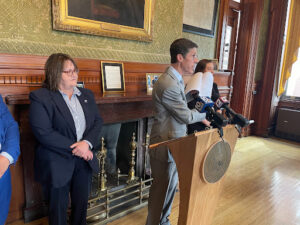



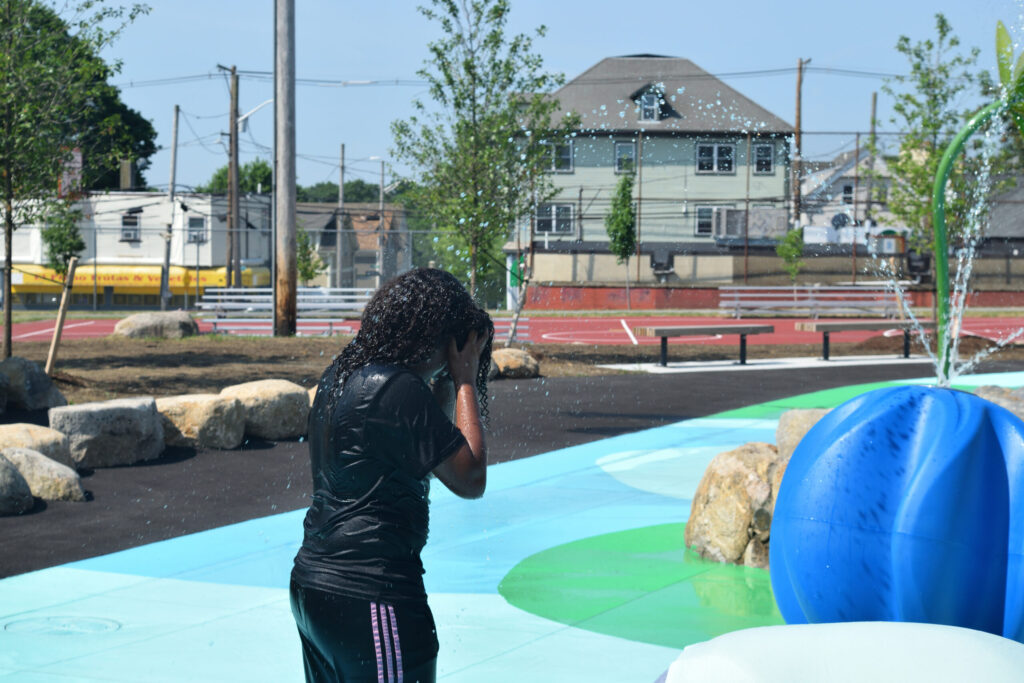
Providence splash pads and pools opened up on Monday, June 29, offering places for neighbors to cool down from the summer heat. Christian, a 15-year-old visiting his father for summer break, was the first to jump in the water when city officials reopened the Joslin Park splash pad.
“I came here with a friend to train a little bit for soccer, and we didn’t bring water,” said the young athlete. “We were really dehydrated and we wanted to get refreshed. And when we saw the water was on here, we just came in. The water is very nice and cold.”
As reported by ecoRI, rising summertime temperatures due to climate change are correlated with higher visits to emergency departments due to heat-related health issues. The splash pads and pools are accessible ways to keep cool in a city without any beaches. Despite living in the Ocean State with 400 miles of coastline, residents do not enjoy beach days equally, according to new research from the University of Rhode Island.
By comparing satellite imagery of the ocean and cell-phone tracking data, researchers found increasing water clarity by one degree coincided with millions of more beach visits for all Rhode Islanders. While lower-income, more diverse communities in places like Providence do see increased trips to the beach when there is higher water clarity, they do so at lower rates than higher-income, white communities in the state. Scientists suggest this could be the result of frequently closing beaches near urban communities, lack of transportation and the high cost of a beach trip.
Water Quality Improves Welfare for All, but Not at the Same Rates
Sonia Refulio-Coronado moved to URI’s Kingston campus from another coastal area: Lima, Peru, and couldn’t wait to keep enjoying the beach.
“I thought, ‘Oh yeah, we are near here, I’m going to do the same thing,’” said Refulio-Coronado, who has a PhD in Environmental and Natural Resource Economics from URI. “To get to the town beach, it’s basically 15 minutes driving, but if I go by bus, I have to go first to Providence, and then from Providence take another bus.”
The long trip was discouraging but pushed Refulio-Coronado to study environmental justice and beach access. Now, she’s the lead author on a new study set to be published in the journal Land Economics that used cell phone mobility data to measure how often different Rhode Island communities traveled to nearby beaches from June to September in 2018 and 2019.
The study found that every additional two feet of water clarity depth led to a 5–6% rise in beach visits from predominantly white, higher-income communities. However, the same amount of improvement only led to a 2–4% rise in visits from communities with higher poverty rates and greater racial diversity.
“Everyone is affected by improvements in water quality, but not everyone is having the same positive effect,” said Refulio-Coronado. The study looked at all 815 census block groups in Rhode Island, which represent about 1,500 people each, and their trips to 789 beaches within a 100-mile radius. “Communities of color or disadvantaged communities in Providence don’t necessarily enjoy these benefits as much as others.”
The study used statistical methods to calculate how much value the water improvements add to Rhode Islanders’ lives based on how much money they spent on additional trips to the beach. In total, a 10% improvement in water clarity translated to about $71,000 of increased value for all people living below the poverty line in the state. For people above the poverty line, the same change in water clarity created a total of $438,000 in added value.
“This is a very standard approach in this kind of analysis,” said Dr. Stephen Polasky, a professor of Ecological and Environmental Economics at the University of Minnesota who was not involved in the study. “I can estimate the total willingness to pay or total value that the person gets from the number of visits that they took given the travel costs that they actually paid.”
Polasky said it was not surprising to see higher income and white communities with access to beach recreation receiving the benefits of improved water quality. He said improving areas like air quality can have the opposite effect, bringing the most benefits to people of color with lower incomes.
“Higher pollution tends to be in lower income places, so if you improve air quality, then then it’s got sort of a distributional effect,” said Polasky. “As opposed to this, where the distribution of benefits is skewed more to the higher income people.”
All Aboard the “Beach Bus”: Ways Forward for Access
The study recommends investing in water management to improve beach quality closer to Providence, as well as implementing short-term policies to create equitable shoreline access.
One option is the “Beach Bus,” offering affordable transportation to clean beaches provided by RIPTA’s seasonal beach service. According to the study, around 90% of beachgoers in Rhode Island drive their own cars, but approximately 16.7% of low-income residents in Providence don’t own a vehicle. Another is adopting lower parking fees for residents of disadvantaged communities, so that higher-quality beaches remain accessible.
“The Constitution of Rhode Island guarantees the right to access the shoreline, and that’s just on paper,” said Refulio-Coronado. “The reality is that if you could use a parachute, you can go to those places. Otherwise, there are lots of problems in access to make that right true.”
For those looking to cool down in their neighborhoods, water facilities will be operating until August 14, 2026 in every ward in the city. This year, the City re-opened the Joslin Park splash pad designed by Providence Parks Department Senior Landscape Architect Sam Greenwood. In addition, Providence opened a new pad at Father Lennon Park in Smith Hill.
“People don’t have a car to go to the beach and pay high, high money to get into it,” said Ward 15 Councilman Oscar Vargas, who represents Olneyville. “These investments [in water parks are] a great idea for the communities. It doesn’t matter what kind of community they need to cool off. The kids love to go and play on it.”
Eric Halvarson es reportero de noticias locales para The Providence Eye.
¿Quieres dejar un comentario? ¡Haz clic!