



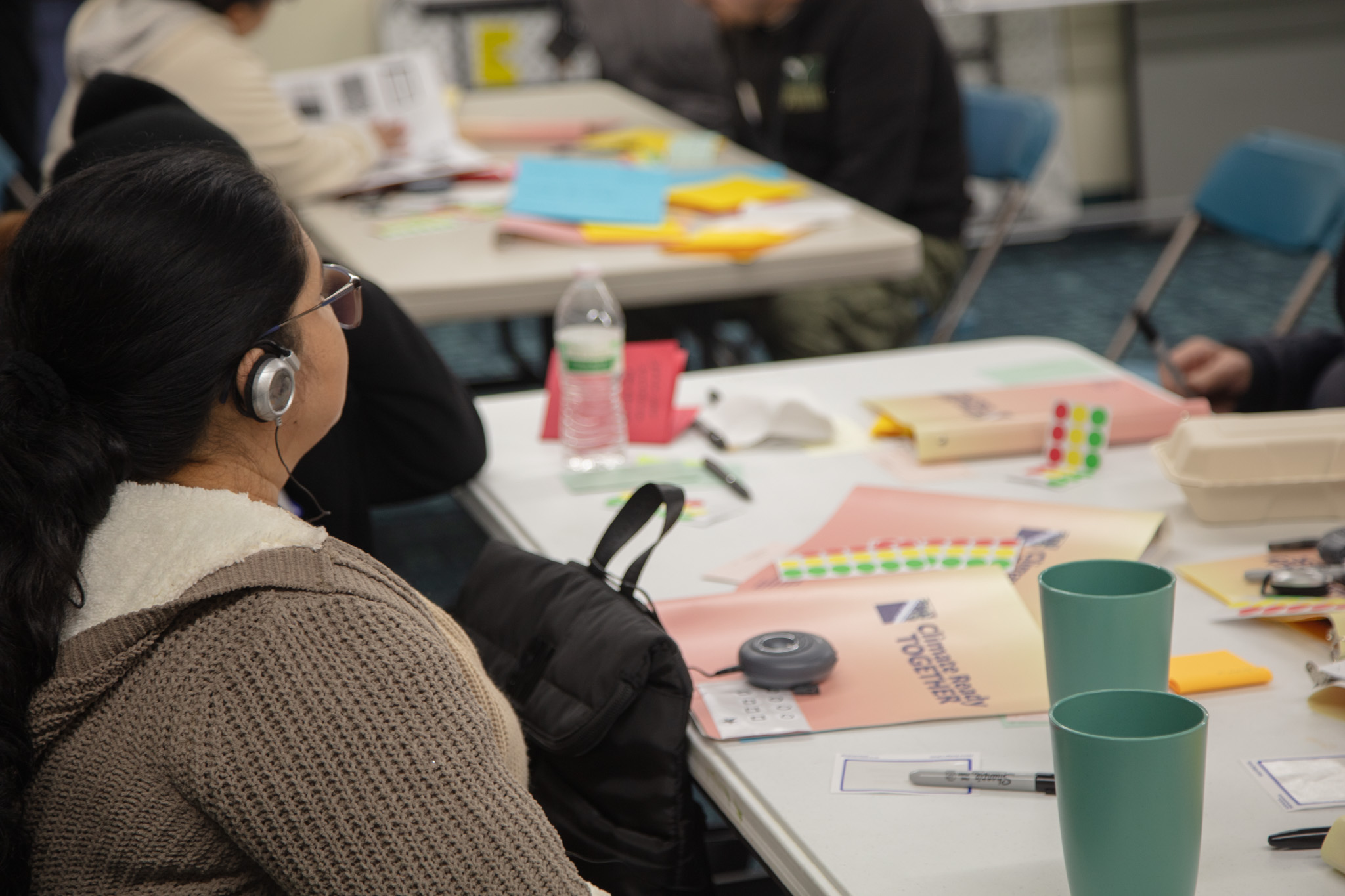
On a Wednesday evening in November, a group of Providence residents gathered in the basement of the Smith Hill Library. Tables topped with folders, stickers, and paper lined the room’s multicolored carpet.
Some residents chatted with people at their table while others picked up headphones for English-to-Spanish translation. But the residents weren’t at the library for book club or a language class — they were hoping to learn how to prepare for a changing climate.
The meeting at Smith Hill Library was one of the first in a series of workshops hosted by Climate Ready Together, a program that teaches Providence residents — across eight separate cohorts — how to address climate change-related issues, such as flooding, in their neighborhoods.
“It really is that marriage of both technical information and community learning that we think is so powerful,” said Michele Jalbert, executive director of the Providence Resilience Partnership (PRP), the nonprofit that created the Climate Ready Together program.
The nine-month workshop series shares general information about how Providence is impacted by climate change and how residents can get involved in addressing it on a macro level, Jalbert said. But facilitators will also teach participants the specifics they need to know in climate emergencies, such as how to prepare their homes and formulate evacuation plans. In exchange for their time, cohort participants are eligible to receive a $450 stipend.
The program also gathers feedback and information from residents as part of a comprehensive Providence climate vulnerability assessment administered by Arcadis, a Dutch-based consulting firm.
Around 60 to 80 signups were expected across the eight cohorts, Jalbert said. By late October, they had received 155.
Jalbert said others had told her that people would never be interested in the program or show up to cohort meetings because they don’t care about climate issues.
After seeing the number of cohort signups, she believed she had proven them wrong.
“Yes, they do care,” she said.
The project was inspired in part by a 2024 PRP cohort for Providence residents to participate in a project funded by the National Oceanic and Atmospheric Administration.
“What we found was a group of people meeting once a month — sharing dinner together, learning together — creates connections and relationships that are really valuable in so many ways,” Jalbert said.
Now, more than a year later, PRP is building on its past success. For the Climate Ready Together program, many graduates from previous PRP cohorts will lead the meetings as community facilitators.
“It’s exactly what I had hoped would happen,” Jalbert said. “You give them knowledge … and they take it from there.”
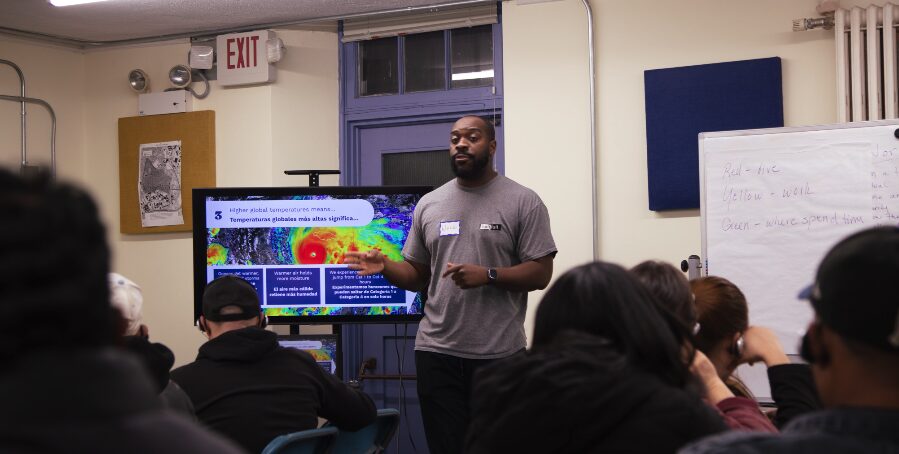
Wole Akinbi said he joined the program as a facilitator for the Smith Hill cohort because he has lived in the neighborhood for most of his life.
“I thought it would be a great idea to learn more information that I can bring to the community,” he said, noting he was also interested in meeting others who live in the area.
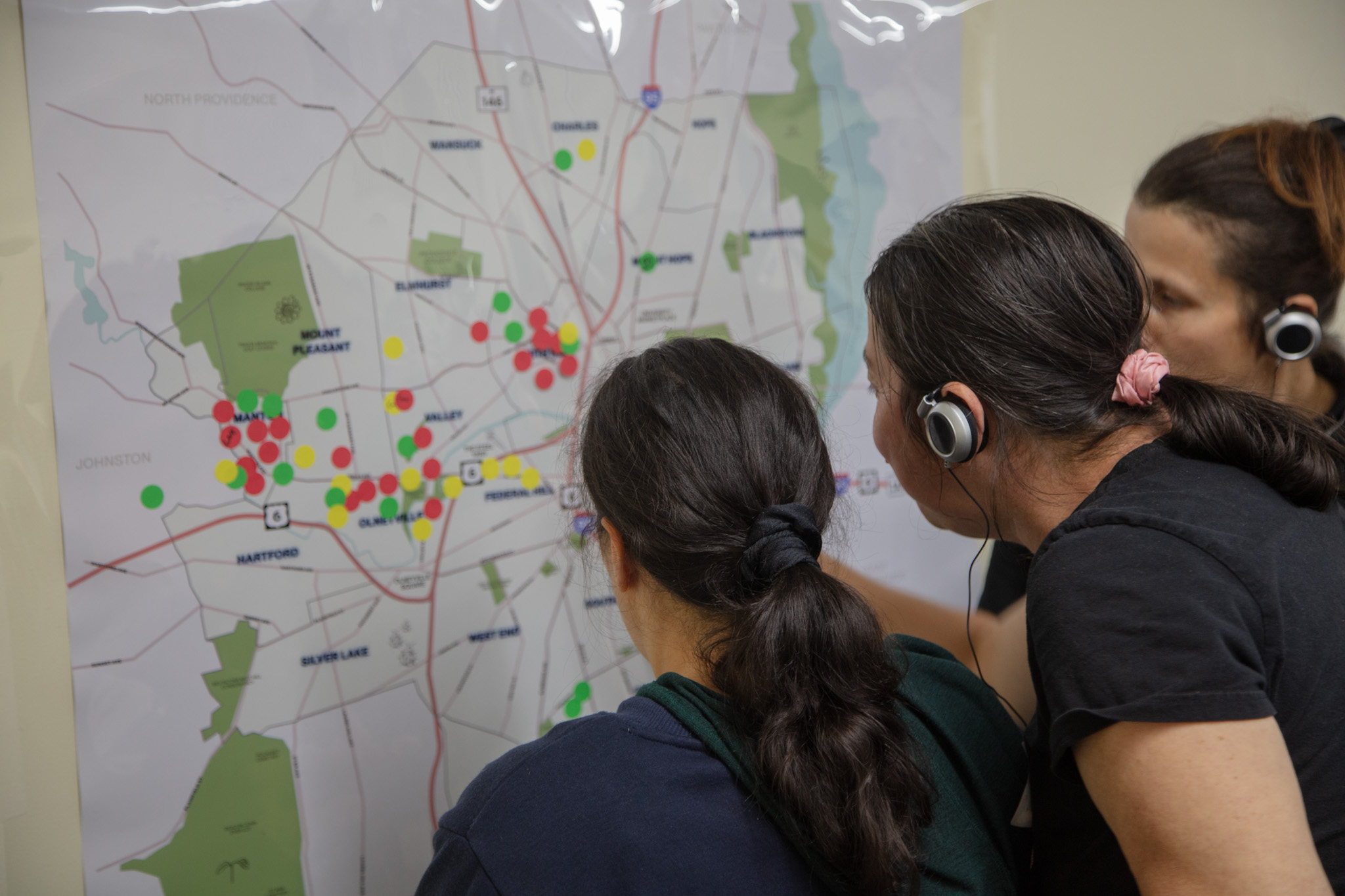
At the November meeting, Akinbi led participants through activities such as placing stickers on a map where participants live, work, and spend time, and discussing their early memories of bad weather. He also asked participants to write about their climate-related hopes and fears on “cohort cards,” which participants submitted to the organizers during the meeting.
The program’s curriculum was designed in collaboration with Roots2Empower, a New England-based nonprofit that aims to advance equity and challenge social injustices.
The first two workshop sessions gave participants a background on the foundations of climate change, said Clare Kim, a program manager at Roots2Empower who developed Climate Ready Together’s curriculum. Having previously worked as a middle school teacher, Kim said she is using her educational background to “guide people into learning” that is enjoyable and long-lasting.

During the program’s first week, the mapping activity aimed to collect data about where residents might go in a climate crisis, such as an incident of flooding.
Although you could map the neighborhood’s points of highest elevation empirically, Lee noted, community members aren’t necessarily considering this data in times of crisis. Instead, they are likely considering fleeing to the places with which they are familiar.
“I think that’s an entirely different set of data that should be incorporated into a city report like this,” she said.
For Linda Young, a participant in the Smith Hill cohort, flooding in her neighborhood has been a source of concern.
She said she wishes the city would unclog storm drains more frequently, because places that “never had flooding before have flooded now.” Young recalled instances of flooding on nearby Branch Avenue, which she suspected caused the stores there to lose business.
Flooding issues like these aren’t unique to Smith Hill or Branch Avenue.
Across the entirety of Rhode Island, flood risks are “dramatically increasing,” said Kim Cobb, a professor at Brown University and the director of the Institute at Brown for Environment and Society.
According to the 2020 First National Flood Risk Assessment, around 26,500 properties in Rhode Island are under “substantial risk” of flooding. The report predicts that the number of properties at this risk level will increase by another 14.7% over the next 30 years.
Flooding caused by extreme rainfall is also a major point of concern for the state, Cobb said. Since 1900, rainfall in Rhode Island has increased by around 5 inches per year, according to the Rhode Island Department of Health.
Young said she has seen the impacts of climate change, but she is interested to learn more about what the term truly means through the Climate Ready Together sessions.
On-the-ground climate communication, such as a program like Climate Ready Together, is “trying to meet people where they are,” Cobb said. It is not often at the top of people’s minds to get educated about climate change, she added, but an opportunity to learn in a community setting makes the experience more enticing.
It also allows for a conversation rather than only instruction, Cobb noted. “If you can’t have your specific questions answered, or if you don’t know what the specific context is for your neighborhood or your home or your community, it’s not going to land,” she said.
The most effective method for combating climate change, however, relies on coordinated state-level strategy, said Cobb, citing the importance of “real awareness and education across many different channels and many different avenues,” including in classrooms and town councils. She also said it is important to communicate with vulnerable communities, such as senior living centers, where information is “much harder to disseminate.”
“I think it’s important to just be more engaged with what the city’s plan is,” said Carol Lisi, a member of the Smith Hill cohort.
Lisi had heard about the program through the library and decided to sign up. While sitting with her table group, she began to talk with those around her.
“Four of us that didn’t know each other at all got together and we were chatting like we’ve known each other forever,” she said. “It’s great to see, again, the different perspectives and just a sense of community.”
After the November session ended, Akinbi said he hopes participants take away the “courage and confidence” to share the information they learn.
“I don’t think when the nine months is up, this work should stop,” he said. “This cohort should inspire another cohort that should inspire another cohort as we progress and move into the future.”
This story was published as part of a collaboration between ecoRI News and students in Brown University’s Science Journalism class. The stories examine the science, history, and human experiences connected to the Ocean State’s rivers — from water quality and wildlife restoration to flooding, pollution, social justice, and the communities working to protect them. To read more stories in this project, click here.


Want to comment? Click!