




The Woonasquatucket River Greenway has been in the works for more than 30 years. It’s a project that bridges the decline of Olneyville’s past manufacturing industry with the current influx of artist spaces and nonprofits to Central Providence warehouses. In the 90s, Jane Sherman, founder of the Woonasquatucket River Watershed Council, started leveraging millions of dollars and her political connections to remediate environmental pollution along the river.
“As we walked down here, over the trash with the seeping sewage coming out, she was describing this luxurious, beautiful landmark,” said Senator Jack Reed. “Fortunately, she didn’t give up, and she convinced me, as she always does, to keep going.”
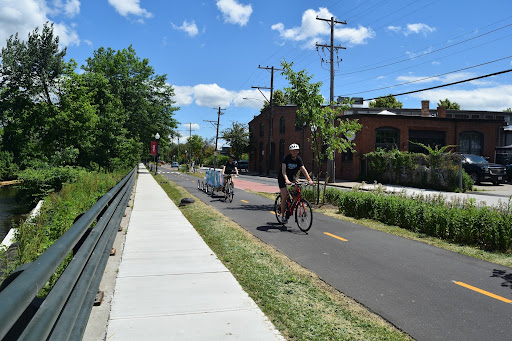
On June 15, dozens of people celebrated completing one mile of greenway that fuses investment in alternative transit, environmental health and public spaces along a historically industrial corridor. After 14 years of stacking funds, designs and construction, the new path represents an achievment toward a larger goalto create pedestrian and cycling infrastructure across the city.
A Bike Path 30 Years in the Making
At the June 15 unveiling, officials and politicians at a sunny press conference constantly credited the inspiration for the project to Jane Sherman. Sherman was working at a nonprofit called The Providence Plan when she began brainstorming how to improve Central Providence with Fred Lippit.
“As we did community meetings in ’94 [and] ’95, people said there was no safe place for the kids to ride their bikes. 47% of the people in Onlyville didn’t have access to automobiles. Getting to the health center and the schools was important,” said Sherman. “So it became an integral part of the planning process, because that need came from the community.”
The Fred Lippitt Woonasquatucket River Greenway has slowly expanded since 2002, and the Woonasquatucket River Watershed Council partnered with the City of Providence in 2012 to begin designing this additional mile of path.
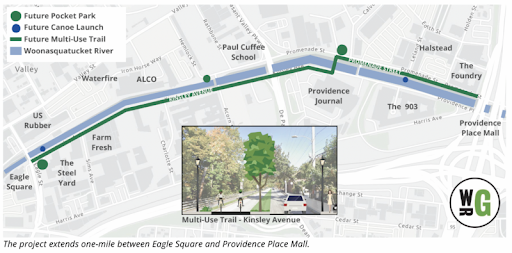
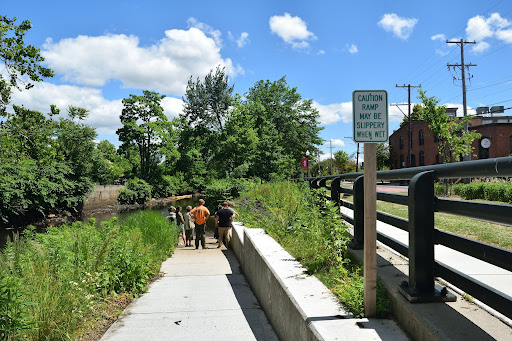
The new section runs from the corner of Kinsley Avenue and Eagle Street towards the Providence Place Mall, but not before crossing over the river onto Promenade Street. The project features protected bike lanes, several “pocket parks” and two kayak launches—one at Eagle Street and another at Leland Street. Along the linear park, there are several pieces of stormwater infrastructure and hundreds of native plantings to improve local water quality.
“Our vision is bold, to continue to transform spaces, create art, access, improve habitat, water quality, and flood resilience,” said WRWC Executive Director Alicia Lehrer. “We want to bring that all throughout our watershed.”
The project cost about $11.5 million in public investment through the Rhode Island Department of Transportation, the Providence Capital Improvement Plan, the EPA’s Southeast New England Program, the Rhode Island Department of Environmental Management, the Northwest Trail, RI Green Bond and Congressionally Directed Spending from Senator Jack Reed.
“The Promenade on Kinsley Greenway is a critical link now between downtown Providence, Smith Hill, Valley, and Onlyville, and it’s helping connect residents to jobs, to recreation, to community resources,” said Mayor Brett Smiley. “This is a part of what has been a net increase of one mile of new bike paths over the last three years, and we are continuing to build out our urban trail network.”
Providence Transit Advocates Celebrate New Corridors
The Kinsley Avenue section of the path ends abruptly at the Providence Place Mall, leading pedestrians and cyclists into a three way intersection with confusing signage. Transit advocate Dylan Giles said the “next step is really continuing to piece together our network.”
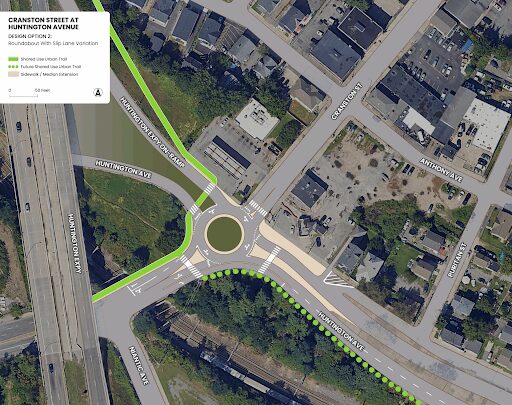
“The bit at the end of the mall is unfortunate, but I think the most important thing with this project is to increase the connectivity,” said Giles, who notes the Safe Streets Plan is attempting to connect city paths to the Washington Secondary in Cranston. “If we can make those critical connections, you will have this monster bike path that will take you all the way from Coventry to downtown Providence. And the benefits, not just for transportation [but] economic benefits of that are huge.”
A city official told The Providence Eye that Providence is “not currently working with the city of Cranston on the Washington Secondary connection.”
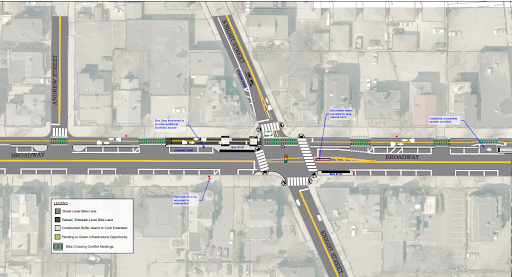
The Providence Streets Coalition is looking forward to the city’s planned work to build a two-way, protected bike path on Broadway. Without eliminating parking, the plan will also install buffer island bus stops and curb extensions to enhance pedestrian safety.
“Broadway is this hugely pedestrianized neighborhood, and those bike lanes are really tricky right now,” said Giles, referring to the bike lanes that run in between traffic and vehicle street parking. “[It will be a] general increase in safety for everyone who’s using the road, whether you’re walking or biking or even driving. That’s one of the most promising projects that’s in the works.”
Officials said construction on Broadway will begin in summer of 2027 and be completed in summer of 2028.
Providence is also moving a two-way separated bike lane on South Water Street from the roadway onto the sidewalk, opening up the way for two-lane car traffic on the road. Mayor Smiley previously moved to eliminate the bike lane in response to Washington Bridge traffic, amid complaints by vegan restaurant Plant City that the infrastructure lowered traffic to the area. A spokesperson later told WPRI the bike lane “was not a factor” when the food hall closed in February 2026, and instead blamed Washington Bridge traffic.
City officials said construction on South Water Street will begin after World Cup activities are complete.
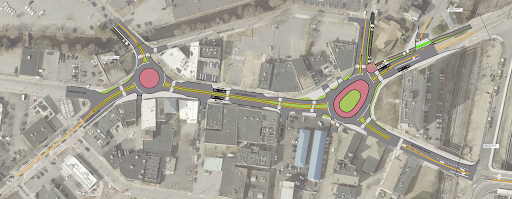
The third major project on the city’s transportation radar is to redesign the often-congested Olneyville Square. Providence officials said they are prioritizing safety improvements in the zone based on a crash analysis conducted in 2025. A concept released that same year proposes replacing traffic lights with roundabouts at the corridor’s two major intersections. Officials said construction is expected to begin in late 2027 or early 2028, and is being coordinated with utility work in the area to minimize the impact on residents.
After celebrating the greenway along the Woonasquatucket, transit advocates also pointed back at the idea of installing a shared use path along another pair of water channels: the Moshassuck and West River. Ian Westcott led a “Jane’s Walk,” a citizen led tour named in honor of urbanist Jane Jacobs, in May called “In Search of The West River Greenway”—a proposed path that would connect downtown to the North End.
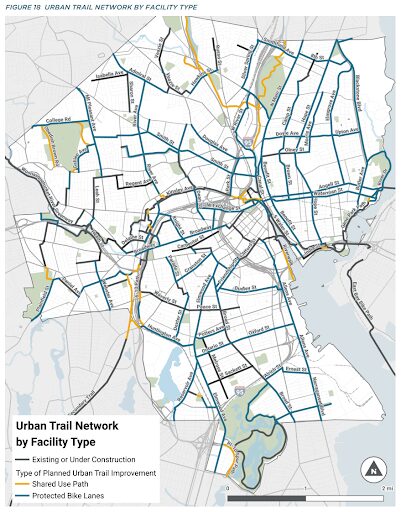
“I think there’s a glaring mobility gap in the north end of the city. An off-street path from Wanskuck and Charles across to North Main Street and downtown would be an enormous asset to the communities around it, similar to how the Woony path has improved the quality of public space in Olneyville, Manton and Hartford,” said Westcott. “It would help us highlight some of the environmental issues that affect the West River like flooding, trash, and sewer outflows.”
Until the next greenway project, transportation is on the move in Providence.
Eric Halvarson is the City News Reporter for The Providence Eye.


Want to comment? Click!