



Nearly half of Providence’s tax base (44%) is tax exempt. This fact requires that the 56% who pay taxes as existing property owners bear the burden anytime the city faces fiscal problems.
Next year, Providence Mayor Brett Smiley wants to increase city property taxes on average by nearly 6% to help cover a fiscal gap in the city budget for the upcoming 2026 fiscal year. Providence’s city budget depends heavily on property taxes, with two-thirds of the city’s revenue coming from property taxes.
Several factors have converged in the last few months to create a “Category Three Fiscal Storm” for the Providence city budget: a Superior Court mandate that Providence increase funding for Providence public schools to make up for several years of underfunding; a significant drop in value of downtown office buildings as more employees work at home; the depletion of the COVID American Rescue Plan Act (ARPA) funds; and a 6% increase in expenses to fund city employee pension and medical benefits.
Providence’s Tax-Exempt Property Problem
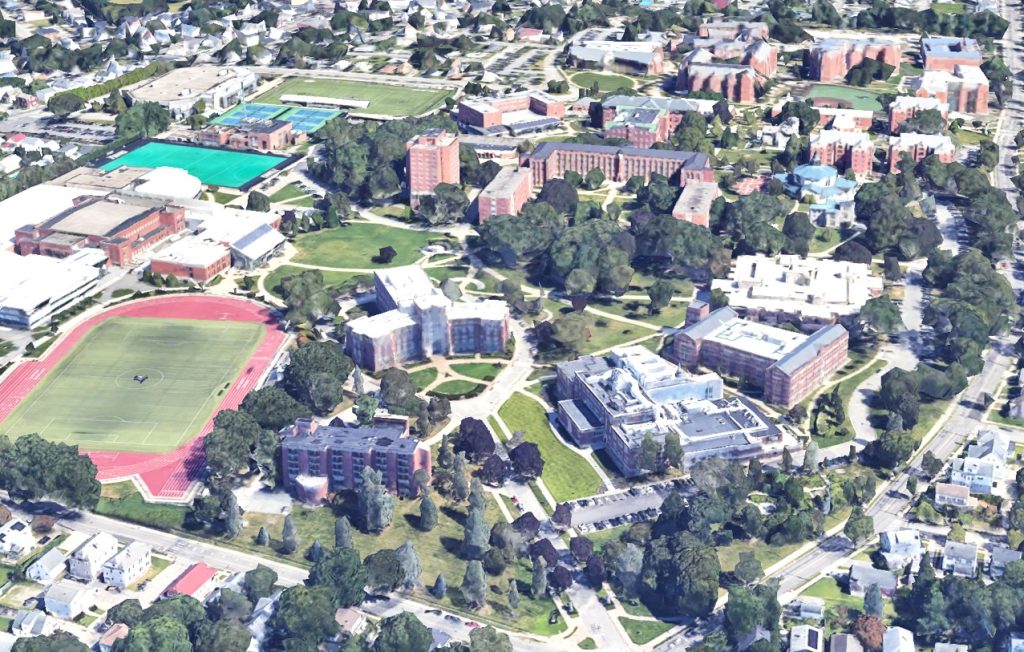
Given that Providence is so dependent on its property tax base for its revenues, the amount of land that is tax exempt, such as that owned by the universities and hospitals, is a significant and perpetual issue for the city.
While taxpayers point to the private universities as the primary culprits in owning tax-exempt property in Providence, the reality is that there are literally hundreds of tax-exempt properties in the city, including:
City-owned land: Schools, parks, recreation centers, fire stations, police stations, Providence Water Supply, North Burial Ground, Triggs Golf Course
State-owned land: State house, state office buildings, Rhode Island College, court houses, RI Convention Center, the Amica Mutual Pavilion, Vets Auditorium.
Federally-owned land: Federal courthouse, VA Hospital, post offices, Amtrak.
Private colleges: Brown University, Providence College, RISD, Johnson & Wales.
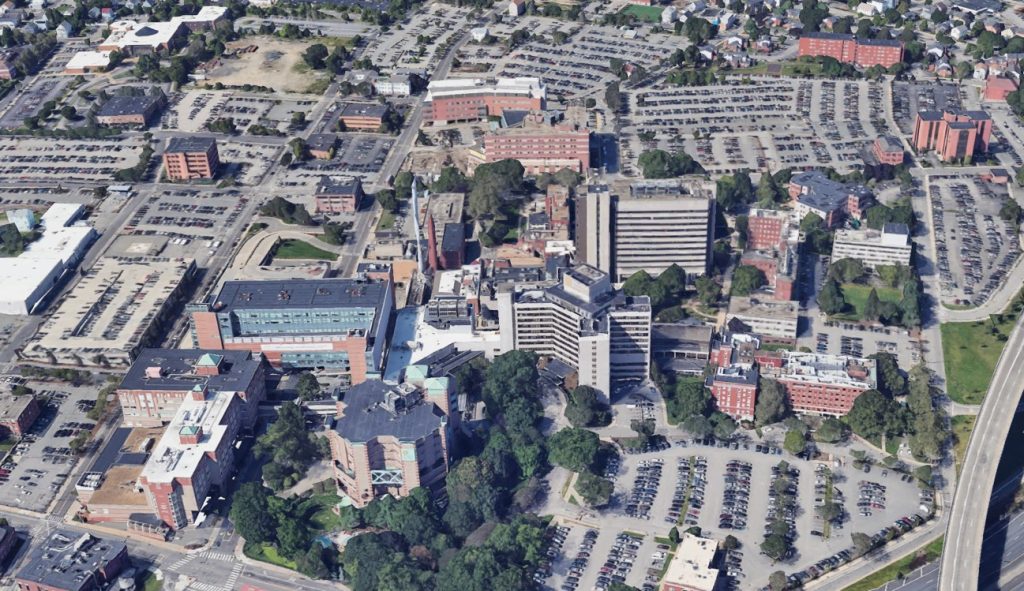
Private hospitals: Lifespan—RI Hospital, Miriam, Hasbro (all now Brown Health); Care New England—Butler, Women and Infants.
Private, parochial, and charter schools: Such as, Moses Brown, Wheeler, Lincoln School, Times 2, Achievement First School, Paul Cuffee School, Community Prep.
Providence Housing Authority (public housing): Such as, Hartford Park, Chad Brown, Admiral Terrace, Manton Heights, Dexter Manor, Carrol Tower, Dominica Manor, Wiggins Village.
Other non-profits: RI Food Bank, Crossroads RI, RI Foundation, Swan Point Cemetery, Diocese of Providence, Jewish Community Center, PPAC, Trinity Theater, YMCA.
What is Providence Doing about Revenues from Non-Profits?
To recover some of the foregone revenue from tax exempt properties, the city seeks funds from a State PILOT (Payments in Lieu of Taxes) program and from individual City PILOT programs with some of the larger land-owning non-profits.
State Pilot Program
In addition to Providence, several other RI communities have significant amounts of land that is occupied by tax exempt property. These communities — Warwick, Cranston, and South Kingstown — joined Providence in 1987 to convince the General Assembly to pass legislation authorizing the State of Rhode Island to reimburse selective communities equivalent to up to 27% of their foregone tax revenue from tax exempt land, called PILOT (Payments In Lieu Of Taxes). In the current fiscal year, FY 2025, Providence is receiving approximately $37.2 from the State PILOT program and has budgeted $38.2 million in the proposed FY 2026 budget. Funding for the state PILOT program remains fluid from year-to-year, however, subject to the annual economic pressures on state government.
Providence PILOT Program: Voluntary Payments from Large Institutions
Providence city officials have negotiated PILOT programs with several of the largest tax-exempt institutions for the last 20 years. In the 2003-2023 period, the four private universities in the city in four separate 2003 Memoranda of Understanding (MOU) made voluntary PILOT payments totaling approximately $48.4 million.
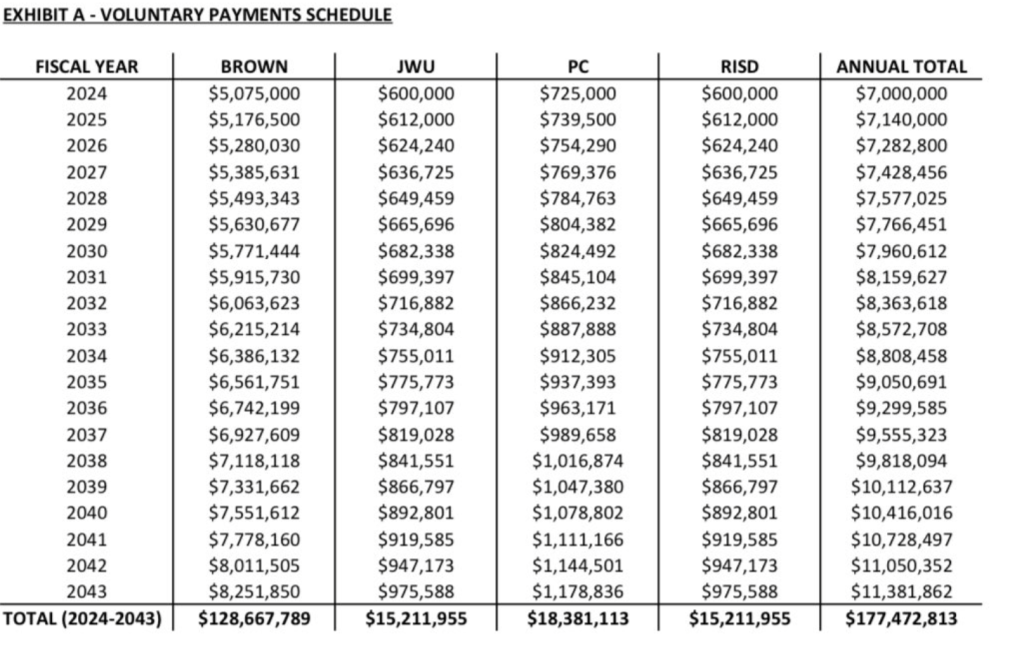
In 2023, Mayor Smiley negotiated a PILOT agreement that combines all four universities into one agreement and lays out a voluntary payment schedule totaling $177.5 million as follows:
In 2024, Mayor Smiley also negotiated short-term (FY 2025 and FY2026 ) PILOT agreements with Lifespan (now Brown Health), Care New England, the Port of Providence, and the Providence Housing Authority. The city is budgeting approximately $4 million from them in FY 2026.
Is the Providence PILOT program a Good Deal for Providence?
Given the current fiscal situation for health care in Rhode Island, the city will have a difficult time negotiating larger PILOT payments from the nonprofit hospitals in the near future.
In terms of what the universities paid prior to 2023, the new 2023 PILOT agreement appears to be a better deal for Providence. Increased voluntary payments will be flowing into the city coffers. And there is certainty for those payments for 20 years. But the annual PILOT payments from the universities to the city are still a tiny fraction of what the normal tax levy would produce. The PILOT voluntary payments in the coming fiscal year will be $7.3 million versus an estimated levy of $95+ million if the universities were taxable.
What is also worrisome, however, is the lack of a requirement that any of the universities pay temporary property taxes on property that they convert from tax paying to tax exempt. The 2003 Agreement classified these as “transitional properties.” They would be taxed for 15 years on a gradually downward scale before they became totally tax exempt. Remarkably, however, properties purchased by the universities after May 1, 2023, that are converted to a university tax-exempt use, such as a dormitory or a classroom, will not be labeled “transition properties,” and will automatically become tax exempt. If Brown wanted to convert, for example, commercial properties in the Jewelry District to dormitories, it can do so without having to pay transitional property taxes.
While Providence benefits enormously from the presence of nonprofit educational and health institutions like Brown, JWU, Care New England, etc, the city will continue to struggle to bridge its fiscal gap, and next year’s budget shows the effects.
Bob McMahon has been a Providence resident since 1978. While an officer in the US Navy, he participated in the recovery of the Apollo 11 astronauts in the Pacific Ocean in 1969. He has a city planning background and worked in the Providence Parks Department for 30 years, first as Deputy Superintendent under Nancy Derrig and later as Superintendent. Married to Pam Kennedy, they have two adult sons, James and Robert. He is a volunteer for the San Miguel School and St. Pius V Church in Providence. Daily devotee of the New York Times word games: Wordle (3.0 average guesses) and Spelling Bee (859 straight days Genius level).
Editor’s note: An earlier version of this article had the incorrect figure for the amount that the City needed to bridge in the budget.
¿Quieres dejar un comentario? ¡Haz clic!