



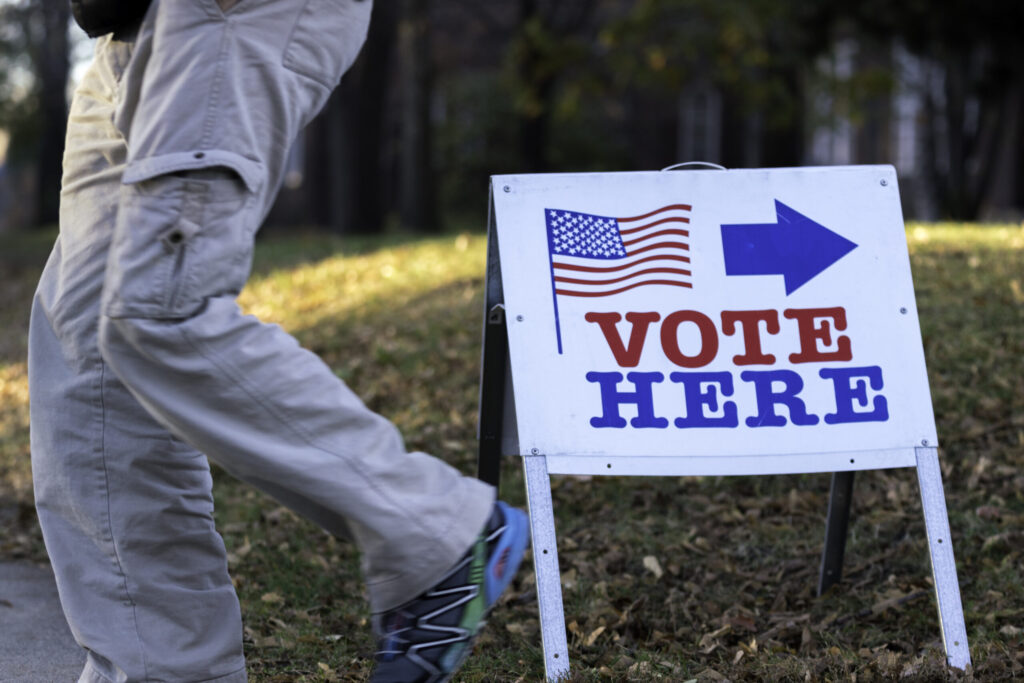
Over 50% of Providence voters showed up to polling places for the 2024 election, but half as many showed up for the last round of midterms in 2022.
As voters register for this year’s midterms, voter turnout in Providence is shaped by factors like competitive local campaigns and voter demographics, but the biggest impact may come from sweeping laws being considered on the federal level.
The U.S. Senate is debating federal legislation pushed by Republicans that restricts access to voting for millions of eligible U.S. citizens. Rhode Island’s Secretary of State Gregg Amore and members of the legislature are pushing back with their own bill to protect against voter suppression in the state.
Election season is still months away, but Providence voters are facing potentially “catastrophic” barriers to ballot.
Local factors driving turnout
“Midterm tends to drive down turnout, but statewide contests and citywide contests will help activate voters, particularly in the Democratic primary,” said John Marion, executive director of Common Cause Rhode Island. “There’s also probably going to be a counter reaction to Trump that will boost turnout.”
In 2018, the backlash to Trump was a major reason more than 47% of eligible voters nationwide cast a ballot, the highest midterm turnout rate since 1966. Around 114 million votes were cast in midterm elections for the U.S. House of Representatives—the first time a midterm passed 100 million votes.
Providence’s voter turnout for the 2018 general election was almost 34%, casting nearly 44,000 ballots.
But in the 2022 general election under President Joe Biden, Providence voters only cast around 34,000 ballots with a voter turnout rate of 26%.
Because Providence has a Democrat majority in politics, most elections are decided in the primary. In 2022, voters cast even fewer ballots for the primary election—around 22,000. While voters may want to choose who will be the next Governor or federal Congressmember, local campaigns for Mayor and City Council earn fewer votes.
The term for this is “roll-off.” It refers to when voters leave elections farther down the ballot blank, and essentially leave votes on the table for local races.
In 2022, Mayor Smiley won his seat in City Hall by beating the runner up by just over one thousand votes. That year, some City Council seats were won by less than one hundred votes.
“When you start drilling down and you get to the City Council, which will be the last contest on the ballot for a Providence vote, then you’re going to see drop off, particularly in wards where there is no contest,” said Marion. “What really drives people to the polls are campaigns, particularly campaigns at the hyper local level, like at City Council.”
Voter Turnout Ward by Ward
In Providence, incumbent Mayor Brett Smiley will face a challenge in the Democratic primary from candidates like State Representative David Morales. All 15 City Council seats are up for election as well, and if races get competitive, candidates will try to motivate residents to come to the polls.
There will be three open City Council seats this year. Ward 5 Councilwoman Jo-Ann Ryan and Ward 11 Councilwoman Mary Kay Harris are both term-limited as they finish up their third consecutive terms. Ward 3 Councilor Sue Anderbois is giving up her seat to run for Lieutenant Governor of Rhode Island.
The City of Providence recently rearranged voting districts to balance population according to the 2020 census. Although the districts have a relatively even distribution of eligible voters, not all wards are as engaged in the voting process. Marion said a myriad of factors impact voter turnout, including race.
“Wards where there are higher concentrations of Black and brown voters tend to have lower voter turnout. And that is not surprising,” said Marion. “Nationally, there’s a racial gap in voting, and that gap also exists in Rhode Island.”
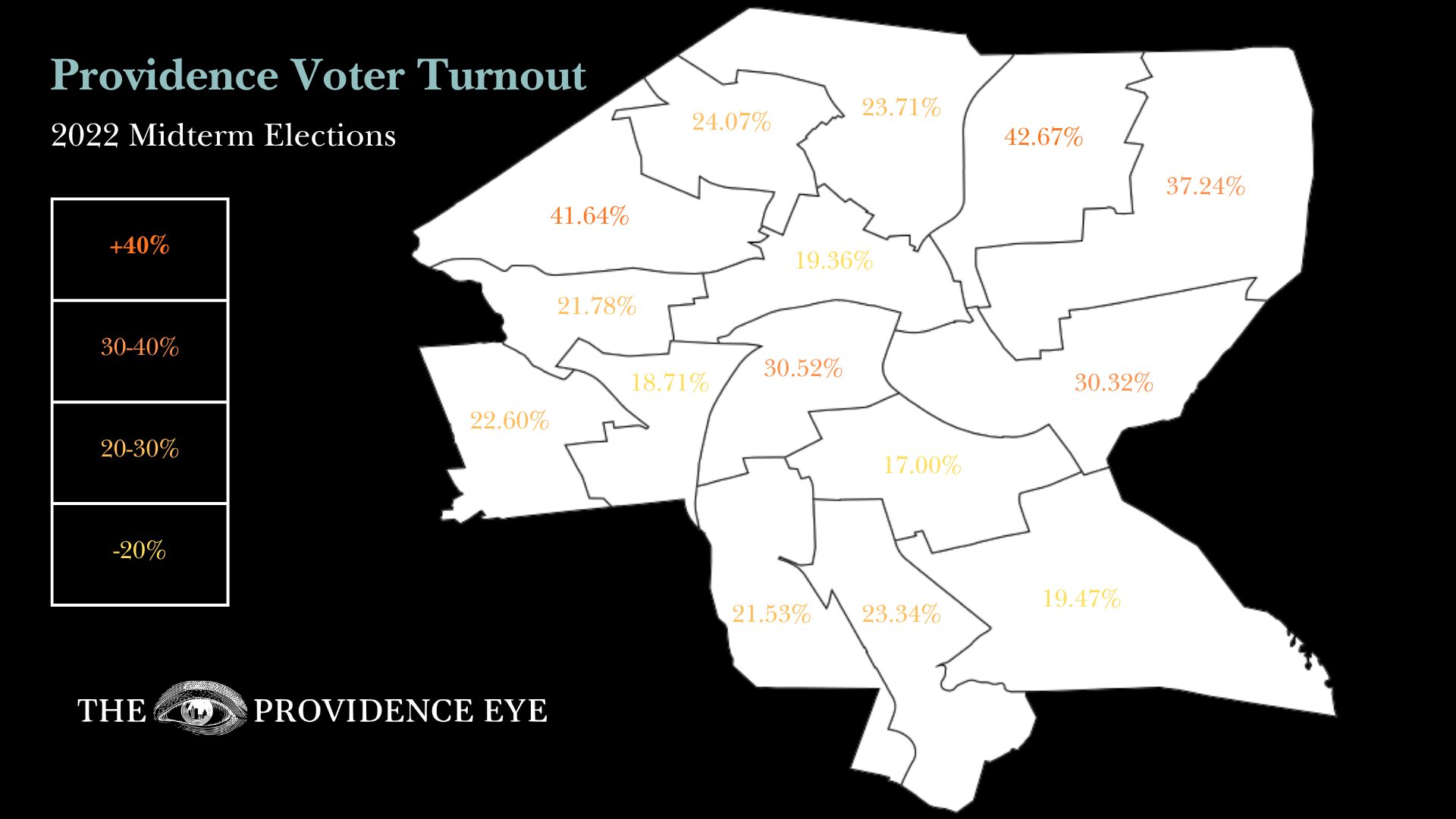
According to Census Data, 68% of the Providence voting age population are people of color, but only 65% of registered voters are people of color. While non-Hispanic white voters in Providence make up 32% of the general voting eligible population, they make up 35% of registered voters.
In Providence wards where over half of voters are people of color (4, 6, 7, 8, 9, 10, 11, 12 and 15), the average voter turnout in 2022 was 20.83%.
During the same election in wards where less than half of voters are people of color (1, 2, 3, 5, 13 and 14), average voter turnout was 34.39%.
Factors such as bias in voter ID laws, discretionary placement of polling places and limited access to translated voting materials all can create barriers to voting for people of color.
Older people tend to vote more as well. Only 8% of voters are between 18 and 24 years old. The largest age group of active voters in Providence are people aged 25 through 45, who make up 45% of all registered voters.
On the older end of the spectrum, 27% of voters are between the ages of 46 and 65. People over 65 years old represent 20% of all voters.
Marion said the young adult vote can change based on the ward. On the East Side, students at schools like Brown might register to vote in local elections, but at RISD, a third of those studying on campus are international students without U.S. citizenship and therefore cannot vote. At Rhode Island College, 85% of students commute to campus and might vote in their hometowns.
Even if someone wants to vote in Providence, the state’s deadline to register can be a significant barrier.
Rhode Island’s Voter Registration Barriers
“The biggest [structural barrier] to increased turnout in Rhode Island and Providence is the voter registration deadline,” said Marion.
In Massachusetts, voters can register 10 days before the election. In Connecticut, voters can register one week before election day. But in Rhode Island, the voter registration deadline is 30 days before elections—the maximum amount of time possible under federal law.
In Rhode Island, same-day registration is only for presidential elections and does not allow a voter to cast ballots for any state, local or other federal races.
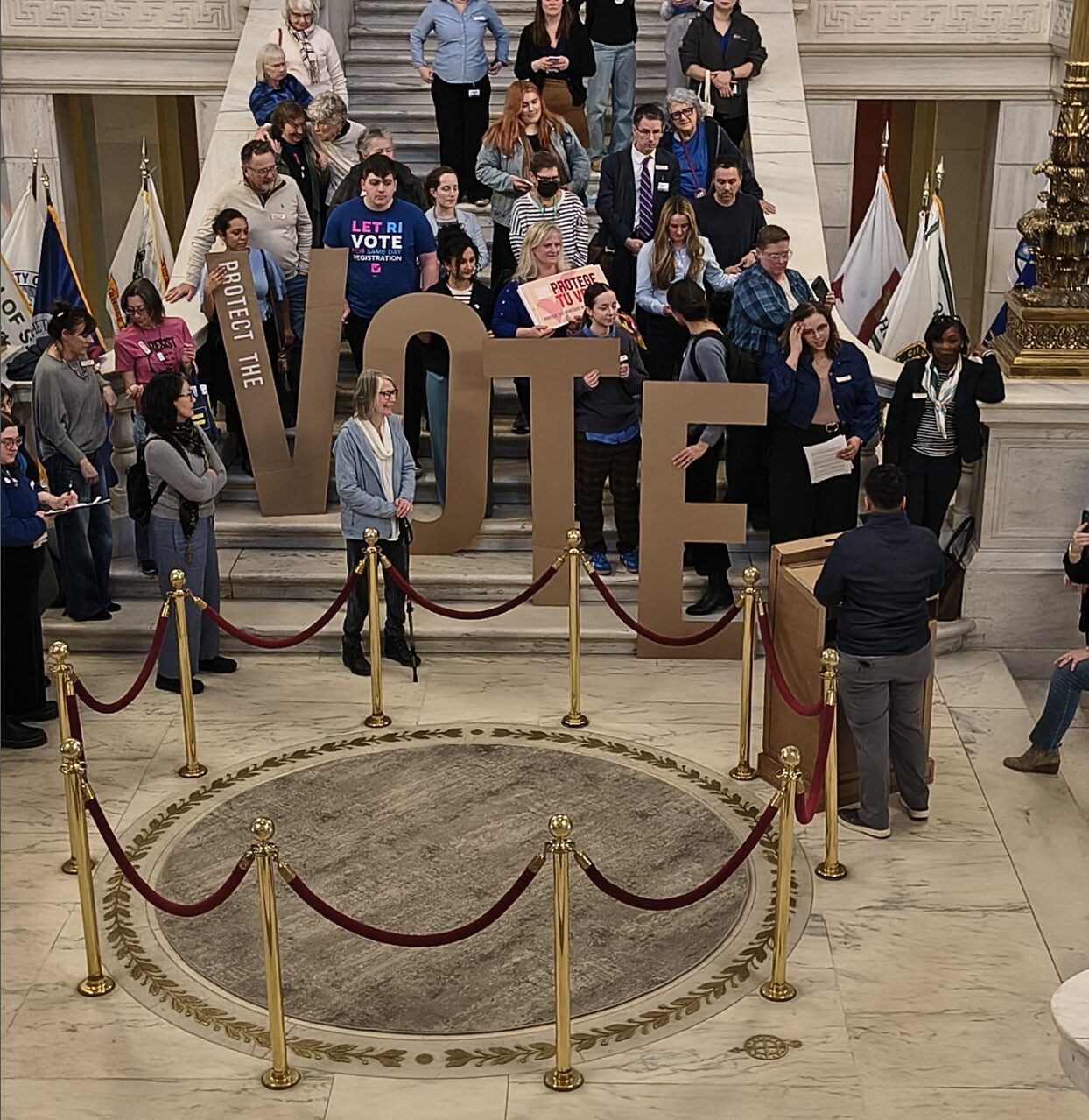
Rhode Island is one of only four states where the voter registration deadline is enshrined in the state’s constitution, making it extremely difficult to change the rule.
Voters can check if they are registered on the Secretary of State’s website by typing in their name and birthday. This election cycle will test the impact of Rhode Island’s first voter list maintenance initiative in the past 15 years.
In the fall, Secretary of State Gregg Amore’s office mailed letters to registered voters asking them to confirm they still live at that address. If a letter is returned undeliverable, that voter’s registration becomes inactive.
In Providence, there are nearly 22,000 voters with “inactive” registrations. The status does not remove the right to vote, but the voter would be required to fill out a new registration form and required to confirm their address the next time they attempt to cast a ballot.
Potential “Catastrophic” Federal Changes to Voting Policy
In the U.S. Congress, senators are debating the Safeguard American Voter Eligibility (SAVE) Act. The bill requires proof of citizenship for voter registration, a photo ID to cast a ballot and requires states to send voter rolls to a federal database operated by the Department of Homeland Security.
While Rhode Island already requires a photo ID to cast a ballot, the SAVE Act would add significant burdens to the millions of people without easy access to proof of citizenship such as a birth certificate or passport. These requirements will increase obstacles for those who cannot afford to purchase a passport, or people who have changed their names, such as married women and trans people. Even Rhode Island’s “Real ID” would not be sufficient to prove citizenship.
Marion said the impact would be “catastrophic.”
“If it went into effect this year, our election officials would be overwhelmed by people having to provide this documentary proof of citizenship before our primary in September,” said Marion. “There’s no money attached to the bill, so there’d be no additional resources, but a significant additional burden, both on the voters and the people who run our elections.”
President Donald Trump swore early in March he would not sign any other legislation until he signs the SAVE Act, but Democrats have sworn to block the measure. Although critics argue the voting changes are being pushed by Republicans to stop a midterm blowback, research shows that more than 21 million voters across party lines do not have access to documented proof of citizenship.
A local effort to preserve voting access is being heard at the State House.
The Rhode Island Voting Rights Act is meant to address the potential impacts of federal legislation. The bill would codify the protections of the landmark 1965 Voting Rights Act into state law.
This proposal would enshrine protections against voting policies that discriminate based on race or color, religion, sex, sexual orientation, gender identity or expression, age, country of origin or change in marital status.
“The RI VRA permits individuals or groups (as well as the Attorney General) to bring legal action against any jurisdiction that subjects voters to suppressive voting tactics or dilutes the power of their vote,” according to the Secretary of State’s office. “The RI VRA prohibits anyone from intimidating, deceiving, or obstructing a voter.”
Local advocates are pushing for the bill to pass this session.
“Our democracy is strongest when it reflects the full diversity of our communities,” said Kelly Nevins, CEO of Women’s Fund of Rhode Island. “As we see growing efforts nationally that could limit voter participation, Rhode Island can take a proactive step by codifying existing voter protections and ensuring that every eligible voter continues to have a clear, accessible path to the ballot.”
Correction: An earlier version of this article contained an incorrect figure for the number of ballots cast in Providence for 2018. The Providence Eye regrets this error.
Eric Halvarson is a City News Reporter for The Providence Eye.


Want to comment? Click!