





Sam Howard’s recent Readers Voices piece —“In Providence, the Blizzard Was a Reminder of the Power of People, Not Politicians”— offers a romanticized view of civic resilience that mistakes emergency improvisation for effective governance and celebrates mutual aid that sidesteps accountability.
While the volunteerism he describes is genuine and inspiring, the reality is that, in the days after the Blizzard of 2026, residents across the city—especially in what the City of PVD Consolidated Plan calls “areas of lower-income concentration” such as the North End, Central Providence (e.g., Olneyville, Hartford, and Valley) and South Providence that have historically suffered from municipal service gaps—were forced to dig out emergency vehicles and clear streets for days. And they weren’t happy about it. Mutual aid is indeed a testament to community strength. But it’s not a substitute for competent governance.
We agree with Howard’s assertion that snow is a force of nature that no mere human, including an elected official, can control. But he carries that argument over to other issues that are the very job of politicians and our government to address such as “crime rates and economic conditions.” If these issues are “out of their control,” then perhaps we should just dissolve the government’s responsibility for anything.
In short, the weather may be out of our control, but a city’s preparedness isn’t. Budgets reflect priorities, equipment levels reflect planning, and response times reflect management. Providence didn’t fail because it snowed; it failed because it wasn’t ready when it did. If that wasn’t the case, then why were the RI governor and other cities able to grapple with the blizzard more effectively?
According to the Providence Journal, even Gov. Dan McKee’s “usual critics didn’t seem to find fault with his overall handling of the storm,” which included a travel ban to make sure that residents would be home by the time snow started falling, “impossible-to-ignore alerts to every cell phone in the area, and calling in reinforcements from other states to help with the daunting cleanup process. Mike Raia, a former adviser to Gov. Gina Raimondo, said it seemed like the administration “finally learned a lesson from the Washington Bridge debacle: Don’t make promises you can’t keep, or set unattainable deadlines.”
New York City admittedly received less snow than Providence, with the same blizzard dropping over 20 inches of it there, compared to more than 35 here. But, still, it’s worth noting that NYC officials were able to reopen public schools the day after the storm, thanks to “thousands of education department staff…working around the clock to ensure schools [were] ready to reopen,” as the news outlet Chalkbeat reported. Streets and sidewalks near schools were cleared to ensure that buses could operate and children could safely attend in-person classes.
Moreover, public officials there and in other cities used the previous storm in January as incentive to plan for the February blizzard, which was predicted a week beforehand. In the D.C. region, for example, officials held a formal post-storm debrief after January’s snow event, acknowledging shortcomings and agreeing to coordinate better before the next storm, including clearer communication and planning of snow-hauling operations.
Although PVD officials may have held similar planning sessions out of public view, this wasn’t clearly communicated to residents who were—along with city council members—already frustrated by the slow, partial, or non-existent response when the city received 19 inches of snow in January. The mayor, in fact, was at a mayors’ conference in DC during the January storm. While this may have been necessary, optics matter: politicians should understand that if the trash and snow aren’t picked up, any grand vision they may have will be dead in the water, no matter how inspired or innovative.
History shows that voters hold leaders accountable for how they manage these kinds of crises. As noted by the Washington Post, Chicago Mayor Michael Bilandic lost his re-election bid amid outrage over a slow response to a 1979 blizzard; in Atlantic City, poor evacuation planning ahead of Hurricane Sandy led to Mayor Lorenzo Langford’s 2013 defeat; and New York Mayor John Lindsay’s failure to address a major storm in 1969 led to the deaths of 42 people and the loss of his reelection primary. (That storm has since been dubbed “the Lindsay Snowstorm.”)
We disagree with Howard’s assertion that residents are “unable to see the full scale of snow-clearing efforts” and “ill positioned to be able to judge a storm response beyond how it impacts them directly.” This sweeping assumption is an insult to the intelligence of many PVD residents, including these writers. Both of us have worked with a wide variety of government officials, community-based organizations, and national and international leaders. We are quite skilled in seeing the bigger picture: in this case, that snow plowing – or its absence – is a symptom of larger budgetary and planning problems.
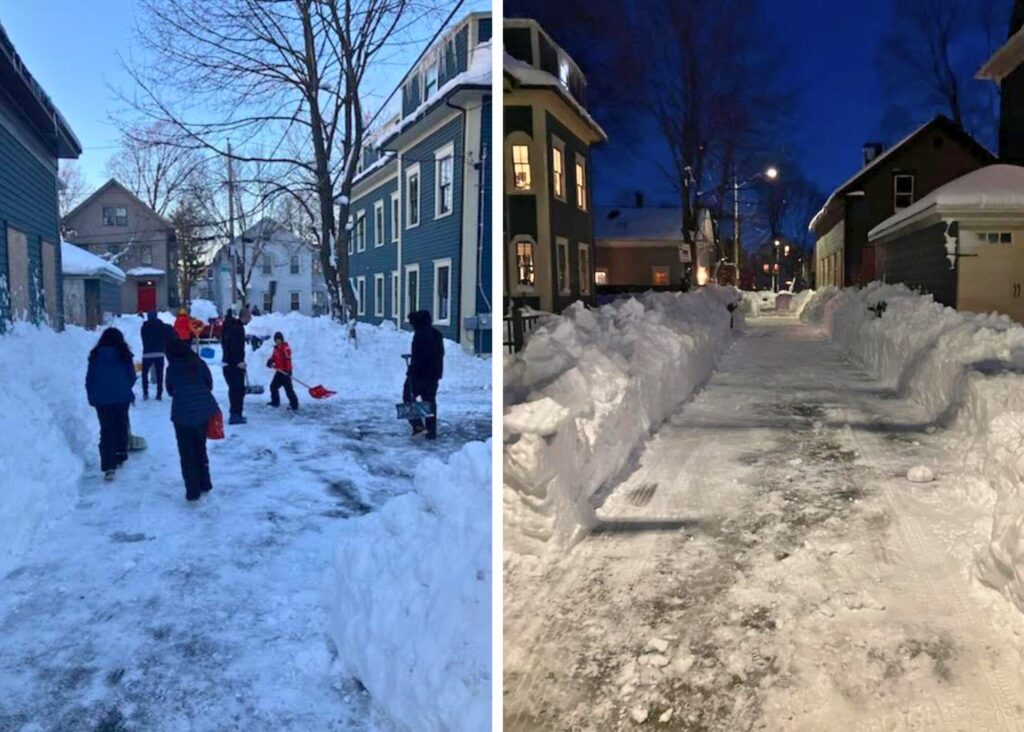
Lest we be accused of being civically disengaged, during the storm, we rallied our neighbors and did what Providence residents have always done. Trapped on our small street in the West End, we joined together and shoveled a passable path ourselves. Across the city, others formed “snow brigades,” cleared intersections, and dug out emergency vehicles. It was inspiring. It was generous. It was civic-minded.
But it was also necessary because the systems we fund and rely on did not show up. Yes, we believe in neighbors helping neighbors, in shared responsibility, in collective action.
But we also believe that there’s a difference between civic participation and civic substitution. When residents must repeatedly call for plows that never come, when children cannot get to school because residential streets remain impassable for days, when major thoroughfares are reduced to single scraped lanes, something more than weather is at work.
Community spirit is a strength. It should not be a workaround. Residents’ concerns deserved to be addressed and accountability systems strengthened to make sure they—rather than the snow on city streets—stick.
Cynthia M. Gibson is a nationally recognized leader and consultant who has worked with hundreds of US and international nonprofit and philanthropic institutions on strategy, program development, communications, and field-building initiatives across a wide variety of issues. She is a principal of Cynthesis Consulting.
Ann Wang has more than two decades of experience in global strategy, advocacy, communications, and nonprofit leadership. Her focus has been supporting leadership and global teams in strategic alignment and advancing their missions to drive policy and systems change across issue areas and geographies.


Want to comment? Click!