



The opening entry in the magisterial compendium begun in 1855 and now known as Bartlett’s Familiar Quotations is an excerpt from “The Song of the Harper,” a poem found in the tomb of the Egyptian king Intef. Dating to around 2600 BCE, the poem speaks of distance and desire. It describes the unbreachable boundary between our living selves and the knowledge of our nature and fate, which we reach for but never attain.
There is no one who can return from there,
To describe their nature, to describe their dissolution,
That he may still our desires,
Until we reach the place where they have gone.
And thus, in a wonderful example of irony, Bartlett’s begins its great gallop through words of wisdom and wit by telling us that the dead have nothing to say to the living. Our departed have sailed off to “there,” that unnameable foreign land, while we, the pitiable living, remain stranded behind, arms extended, a bundle of vain hopes and throttled desires, and incapable of making contact.
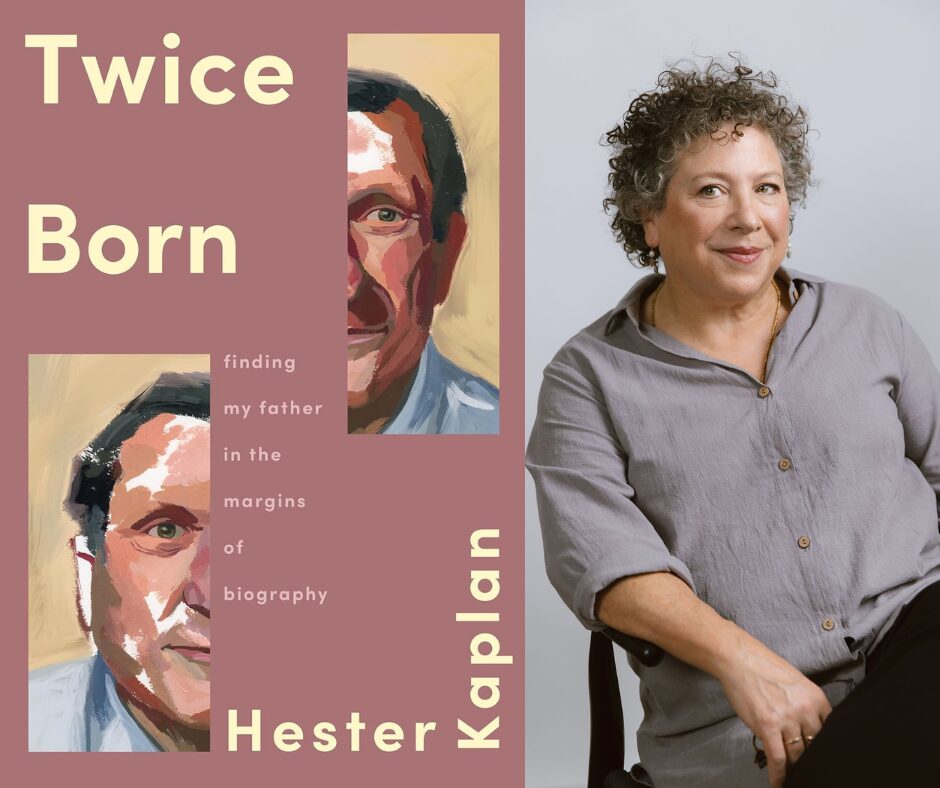
This is not to say we can’t try, however. A spirit of reaching into the beyond suffuses longtime Providence resident Hester Kaplan’s most recent book, her fifth to date, and her first book of nonfiction. Twice Born: Finding My Father in the Margins of Biography is a subtle and moving work of both biography and memoir in which the author tries to close the distance between herself and her aloof father, the acclaimed writer and editor Justin Kaplan, who died in 2014.
Best known as a biographer, he won the National Book Award and the Pulitzer Prize for his 1966 biography of Mark Twain before going on to write two other celebrated biographies—one of Lincoln Steffens and the other of Walt Whitman—a history of the Astor family, and serving twice as editor of Bartlett’s Familiar Quotations (which means he almost certainly would have known the elegiac excerpt above from “The Song of the Harper”). He was a man who communed with the writers who had shaped the American past. It could be said that “to describe their nature, to describe their dissolution” lay at the center of his life’s work.
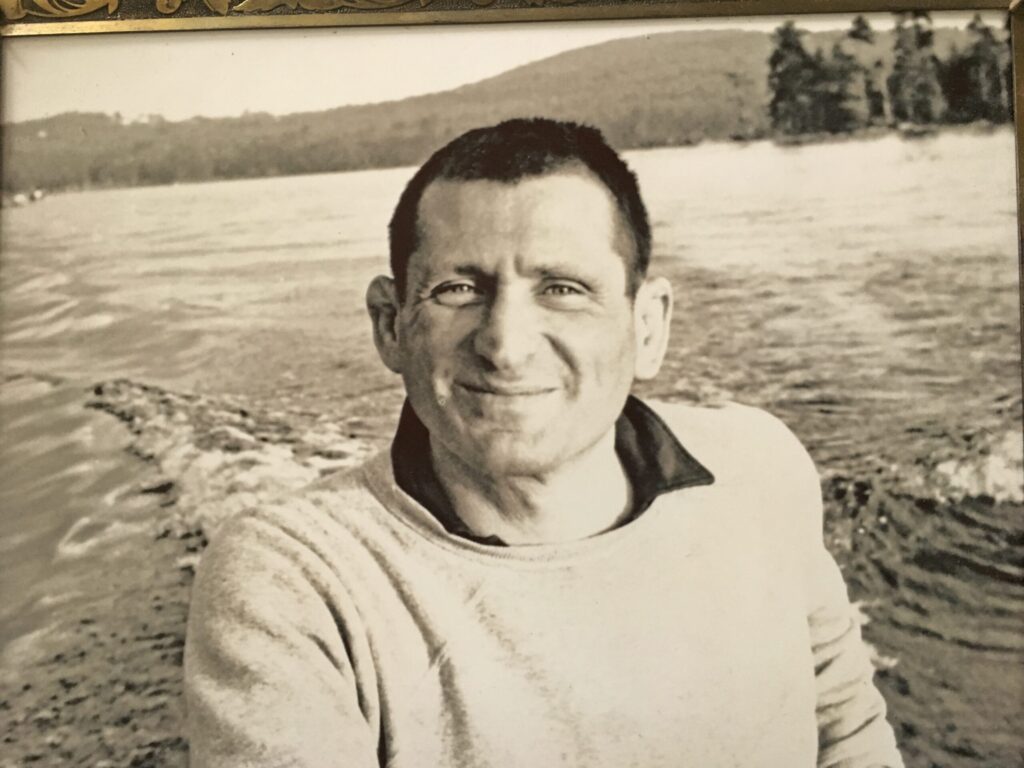
In Hester Kaplan’s search to understand her father, she proves both curious and intrepid. In the opening chapter, she and her husband visit the funeral home on the morning of her father’s cremation. When the time comes, she pushes the button that sets the flame alight. “There was a click, then a vacuum of silence, then a whoosh as the flames took shape.” She watches for a moment through a small metal hatch, as if “at a peep show.” A moment later, she lets the hatch swing closed. She has done what many of us would not be able to do. She has pushed her father’s ship from this familiar shore. He is “there” now, farther from her than he has been at any point in her life. And yet, the central premise of Twice Born is that it’s only now that she can set about getting to know him. It’s a sentiment that, if I had to guess, would likely have resonated with her biographer father, for whom souls that lived at a significant remove proved more knowable than those who shared the newspaper at breakfast.
It’s worth pointing out that both Kaplans would probably get itchy under the collar about my “setting sail” euphemism, as in the book’s early pages we are told that Kaplan the father instructed Kaplan the daughter that “People didn’t pass away. They didn’t kick the bucket or buy the farm or go to a better place: they died. They were dead.” She was to “use language precisely.” And in this vein, Twice Born is not “just” a memoir of a child of writers who had the (let’s admit it: remarkable) courage to become a writer herself, or a biography of an acclaimed biographer, but also an informal treatise on writing.
It’s full of the kind of juicy tidbits you’d get if you were a fly on a wall in a house full of writers on Francis Avenue (aka Professors’ Row) in Cambridge, Massachusetts in the 1960s and ’70s. Which is exactly the kind of house—drafty windows, check; peeling paint, check; towers of books under and on top of everything, check; all manner of famous writers wandering in and out and getting drunk and flirting and “braying” and “ogling,” and even helping the children with their homework, check—in which Hester grew up because her mother, Anne Bernays, is also a writer, and everyone they knew seems to have been a writer, too.
Those of us who grew up in or near Cambridge will recognize the disdain for material display, the obsession with intellectual achievement and its evil twin, status, at institutions (okay, one institution) of higher learning. Spoiler alert: the homework helper was John Updike. No spoilers, however, on who was getting drunk and flirting. You’ll have to read the book for that.
This would be a good point to disclose that I was once a fortunate recipient of Hester Kaplan’s wide-ranging knowledge about the world and craft of writing. After leaving my life as a historian, I enrolled in 2016 in one of her short story writing courses, for which I wrote an embarrassingly unimaginative piece of autobiographical writing. I was consequently relieved to learn, when reading Twice Born, that Kaplan’s first attempt to write about her father was a short story, aptly titled “The Biographer,” in which she searched for, although never quite found him.
In Twice Born she gives it another go, leaving fiction behind, and for the first time, taking up the mantle of her father’s vocation. With a keen and sympathetic eye, liberated of the need for a fictional apparatus, she examines the man whom she describes as “always present in my life but always hidden.” The central questions of biography—what formed a person, how to know with any certainty what it felt like to be them, and how they made their way in the world—motivate her investigation. In this pursuit, she is endowed with her own personal Virgil: by writing about his approach to these very questions, her father provided the playbook his daughter would need to examine him, one day, as subject. Justin Kaplan had written:
We tend to assume…that we are looking for a “core” in biography, a naked self, an unmoving mover…this core may be only the sum of many “presentations of self,” interactions, gestures, codes, and signifiers. The real me of creative people may be found only in the making of the work and in the work itself.
Hester Kaplan takes her father the biographer’s wisdom to heart. Two years after his death, and for the very first time, she cracks open Mr. Clemens and Mark Twain, the biography that established her father as a major American writer. It’s there, in her father’s observations and meditations, in his obsessions and his sensitivities, that she endeavors to find him. She knows that her pursuit will at times require her to intrude on his cherished privacy, or to assume an adversarial or inquisitorial position. Her way of negotiating these challenges—which could stop any sensitive biographer in their tracks, but especially so, a child writing about a parent—is to talk with him.
They argue and negotiate. He lectures her on what biography is really about and how it works. She talks back, sometimes with a clip in her voice, but other times patiently, or with a gentle, prodding humor. Sometimes, they compromise. In one touching scene, she refers to notes of his that she found in which he had written about his own father.
Those are my private notes, he says.
I found them in the red binder, the one you left for me to find, I remind him.
Here, the push and pull, the dance of distance and intimacy that is part and parcel of the parent and child relationship, and so too, of biographer and subject.
Like any mortal being, Hester Kaplan cannot bring her father back from the distant shore. But in Twice Born, she searches for him with such attention, with such an eye for his habits and an ear for his voice, that she very nearly reaches the place where he has gone. At the very least, she inhabits the space between, constructs a bridge of words, of stories, and shows us how the search to better know our departed, if conducted with such care, might actually bear fruit.
Alizah Holstein is the author of My Roman History (Viking Press, 2024). She lives with her family in Providence, RI.


Want to comment? Click!