

Providence’s World Cup Plans Ignore the Environment. I’m Worried About the Impact.

Editor’s Note: This article was originally published by ecoRI on June 2, 2026. It has been republished with permission.

Providence is not a World Cup host city. Gillette Stadium is in Foxborough, Mass., 25 miles north. But this summer Rhode Island is preparing for up to a million tourists, and Providence has volunteered for something close to host-city-scale impact — a FIFA Fan Zone at Waterplace Park running June 11 to July 19, with road closures downtown starting June 1, and an already jam-packed summer calendar that includes the Semiquincentennial, Pride, Juneteenth, the Day of Portugal Festival, and Puerto Rican Bay Fest. The city’s own Department of Art, Culture and Tourism director called it “jam-packed” and sounded the planning alarm months ago.

The economic preparation has been thorough. Security coordination with the Boston Police Department and FIFA. Hospitality workforce training. A tourism promotion nonprofit, Ocean State 2026, stood up by the governor. Mayor Smiley declared in March: “We’re ready.”

What the city did not prepare for is everything that isn’t economic.

There is no announced waste management plan for the Fan Zone. No composting infrastructure, no recycling beyond standard city bins, no protocol for vendor packaging and single-use plastics at an outdoor event running for nearly six weeks in July heat beside a tidal river.

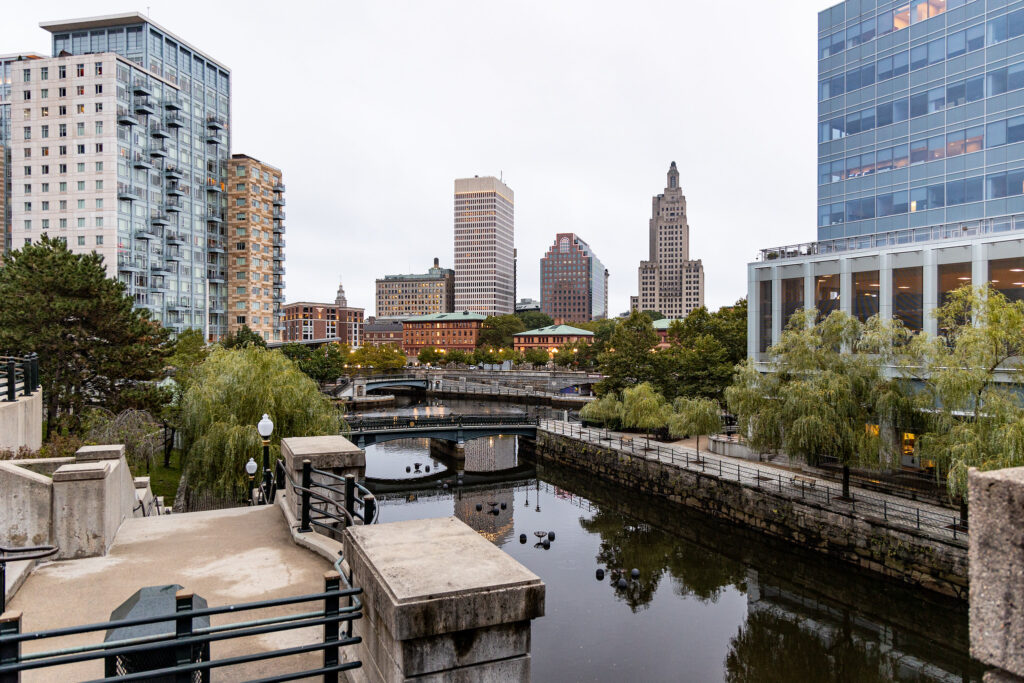
Waterplace Park is not a stadium with a loading dock and a sanitation crew. It is a riverfront park, and its drains run to the Providence River.

There is no announced air quality monitoring plan. Every fan traveling from Providence to Gillette is doing so by car or bus — Rhode Island treasurer James Diossa acknowledged he was “very shocked” that no train accommodations were arranged, and said he pushed hard and couldn’t get it done. Downtown Providence will absorb concentrated vehicle emissions on match days, in a city that already sits at the intersection of three major highway corridors, on the hottest weeks of summer. People with asthma in South Providence will feel this. Nobody will be counting.

There is no noise mitigation plan for a multi-week outdoor amplified sound event in a densely populated urban core. Providence’s noise enforcement system was already broken before this summer — documented, reported, unaddressed. The Fan Zone will not be shut down over a noise complaint. The political pressure to let it run will override everything. And when it’s over, the precedent will remain: the city ran a six-week amplified outdoor event with no noise management and no consequences, and every future promoter will know it.

Then there is the river itself.

The Providence River’s recovery is one of the city’s genuine civic achievements — decades of advocacy, investment, and restraint that transformed a neglected industrial waterway into a living corridor. Great blue herons fish its banks. Cormorants move through in migration. Kingfishers work the shallows. The Department of Environmental Management has previously closed the Lower Providence River due to water quality events triggered by runoff. Six weeks of crowd pressure, food vendor grease, and waste entering storm drains that outlet to the river is exactly the kind of diffuse contamination that triggers those closures — after the fact, when the damage is already done.

Other cities have learned this the hard way. At the 2024 Paris Olympics, France spent $1.5 billion cleaning up the Seine and still couldn’t keep it clean — the men’s triathlon was postponed after heavy rain overwhelmed the system and an athlete fell ill. Paris had a plan and the money to execute it. Providence has neither.

Providence is an Urban Bird Treaty City. That is not a ceremonial designation. It is a formal federal commitment, made in partnership with the U.S. Fish and Wildlife Service, the Audubon Society of Rhode Island, and DEM to protect migratory birds and their riverine habitat. June and July is peak season on the Providence River corridor — herons feeding, cormorants moving through, the full summer ecology of a waterway that took decades to restore. The city signed that treaty. Then it applied for a Fan Zone license at Waterplace with no wildlife impact assessment, no noise mitigation for nesting season, and apparently no one asked the question the treaty required them to ask.

The city’s full public commitment to the environment this summer is a single quote. Mayor Smiley, on the Fan Zone: “This is going to be the best party south of Foxboro.”

None of this is inevitable. Some of it may not happen. The herons may return. The river may come through the summer intact. The air quality data, if anyone collects it, may show nothing alarming.

But that is not the point.

The point is that these were foreseeable questions. There was time to ask them — months of planning, a nonprofit stood up specifically to manage Rhode Island’s World Cup preparation, a mayor who said “we’re ready” in March. The environmental checklist that Dallas ran as an actual host city, that FIFA’s own sustainability framework required of host cities, that the Urban Bird Treaty implicitly demanded of Providence — none of it was applied here.

This piece is a sign in the ground. The Fan Zone opens June 11. We will see what Providence was actually ready for.


Liam Freaney is a Providence resident and data analyst. He writes about civic policy at liamfreaney.substack.com.

Want to comment? Click!