





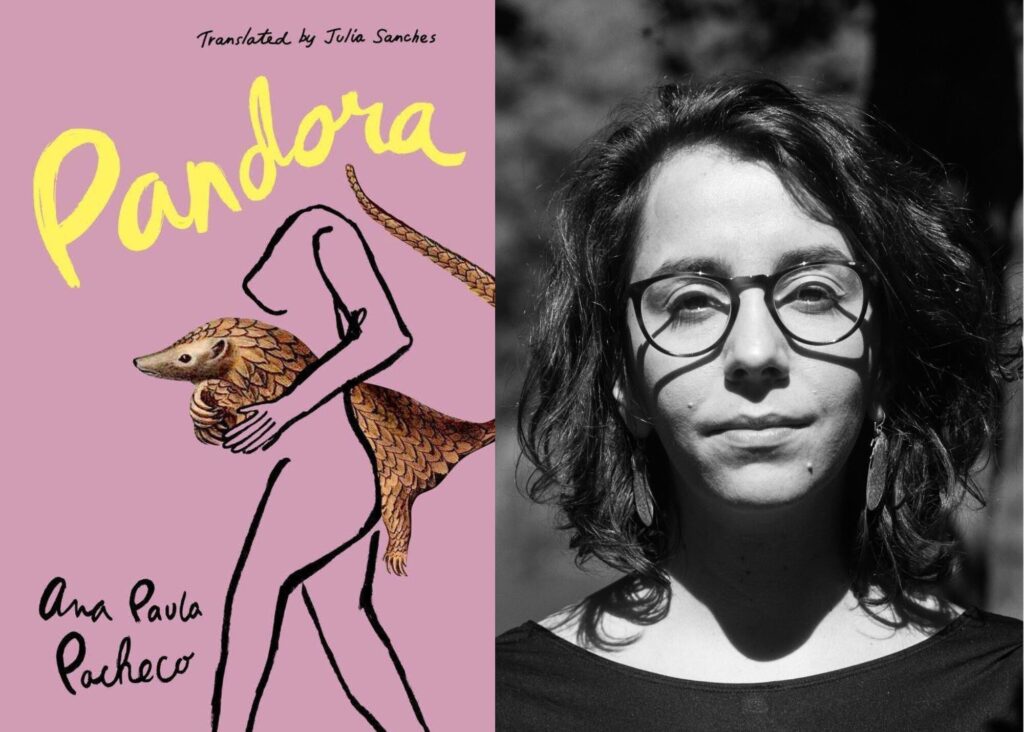
Written by the award-winning Brazilian fabulist Ana Paula Pacheco, energetically translated from the Portuguese by Julia Sanches, Pandora is a strange and unsettling novel. For this reason it is also perfectly attuned to its equally strange and unsettling subject: the surreal nature of life under lockdown during the Covid-19 pandemic.
Translators tend to keep a low profile, so you may not know that Sanches, who is a Providence resident, is also among the world’s most important translators from any language now working in English. She has translated more than thirty full-length works of imaginative literature from the Spanish, Portuguese and Catalan. Of these, two—Eva Balthasar’s Boulder (2020) and Gabriela Wiener’s Undiscovered (2024)—have been recent contenders for the prestigious International Booker Prize for translated literature.
The recognition is well earned. As a translator, Sanches opens doors onto important literary worlds that anglophone readers might otherwise miss. She keeps her finger on a distinct pulse, favoring storytellers who wade directly into the literary equivalent of mundane filth, who confront readers with the world’s absurdity, grossness, and violence, the grim scenes that other writers often prefer to step around. But the writers she translates do more than merely shock. Both Boulder and Undiscovered featured offbeat narrators gripped by strong and familiar pressures—becoming a mother, discovering a startling family history—and responding to them imperfectly, in ways that may be strange but are also thrillingly familiar in that strangeness.
Pandora stays true to this type. The narrator, a literature professor who has just lost her wife to Covid-19, is mired in grief after her wife’s death from the virus and is additionally maddened by the pressures of lockdown. Ana’s only connection to reality is through her computer screen, where she meets with her increasingly dismayed supervisor at her university. Soon enough, even that link, always tenuous, snaps entirely, and Ana spirals.
The longer she remains stuck inside, the more her internal world dominates her consciousness. Ana under lockdown becomes monstrous as she contends with her personal demons. Yet her outward appearance does not change. Instead she is joined by strange creatures: a needy pangolin and, later on, a giant bat.
It’s no coincidence that both bats and pangolins were also species of interest during the pandemic as animals that were suspected or known to be viral reservoirs. The problem was not so much the creatures themselves as the pressures of ever closer human proximity to them. Pacheco inverts this dynamic to great effect, allowing the pangolin and the bat to encroach on Ana’s habitat, to push on her boundaries and make a mess of her space. Ana’s apartment becomes carpeted with insects because the pangolin “likes his food fresh.” The giant bat exists in a cloud of parasites that infest the air and play havoc with Ana’s allergies. She rage-cleans constantly; when that doesn’t work, she escapes to the laundry room and disappears behind a cloud of bleach.
But what Ana resents and avoids, she also loves. Both the pangolin and the bat are targets of her erotic attention as well as her disgust. Indeed it is hard to know which feeling is in the ascendant most of the time, especially since she does all the cleaning up. “Animals are not what they used to be,” Ana says philosophically, making room in her imagination for what she does not really fit in her apartment despite her sometimes-passionate feelings to the contrary. “And no one is only what they are.”
Tracing Pandora’s efforts to keep a lid on the chaos, Pacheco captures the dull horror of the pandemic lockdown, the ways days and weeks could be subsumed with cleaning and cooking, only to be followed by more of the same, with every task completed through a haze of low-grade fear. But what if this was really the absurd part: those endless and dully anxious days were actually the good days, the days when no one you knew was in crisis, hungry or broke or facing eviction or dead or dying? For all the novel’s overt strangeness, these are the kinds of days captured in Pandora.
Which is not to say that Ana, the narrator, misunderstands the bigger picture. She may be utterly delusional about what’s happening in her apartment, but she is clear-eyed in her assessment of the forces that have trapped her there. Dreaming up a syllabus on “Recent Developments in Contemporary Brazilian Literature,” Ana, tongue firmly in cheek, asks her students to consider whether literature “is a personal investment.” “Throughout the semester,” she writes in her facile professor-ese, “we will linger on the nexus of artistic experience and historical process in order to grasp how subjectivity is represented in the context of the financialization of art and life.”
This wink at the reader—whose subjectivity while reading is caught in precisely the same financialized context—reveals Pacheco as a lively satirist. Much of the fun of Pandora derives from Pacheco’s keen sense of the absurd, particularly the absurdities that cropped up in the enforced close quarters of lockdown, where the most personal and intimate requirements of others had to be accommodated no matter how weird they were. Ana, for her part, copes in a familiar way, falling back on her formidable powers of denial. “We want nothing to do with herd immunity,” she declares of herself and the pangolin, convinced of the health-preserving power of her own virtue. “We’re clean and honest,” she continues, primly doubling down, “and we have happiness and good health, which can’t be bought.”
In addition to poking fun at the conspicuously virtuous, Pacheco also pokes fun at herself. Like her narrator, Pacheco is a literature professor, and she gives her narrator her own name. I imagine the similarities stop here—I would be surprised to learn that Pacheco is in fact married either to a pangolin or a seven-foot vampire bat—but her playful willingness to implicate herself in her addled protagonist’s phantasmagoria blunts the sharpness of the satire and invites the reader to view Ana generously. There are no good days for anyone in a global pandemic, Pacheco seems to suggest, but only days of horror that, in retrospect, come to seem like scenes out of myth.
Pandora by Ana Paula Pacheco, translated by Julia Sanches
Transit Books, November 11, 2025
156 pages
ISBN 9798893390224
$18.95
Diane Josefowicz is the author, most recently, of Guardians & Saints: Stories, published in October by Cornerstone Press. Her second novel, The Great Houses of Pill Hill, will be published by Soho Press in May, 2026. Learn more at: www.dianejosefowicz.com


Want to comment? Click!