



In Providence, a growing movement shows how climate action can begin in the lunch line. Through the Rhode Island School Recycling Project (RISRP)’s Get Food Smart program — supported by the City of Providence Office of Sustainability and the USDA — students across the city are leading the charge to prevent wasted food and build a more circular economy.
Throughout Rhode Island, schools send an estimated five million pounds of food to the landfill each year — nearly 28,000 pounds a day, including more than 4,000 pounds of unopened, edible food. Programs like Get Food Smart are designed to change that trajectory by pairing prevention, donation, and composting with student leadership.
Classrooms as Climate Labs
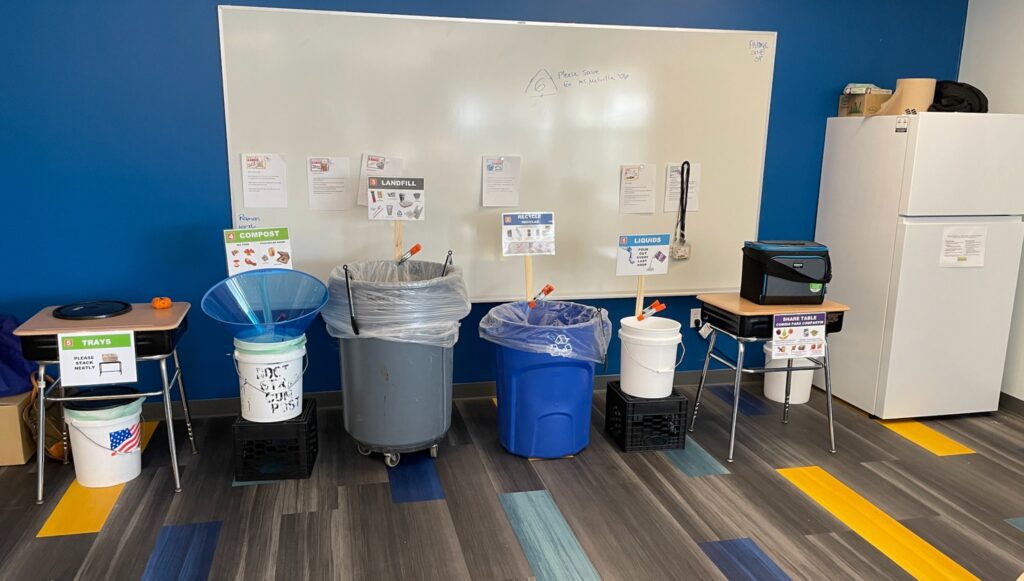
At Webster Avenue Elementary in Silver Lake, four times a year, students weigh every bag of food scraps, record the numbers, and calculate how their daily choices add up to measurable climate impact. What began as a cafeteria exercise has turned into hands-on science — connecting math, sustainability, and civic pride. These quarterly investigations are called food waste audits.
Where Get Food Smart has been implemented, schools have reduced cafeteria food scraps sent to the landfill by as much as 78%, demonstrating how simple measurement and student engagement can drive meaningful climate outcomes. One student at Webster said, in response to the program’s outcomes, “I didn’t know how much our school is helping the earth.”
At William D’Abate Elementary in Olneyville, that same curiosity sparked real results: In just a few months, the school diverted 13.6 tons of wasted food, donated nearly 6,000 pounds of edible, healthy food, and cut its carbon footprint by the equivalent of removing six cars from the road. Fifth graders proudly call themselves “Food Waste Rangers.” These students are not just learning about climate change, but also the role they can play in mitigating it.
During Compost Awareness Week, RISRP took this spirit citywide. Students at eight Providence schools received compost from Earth Care Farm and planted vegetables and herbs in new garden beds. At Leviton Dual Language School, a lucky raffle winning class got to visit the farm in person — exploring compost piles, meeting red wigglers, and learning how lunch scraps can become soil that grows new food.
A Citywide Effort with Measurable Results
Get Food Smart is currently active in more than 65 schools (including 16 in Providence) across 17 Rhode Island districts, reaching thousands of students each year. Collectively, participating Providence schools are poised to divert over 30,000 pounds of food annually through a combination of prevention, donation, and composting.
The program also helps schools meet state legal requirements. Rhode Island law requires large generators of food waste — including schools — to divert organic material from disposal. RISRP’s approach pairs those requirements with education and support, helping schools move beyond compliance toward waste prevention and food recovery.
Extending the Impact Beyond the Schoolyard
While RISRP brings hands-on learning to schools, the City’s waste reduction initiative also supports local businesses and institutions in preventing and diverting their own wasted food. Working with technical partners like CET — a nonprofit that helps schools, businesses, and communities reduce waste and emissions — businesses receive no-cost guidance to measure waste, donate surplus food, and compost what remains.
Hope & Main Downtown Makers Marketplace & Cafe now diverts about 4.9 tons of food material from disposal each year. With CET’s support, they established a program with Remix Organics and began collecting back-of-house food scraps in May 2024.
Across the city, schools, restaurants, and markets are discovering that waste prevention and diversion reduce emissions while strengthening the local food system by keeping resources in circulation.
Providence as a Model for Circular Communities
Providence’s approach — connecting classrooms, cafeterias, and commercial kitchens — demonstrates what’s possible when waste reduction becomes a shared civic goal. The city has invested in education, infrastructure, and technical assistance that make waste prevention easier for schools and businesses alike.
That momentum received a major boost in 2025, when the Rhode Island Foundation and 11th Hour Racing awarded $750,000 to RISRP to help expand cafeteria food waste recycling to every elementary school in the state. The investment positions Providence as both an early adopter and a testing ground for practices that could soon be standard statewide.
From fifth graders weighing apple cores to kitchen staff sorting scraps after lunch, food waste reduction is becoming part of daily life in Providence.
If you want to bring the Get Food Smart program to your school, contact the Rhode Island School Recycling Project at [email protected]
Samantha Salvatore is a Waste Reduction Consultant at CET, a regional environmental nonprofit helping people and businesses decarbonize through waste reduction, energy efficiency, and electrification. Based in Providence, she provides direct technical assistance to businesses and institutions, implementing or improving waste reduction programs with a focus on wasted food. She is a certified TRUE Zero Waste Advisor and holds an MBA from Suffolk University. You can find her playing ultimate frisbee in RI People’s Ultimate League and nurturing a budding hobby in film photography, enjoying the slower, more thoughtful process.
Emily Susan Gaylord is the Director of Communications and Market Evolution at CET, where she advances the organization’s mission to innovate, implement, and scale the environmental solutions that communities need to thrive. Her work centers on strategic storytelling, partnerships, and service development that support just and resilient climate solutions, with a particular focus on wasted food reduction and resource efficiency. Through her leadership, Emily helps translate data, policy, and on-the-ground practice into clear, actionable insights that enable businesses, institutions, and communities to reduce emissions, strengthen operations, and deliver measurable climate impact at scale.


Want to comment? Click!