






Providence has one of the lowest construction rates in the country in a state that had average low vacancy rates in 2023 of 3.7% for apartments and 0.3% for houses. In short, there are not enough homes and we are not building new ones fast enough.
Some housing advocates think fewer restrictions on ADUs might be one answer to the housing crisis. What’s an ADU, or Accessory Dwelling Unit? They are more commonly known as an “In-law Apartment” or a “Granny flat.” They are an independent living space with bathroom and kitchen, either attached or detached from the main dwelling.
In the past year, ADUs have been promoted as one more tool to create additional housing within the structures that already exist or with modest increases in new structures on existing, owner-occupied land. But, can they do enough to add much-needed housing?
Changes in state and city law
The State and City seem to think so. ADUs had been allowed in Providence but rules were restrictive. These units had to be used for related family members of the owner-occupant who were 62 years or older. But new state-wide updates signed into law by Governor McKee in July 2024 allowed one ADU “by right” on owner-occupied properties, regardless of the occupant’s relationship to the homeowner (“by right” means the homeowner does not need local zoning approval).
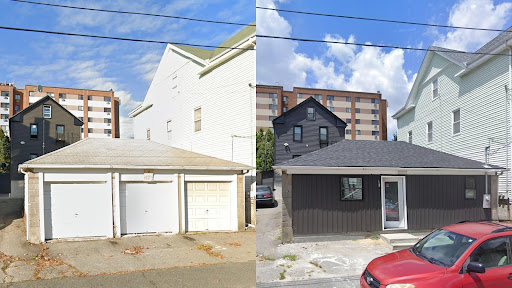
After state-wide passage, Providence had to amend its own restrictions. By November 2024, the City Planning Commission passed its new language which largely reflected state ADU definitions. The state law allows new detached ADUs only for properties on lots 20,000 square feet or more. Since Providence’s average lot is half that size, the City expects most ADUs to be constructed within existing dwellings or in accessory structures, like modified garages.
The updated Providence zoning laws define an ADU as the following:
- An ADU must be attached to a foundation and not be mobile
- An ADU may be inside an existing structure (i.e. attic or basement), in a permitted outbuilding, or in a detached garage
- An ADU is limited in size to whichever is less: 60% of the gross floor area of the principal dwelling, or 900 square feet for a studio or one bedroom or 1200 square feet for two bedrooms
- An ADU may not have more than two bedrooms
- An ADU may not be used for short-term rentals (AirBnB)
The city prepared a publication that guides interested homeowners through the regulations.
To Add an ADU, What are the Options?
Assume a homeowner has a modest single family home in Providence on the average lot size of around 5,000 square feet with a detached two-car garage measuring about 20 by 20 feet (total 400 square feet). It’s small, but it might work.
Make an ADU out of a Garage
A 400 square foot garage seems small, but the microlofts at The Arcade range from 225 to 450 square feet. The real problem is that most garages are just a structure — walls and a roof, maybe one meager electric service line, but no insulation, no heat, no water, and no sewer. To make it habitable requires a hefty investment of upgraded electric service, new water and sewer lines, as well as a new bathroom and kitchen, which are not cheap rooms to create.
All of this means architecture plans, building permits, and dealing with the city for water and sewer hook up. With construction rates as high as they are right now, the cost to rehab a garage like this could be as low as $60,000 or as high as $150,000 depending on the size and finish.
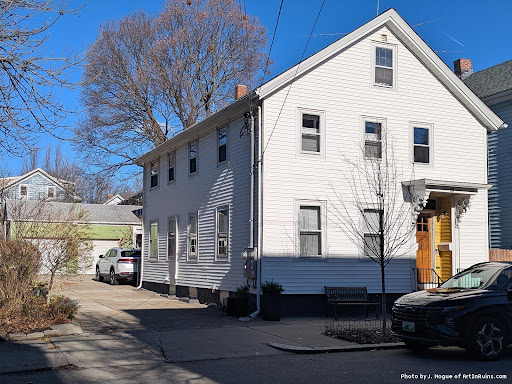
Rather than rehabbing the garage, it might be preferable to add an addition to the existing home.
Add New Space to a Home as an ADU
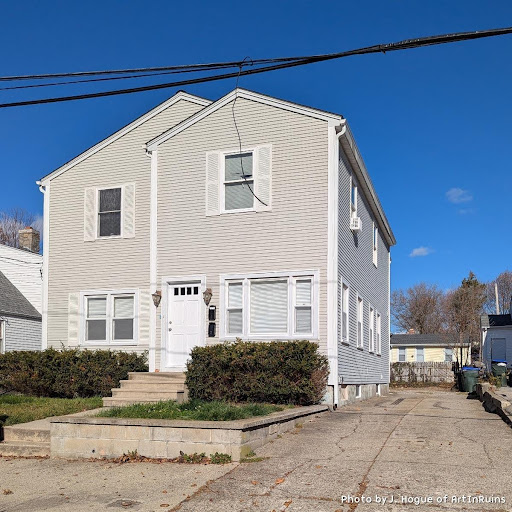
Adding a new living space ranges on the low end of $40,000 but that can jump up to $180,000 with premium finishes. Since it is in an existing home, the homeowner might be more tempted to match existing trim details and invest more in bathroom and kitchen countertops, floors, and fixtures.
There is also the complication of how large a new addition is allowed to be. Zoning does not exempt ADUs from lot-coverage requirements. The 5,000 sf lot already has a 2,000 sf home. In an R3 zone, the allowed maximum building coverage is 45%, which for a 5,000 sf lot means the limit is 2,250 sf. That only leaves 250 sf for an addition. In an R4 zone, the project has a better chance because the maximum coverage is 55%, which would allow a total building area of 2,750 sf, or a 750 sf addition. (More about zoning rules in a related story.)
If the coverage maximums would restrict the size of an ADU, the Zoning Board would have to grant a dimensional variance. Inevitably, that requires time and work, and potentially the expense of hiring professionals to testify, which is hassle not many homeowners are willing to go through.
Add an ADU to your basement or attic
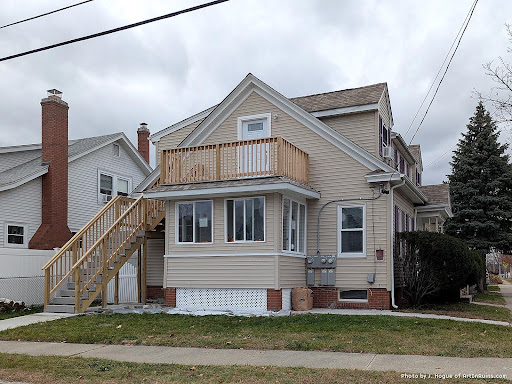
There’s one other option, and this is where Bob Azar, quoted in a piece last summer in the Providence Journal, expected most new ADUs to be located. If my elderly parents were actually coming to live with me, basement or attic stairs would probably not be the best thing for them, but since an ADU does not have to be used for a relative, the option of creating a unit for rental income is now possible under the new ordinance.
An ADU in an existing house without expanding the footprint is the least expensive option. Fewer houses may be able to take advantage of it, however, as attics need to have adequate ceiling height and basements need adequate height and moisture control. Similar to a garage, many of these spaces are actively used, even if just for storage. The owner needs to be ready to commit to having more people in the house and having less room to store their own belongings.
The same sources from 2025 place the cost of a basement or attic conversion at around $60,000 to $150,000 or more, depending on the square footage that is included. Unlike new additions or garages which tend to be smaller footprints, a basement’s size and how much of it is converted becomes a large factor in the overall cost.
Why Aren’t There More New ADUs?
Considering the costs involved and whether or not the investment will add value to the home, it’s easy to see the shortcomings of ADUs. They are expensive to build, even if they are added to an existing structure.
In fact, since 2024, the City of Providence has received about 100 ADU permit applications with only nine completed projects so far. Six of the nine were within an existing dwelling, two were garage conversions, and one was a second floor addition to a detached garage.
But, one could argue, the changes in the law are only a year old and construction of any kind is expensive right now. The fact that there have been nine new housing units added because of this relatively new and potentially unknown allowance is encouraging.
What can be done to encourage more ADUs?
For one, more attention can be paid to the fact that these kinds of units are now allowed. While the colloquial terms of “In-law apartment” or “Granny-flat” conjure images of living with one’s parents, that is no longer the case. If a home can accommodate such a space, it can become an extra rental unit for a friend or stranger.
Meanwhile, there are more changes that could be made to speed up the creation of ADUs in Providence. For example, why not allow short-term rentals in such spaces? If ADUs allowed student rentals (does 8 months qualify as short term rental?) would that take pressure off existing apartments?
Furthermore, the City Plan Commission could adjust regulations to allow more lot coverage if an ADU was added to a site. If the City wants to promote more density with ADUs, they could allow existing lots to actually become denser. Further, there could be more flexibility when adding a detached ADU on a small, otherwise unbuildable lot that is currently used for parking.
If the City wants to encourage more density and more housing without drastically changing the character of existing neighborhoods, more attention and flexibility could be considered for ADUs. They are not the single answer to the housing shortage, but, despite the costs, they are still a useful tool to wield.
Special thanks to Ian Baldwin, Principal at New Model Architecture, and Michaela Antunes, Director of Communications for Economic Development, City of Providence, for consulting on this piece. For more information about ADU, see the Providence Preservation Society’s article from October 2024.
J. Hogue is a digital designer and strategist by day and amateur photographer and historian on nights and weekends. He donates his time to maintain ArtInRuins.com, which documents the architectural changes of over 400 properties in and around Providence.


Want to comment? Click!