


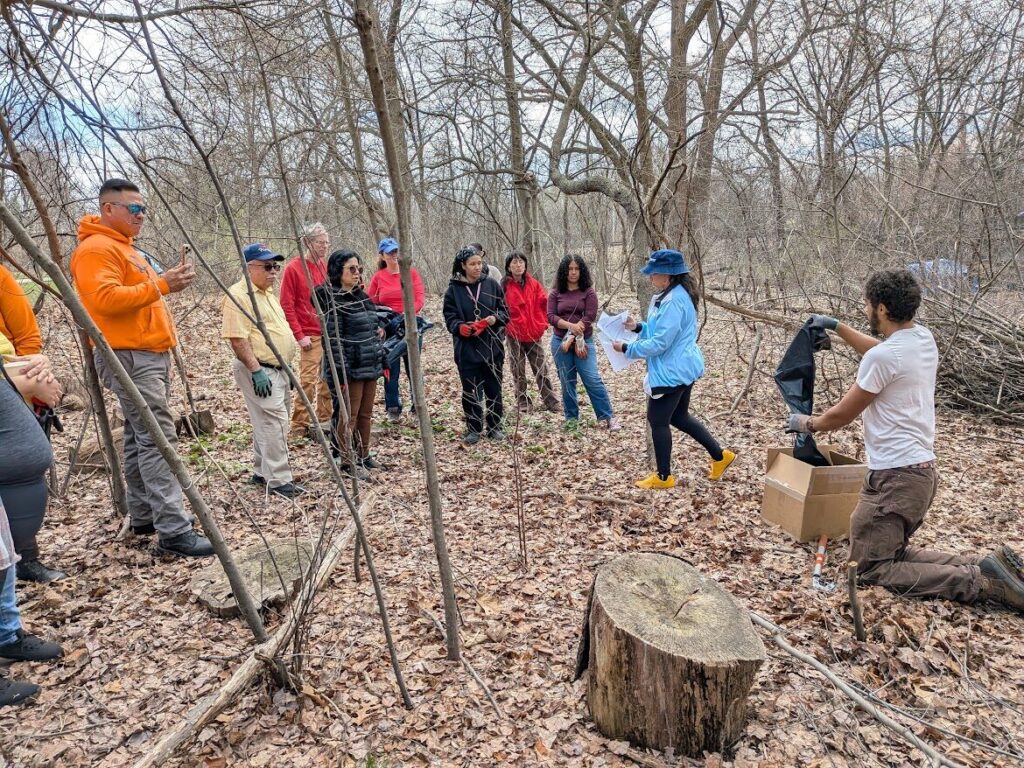
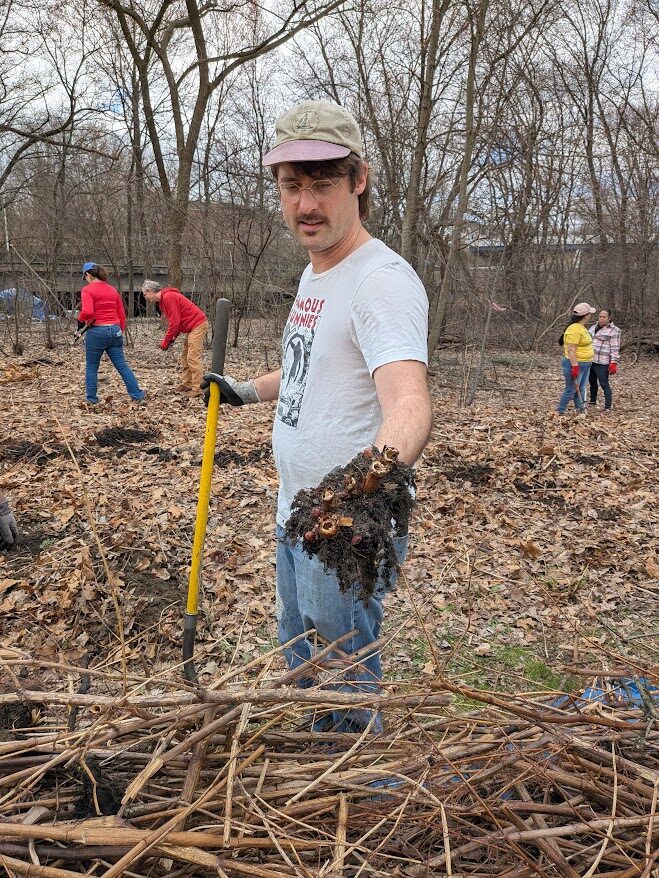
Micah, one of the youngest in a group of “Forest Care Days” volunteers at the Woonasquatucket Greenway in early April, thinks finding and digging up invasive Japanese knotweed rhizomes from the soil is easy—with her shovel, she swiftly scoops out one, then two rhizomes with their distinctive brown and pink spear-like shoots.
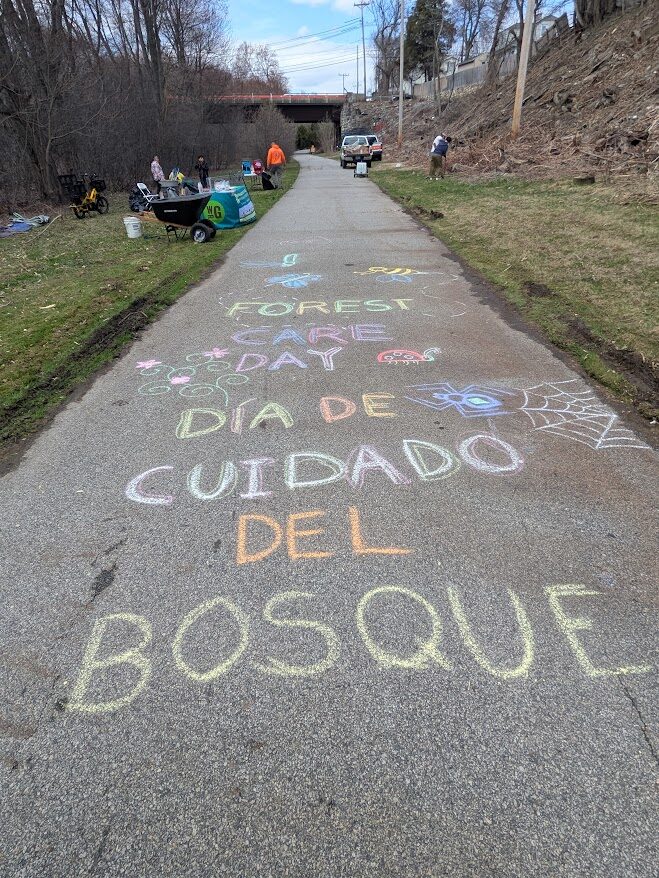
Hosted by the Woonasquatucket River Watershed Council (WRWC), volunteers spent the morning sprucing up an area along the Greenway by clearing out knotweed, picking up litter, and trimming back Buckthorn to make space for red maple tree growth. Over the winter, knotweed’s tubelike stems become wooden and hollow. After cutting the stems back and collecting them in a large pile, volunteers trimmed and stacked them in handmade bee hotels to provide habitat for Mason bees.
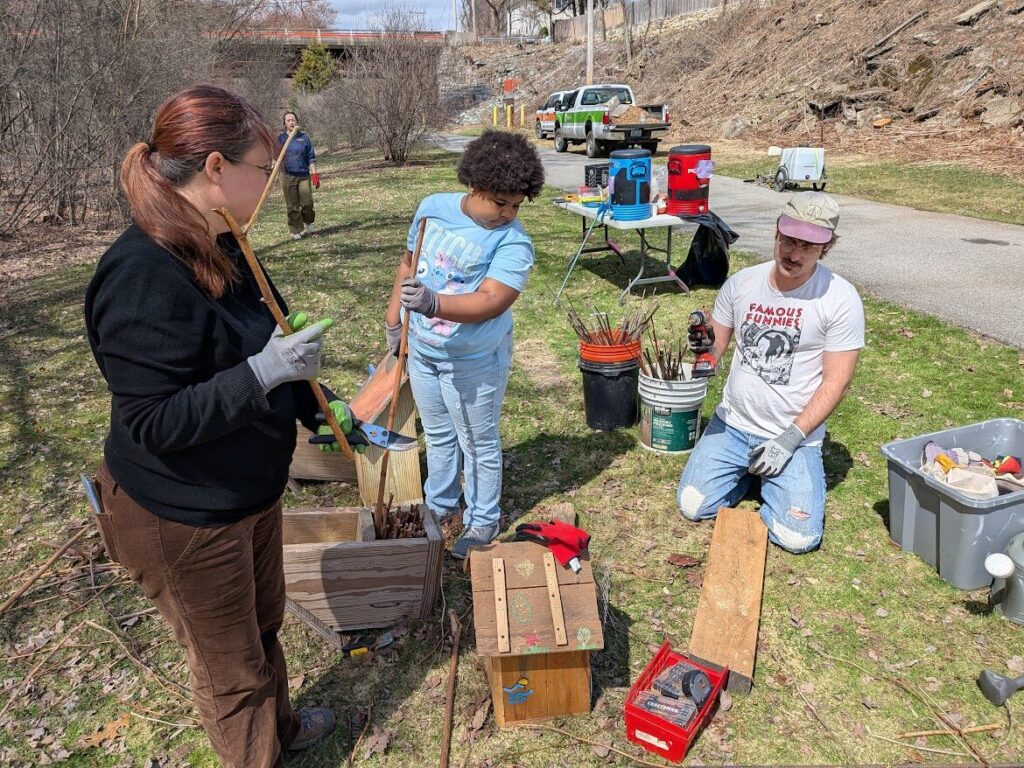
Andrew deLisle, WRWC Special Projects Supervisor, explained the next step for the cleared out knotweed patch was to place a clear plastic tarp over the area to discourage it from growing. “It will probably come back,” deLisle explained, noting that knotweed is notoriously hard to eliminate, “but this is still a critical step in forest management by reducing invasives and supporting native plants and biodiversity.”
Forest Care Days are part of a series of events hosted by WRWC, where volunteers learn to care for Providence’s urban woodland every first Saturday of the month from April through late fall. After a long, frigid, and snowy winter, community members were enthused to spend time outdoors, getting the Greenway’s maple grove set up for success. “I often walk along the Woonasquatucket Greenway and notice it can get littered, so I wanted to get into nature and help clean it up,” said Marcia, a new volunteer who lives in North Providence.
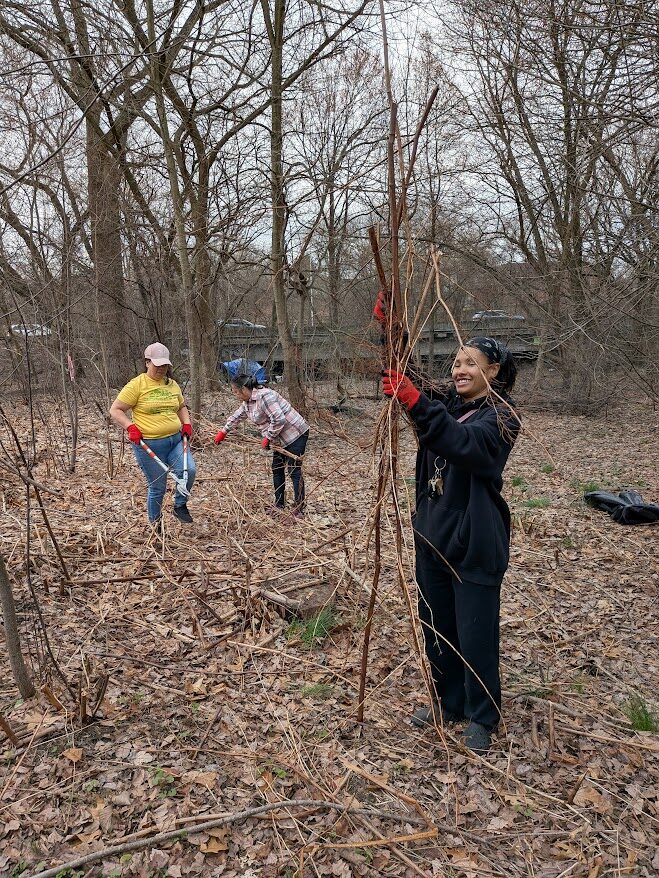
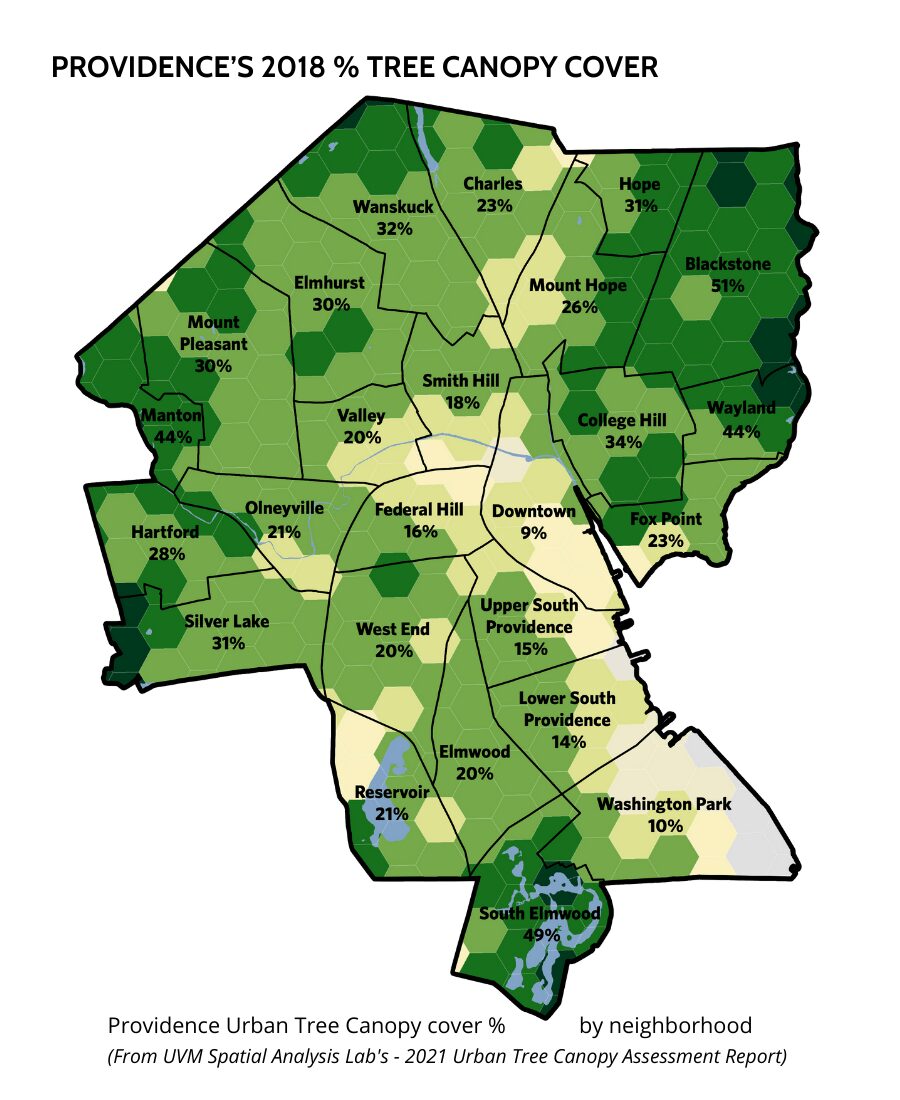
April’s Forest Care Day was also the second Nuestros Bosques (“Our Forests” in Spanish) workday event. Nuestros Bosques is a program aiming to increase urban tree canopy through community engagement by providing training and paid tree care opportunities for adults living in neighborhoods such as Olneyville, Manton, Mount Pleasant, and the Valley. According to the Tree Equity Score analyzer, these areas in Providence have the lowest amount of tree cover.
“The impetus for starting the program came from a recognition that taking care of trees requires a lot more effort than staff resources alone can provide,” says Layla Farahbakhsh, WRWC Nuestros Bosques Program Coordinator. “Nuestros Bosques harnesses community interest with training and resources through a grant from the Hispanic Access Foundation, which is supported by the USDA Forest Service.”
Nuestros Bosques programs are found throughout the U.S. and Puerto Rico. The program, which launched in 2025 in Providence, had a bumpy start. Earlier in 2025, the Trump administration froze funding that was promised for certain community projects, including the $1 million grant for Nuestros Bosques and greenway expansion along the Woonasquatucket River. WRWC and other non-profit partners sued the administration in Woonasquatucket et al. v. Department of Agriculture and won in federal court in April 2025, which subsequently unfroze the funds.
“The Nuestros Bosques grant has three main areas of focus,” explained Kuno Haimbodi, WRWC River Ranger Tree Steward who also supports Nuestros Bosques. “The first is building Miyawaki forests in the city, second is fostering resident leadership, and last, maintaining and planting public trees.” Haimbodi continued, “Miyawaki forests is the practice of building forest cover quickly on land that has been degraded. It starts with getting the soil healthy, and then planting easily adaptable trees like oaks and maples as densely as possible.”
Nuestros Bosques participants can earn stipends through workdays, which consist of tree planting, stewardship events, and other urban forestry projects such as the Forest Care Days along the Greenway. Much of the work happens along the Woonasquatucket River, aimed at protecting streambanks, enriching native ecosystems, and providing shade for neighborhoods.
“I love going outside and doing projects like this,” said one Nuestros Bosques participant Tarriana. “I have a one-year-old son and I am excited to teach him how to care for and appreciate nature.”
Although focused primarily on the Greenway, Nuestros Bosques is expanding its footprint further into low canopy neighborhoods and public properties. “We have been building relationships with the Providence Housing Authority and are aiming to take care of street trees and trees in state-owned sites as well,” said Haimbodi.
Farahbakhsh also highlighted that Nuestros Bosques is closely linked with other organizations focused on improving Providence’s tree canopy, such as Providence Neighborhood Planting Program (PNPP). In fact, PNPP and WRWC’s work are part of a larger effort supporting the “PVD Tree Plan,” a strategy and community-led initiative to build a healthy, equitable, and resilient urban forest in Providence. Although Providence’s tree cover has increased from 18% in 1999 to 27% in 2018, tree inequity in the city persists.
In order to build a more environmentally equitable city ready to adapt to climate change, the plan recommends increasing total tree canopy in low canopy focus areas from 16% to at least 25%. Community-led programs like Nuestros Bosques are part of critical efforts to support that goal.
“Trees are vital to our communities—they beautify our streets, provide fruit for neighbors, and enhance our overall quality of life,” said Haimbodi and Farahbakhsh. Through Nuestros Bosques and other initiatives nurturing Providence’s trees and urban woodland, they hope the city can be more prepared to adapt to a changing climate while fostering beauty and joy in all neighborhoods.
To learn more about Nuestros Bosques or get involved with Forest Care Days and other events along the Woonasquatucket Greenway, visit https://wrwc.org/events/
To learn about Providence Neighborhood Planting Program, where residents can organize tree plantings and learn how to take care of urban street trees through its tree steward program, visit https://pnpp.org/
Correction: An earlier version of this article contained an error in Woonasquatucket River Watershed Council’s name. The Providence Eye regrets the error.
Amber Ma lives on the west end of Providence with her husband and two cats. She loves gardening, shopping at farmers markets, and cooking with local and homegrown ingredients. She is also passionate about transit, sustainability, and pollinators. She is a volunteer at the Community Cat Center in Johnston. She and her husband went car-free in 2022 and are always exploring the city by foot, bike, or bus.
¿Quieres dejar un comentario? ¡Haz clic!