





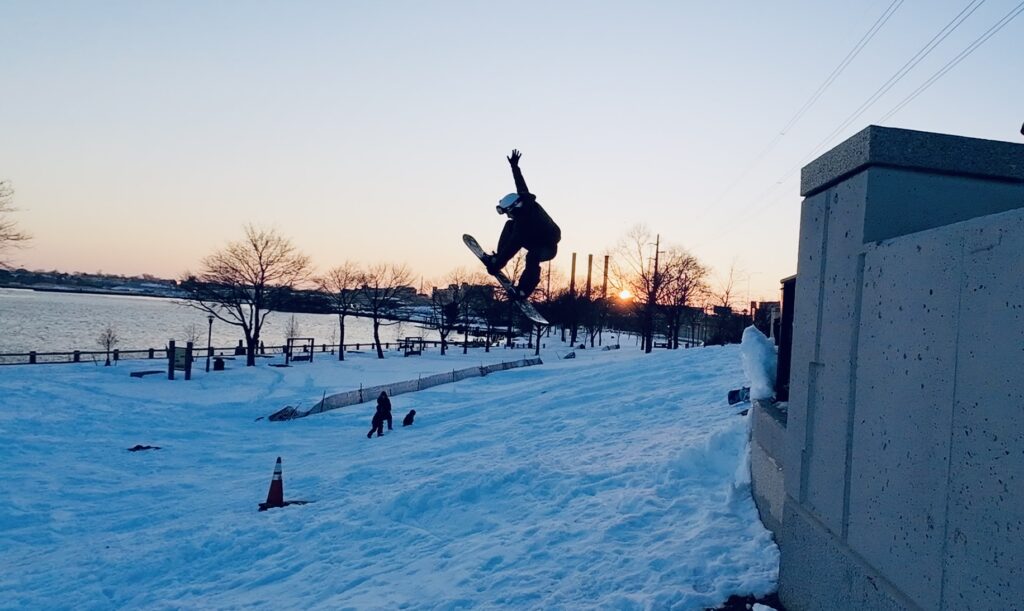
The snowboarder clicks his boots into their bindings. He adjusts his bulbous helmet. Half his snowsuit glows orange in the fading sunlight. Kids back away, giving the stranger room. He nudges his board forward, until it tips down the icy slope. He picks up speed, down one concrete incline, then a second. The boarder shoots across a flat walkway, then rockets over a jump.
He flies. Crouches into his board. Extends one arm. For two balletic seconds, he’s airborne, sailing across the Providence skyline. Then he smashes into snow, loses his balance, and flops onto his back. Powder puffs around him. He hobbles upright and curses, annoyed not to have stuck the landing. But every kid gapes in wonder. Every parent grins. Some clap and whoop. This guy has done what none of us would dare to do: he’s launched off a three-foot ramp, right in the middle of India Point Park.
All week, after the storm, I’ve seen skiers in the streets, snowboarders on College Hill, and strangers snow-shoeing down sidewalks. To my delight, the Blizzard of 2026 has transformed Providence into an alpine resort. Neighbors skate-ski in the middle of motorways, where traffic has vanished and all lanes are buried beneath lumpy white. Passersby wear goggles and balaclavas, gaters and toques. They hobble up slopes in heavy plastic boots, pausing in the middle of their ascent to admire the muted lights of the State House dome.
I grew up in Vermont, and skiing is as natural to me as walking. Yet I haven’t owned a pair of skis in years, and I envy all these winter sportsters. The concept of skiing goes back at least 5,000 years, long before fancy chalets and après-ski brewpubs. Prehistoric Scandinavians used wood planks for simple transportation. When the snow is thick enough, gliding is just easier than trudging.
After the blizzard, this wisdom surfaced: The skies dumped a record-breaking 37.9 inches. Driving was briefly banned. Cars turned into frozen mounds. In the absence of traffic – or anything better to do – skiers and snowboarders seized their chance. Unplowed avenues became ski trails. Skiers could go anywhere. Traffic signals and road signs meant nothing, if only for a few hours.
After three days of cancelled school, my 12-year-old son and I are stir-crazy, so I take him sledding in India Point Park. Friends have suggested this spot, and we’re eager to try it. I didn’t realize the park has such a decent hill, located at the foot of the pedestrian bridge. By the time we arrive, the grassy slope is scored with sled runs. Children slide their way down, as do students and parents.
Then I see it: a jump, built out of packed snow. It rises up to my waist, the surface polished and glistening. The incline stands at the bottom of the bridge’s long staircase, which feeds into the park. The smooth divider between stairs has been molded into a snow-covered chute. When the first snowboarder shows up, I flag him down.
“Is this for real?”
He laughs. “Oh, yeah. We were doing jumps all yesterday.”
“I thought it was a joke.”
“Oh, no, man. It’s no joke.”
As the sun sets, boarders line up at the top. One by one, they skid down the chute and launch into the air. In the moment, it’s a curiosity, a diversion, a stunt. I have no idea, watching them, how much attention this little jump will get in the coming days. Videos will circulate on my feed. The Providence Journal will post drone shots to its Instagram account. Friends in other cities will send me links, demanding, “HAVE YOU SEEN THIS?!” Or even: “IS THIS YOU?!”
I delight in this, until the sun sets, and the temperature drops, and it’s time to go home. I cook a warm meal, take a hot shower, and relax beneath blankets. Then I take out my laptop, scroll through ski listings on Ebay, and dream about next winter.
Robert Isenberg is a writer and filmmaker based in Providence. His latest book is Mile Markers: Essays on Cycling, and he produces the YouTube series You Are Here.


Want to comment? Click!