



Beginning in the late 1600s, enslaved people lived in Rhode Island and their enslavers profited from their stolen labor, as well as the wider economy of the Transatlantic Slave Trade. However, according to research compiled by the nonprofit group Stages of Freedom, Rhode Island may have also played a role aiding captives who attempted to escape to freedom.
“The Underground Railroad in Rhode Island” claims several sites in Providence, such as the former site of the Bethel AME Church, harbored people seeking freedom from slavery. While other historians cast doubt on the evidence behind these claims, Stages of Freedom hopes this effort will launch further investigation into archives of anti-slavery activity in Rhode Island.
Uncovering Anti-Slavery Activism in Rhode Island
The National Park Service operates an interactive online map of the Underground Railroad, a term that describes the general efforts of enslaved people to gain freedom. The Network to Freedom map displays over 800 locations with verifiable connections to Underground Railroad, but the map has no safehouses listed in Rhode Island.
“We were actually approached by the National Park Service to at least get one listed,” said Stages of Freedom Program Director Robb Dimmick. “The money that was promised—of course, under Trump—was rescinded. So, we just decided to undertake the project on our own.”
Stages of Freedom said NPS approached them in 2022, but did not provide documentation of the award by the time of publication. The NPS said in a statement to The Providence Eye that the Network to Freedom offers grants to preserve and interpret Underground Railroad history every year.
“For Fiscal Year 2024, Stages of Freedom applied for a research grant for their project, ‘Unearthing Underground Railroad Sites in Rhode Island,’” said NPS. “While the NTF staff recognized the project’s potential, it was ultimately not selected in what was a highly competitive application cycle.”
After conducting their own fundraising, Stages of Freedom hired Brown University student Owen Hwang in 2025 to compile the bibliography of research on the places, leaders and activists who organized against slavery in Rhode Island. Hwang said combing through archives, reading and speaking with other historians about the topic was “tricky.”
“There’s certainly very little that survives from people escaping from enslavement themselves,” said Hwang, who is now studying law at Harvard University. Hwang points out that many preserved documents come from wealthy and white groups in Rhode Island, meaning the stories of people of color are often forgotten. “We try to center those voices at Stages. It involves careful work—reading between the lines and looking at a lot of different documents together and seeing what sort of picture it paints.”
Stages of Freedom released the bibliography on March 11, 2026, with over 70 sources. The wide variety of sources include a first-person account published in The Providence Journal in 1918 of a teenager named Isaac Cundall aiding a slave in Ashaway. The Newport Historical Society says Frederick Douglass passed through Newport while escaping enslavement. However, local historian and researcher Traci Picard said there may not be sufficient proof that a network was helping people pass through Rhode Island’s capital city.
“The Underground Railroad was a pretty minor part of the overall abolitionist picture of Providence,” says Picard, who leads free walking tours about slavery and its legacy in Providence. Picard notes there were active abolitionists in the area, but only a small fraction of enslaved people escaped to freedom in the U.S. “I have not ever found evidence of significant long-term underground railroad action in the city of Providence.”
Picard said the first enslaved people in colonial Rhode Island were Narragansett captured after King Philip’s War in the 1670s, but the first slaving voyage ship arrived in Newport in 1696. Soon after, Rhode Island shipping magnates trafficked enslaved people as well as the raw materials produced by enslaved labor: molasses, sugar cane and distilled rum. By 1750, Rhode Island had the highest per-capita number of enslaved people in New England—about 10% of people in Newport, Bristol and Providence. According to “Dark Work: The Business of Slavery in Rhode Island” by Christy Clark-Pujara, more than 60% of all slave ships from North America left from Rhode Island.
In 1793, Moses Brown and Samuel Slater launched the industrial revolution processing textiles at Slater Mill in Pawtucket. This process depended on the harvest of cotton by enslaved people, which was in-turn used to create clothing for slaves living on plantations in the South.
“The Rhode Island economy was based, beginning in the early 1700s, on the business of slavery,” said Picard. “We built the colony, and then state, on various forms of entanglement with slavery.”
A Short Tour of Underground Railroad Sites in Providence
Stages of Freedom argues that the same port infrastructure that facilitated the slave trade also brought freedom seekers to New England. After ships from the South traveled up to Newport or Providence, Black sailors and dockworkers could guide escaped enslaved people to local safe houses, churches and other stations farther north in New Bedford, Massachusetts as well as Vermont, Maine and Canada.
“It’s only in the last 10 to 15 years that people realize the majority of enslaved people came on ships,” said Ray Rickman, executive director of Stages of Freedom. “They did not come from the classic down the road at night. First, you have to come 500 miles. That’s a problem when walking.”
Rickman said the history is difficult to track because of the secret nature of the network, especially after the federal government cracked down on freedom seekers in 1850 with the Fugitive Slave Act. White abolitionists including Quaker leaders like Elizabeth Buffum Chace in Central Falls are well-documented in primary sources, but according to Stages of Freedom, Black community leaders and centers like the Congdon Street Baptist Church also “provided essential lodging, food, and security for freedom seekers.”
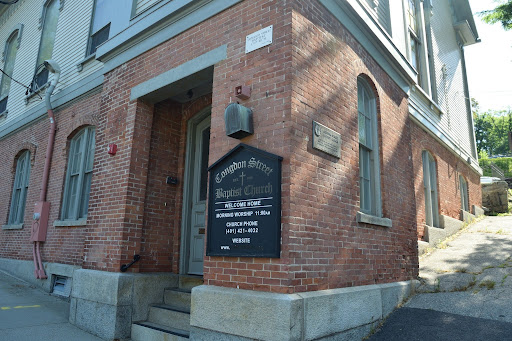
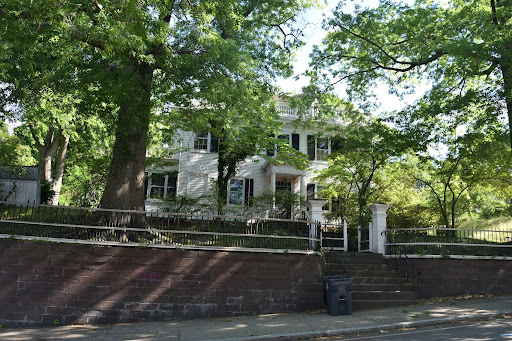
Around the corner from the church, the Captain George Benson House housed several members of the Benson family, who likely participated in groups like the Providence Society for Promoting the Abolition of Slavery. Eliza Benson married abolitionist William Lloyd Garrison, who founded abolitionist newspaper The Liberator, and operated a progressive social club in Massachusetts. Stages of Freedom said the Benson house “was a refuge that sheltered African Americans escaping from slave traders and hunters in the late 18th and early 19th centuries.”
“If Frederick Douglas stayed there, that’s a good sign,” said Picard. “I have seen records in the Benson family… There is some evidence there that he was actively anti-slavery.”
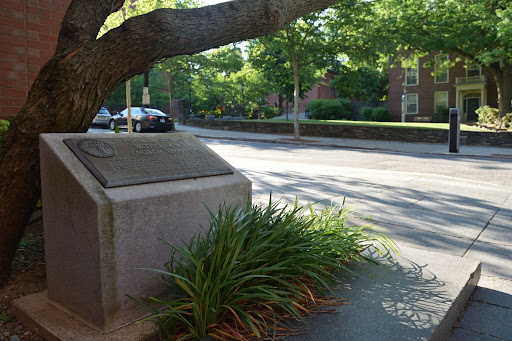
Picard does not have evidence to support the claim that Benson’s house was a “refuge,” but said Bethel A.M.E. Church was a more likely site for aiding freedom seekers. Originally formed as the African Freeman’s Society in 1795, Bethel AME’s building at 193 Meeting Street was constructed in 1866. Brown purchased the building with promises there would be “no severe alterations,” only to tear it down in 1966. A plaque commemorating the site as a location on the Underground Railroad was installed in 1995.
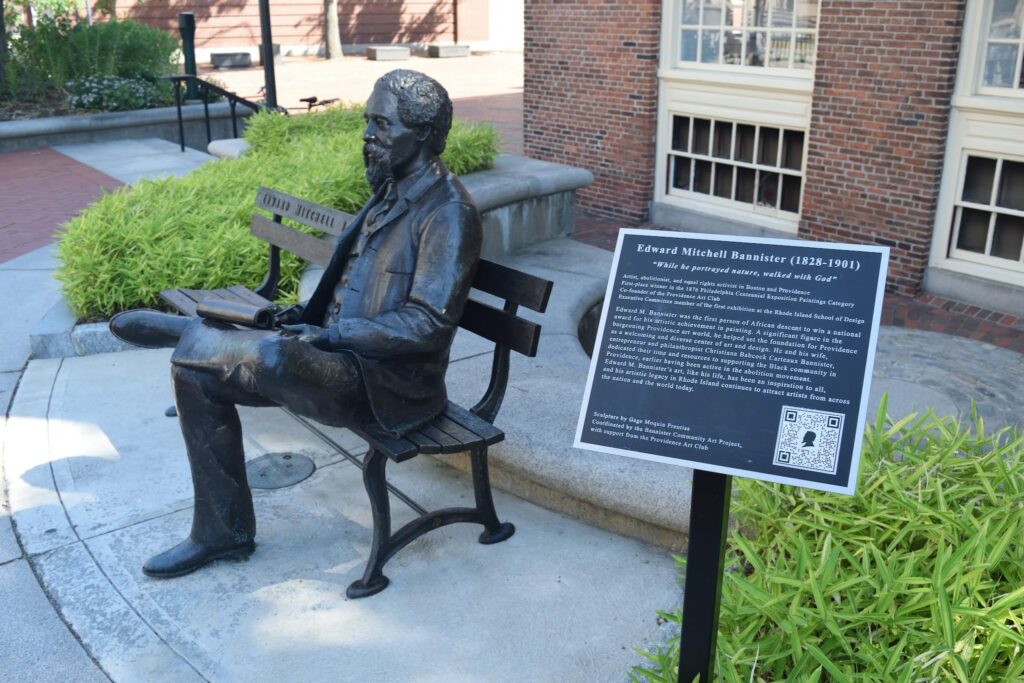
At the bottom of College Hill in Market Square, visitors can sit with a statue of Edward Mitchell Bannister, an artist whose painting won first prize at the Philadelphia Centennial Exposition in 1876. Once judges discovered he was Black, they attempted to withdraw their decision. Bannister and his wife Christiana assisted Underground Railroad operations in Boston before moving to Providence.
“He cofounds the Providence Art Club, an extraordinary thing for a man of color to engage with wealthy white men to create something that endures to this very day,” said Dimmick. “She creates a home for widowed black women.”
Picard, Hwang and the team at Stages of Freedom encourage local Rhode Islanders to learn about the state’s history, both for its role participating in slave economies and resisting them.
“This would be a success if we can get people to get out of their homes and see the sites, to get out and engage with the history, to start a conversation about part of our past that is increasingly contentious right now,” said Hwang. “It’s easy to say there’s no evidence when the work’s not done. So we’re happy to have been a part of that and we hope that we can inspire other people to learn about this and get interested in it.”
Eric Halvarson is a City News Reporter for The Providence Eye.
[Correction: An earlier version of this article has been corrected to represent an accurate date.]


Want to comment? Click!