




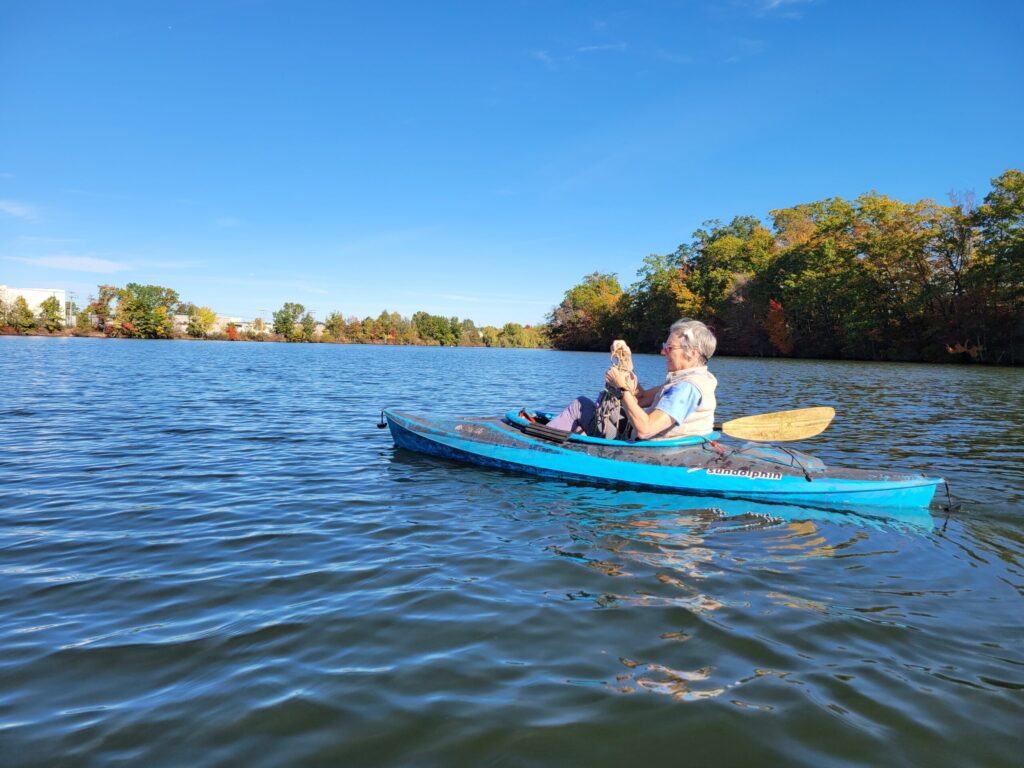
Mashapaug Pond, Providence’s largest body of freshwater at 114 square acres, has long been plagued by poor water quality, making it unsuitable for most recreational use. In 2025, the Rhode Island Department of Environmental Management (RIDEM) released its draft general permit for the Mashapaug Watershed. Through this permit, RIDEM aims to revitalize Mashapaug water quality chiefly by curtailing stormwater run-off from surrounding businesses. Critics, including local residents and Save the Bay, suggest that without key changes, the proposed permit will fail to meet its stated goals and Mashapaug will remain in its current degraded state.
The pond has long been on the DEM’s “List of Impaired Waters.” It suffers from high levels of Chlorophyll A (an indicator for toxic algae blooms and cyanobacteria), low levels of dissolved oxygen, and high levels of phosphorous and fecal coliform. As a consequence, it is not swimmable, not recommended for boating, and its fish are not edible. Every year, usually in late summer, the DEM posts warnings on its website about Mashapaug’s water quality when testing reveals high algae and cyanobacteria counts. See The Providence Eye’s previous article
In 2007, the DEM identified a 1.8 square mile Mashapaug watershed and deemed stormwater runoff the most significant source of phosphorus, the key contributor to the pond’s ill health. Mashapaug is an oasis in a mass of concrete: it is hemmed in by Route 10 and the Huntington Industrial Park on the west, the Job Lot Plaza and the 10 on-ramp to the south, and Reservoir Avenue to the east. While the situation is poor, it is not hopeless; Mashapaug is home to three parks and even attracts birders to its shores. Moreover, efforts have been made to improve the pond’s water quality. Mashapaug Cove (on the northeast end of the pond) was once home to Gorham Manufacturing, the world’s largest manufacturer of silver goods. Toxic metals once contaminated the shore and the Cove, but over the last decades, these contaminants have been largely remediated. This area is now occupied by Mashapaug Park, a Tesla dealership, and Jorge Alvarez High School.
The Nuts and Bolts
The Mashapaug General Permit is a response to a petition filed by the Conservation Law Foundation in 2018 and the Rhode Island Attorney General in 2024. The aim is to bring Mashapaug into compliance with the Clean Water Act. Specifically, the DEM proposes a “Mashapaug General Permit to regulate previously unpermitted stormwater discharges into Mashapaug, Spectacle, and Tongue Ponds in the Cities of Cranston and Providence.”
Tongue and Spectacle ponds lie to Mashapaug’s west and feed into the latter. Much of the phosphorus flowing into Mashapaug comes from Spectacle (on whose southeast side is Twin Oaks restaurant and which is almost entirely in Cranston). Major contributors to stormwater runoff are commercial properties in and around the Huntington Industrial Park on the pond’s west side. The DEM’s goal is to reduce phosphorous in stormwater discharges by 65 percent in Mashapaug and 68 percent in Tongue and Spectacle ponds.
The permit proposes a series of measures for properties with one or more acres of impervious surfaces. Most relate to having property owners maintain and clean their properties to minimize the organic and inorganic waste that washes into the water bodies. This includes basics like securing dumpsters, preventing and remediating spills, reducing use of salt, sweeping properties, and other common-sense actions. Other measures like twice-yearly inspection and cleaning of “stormwater management structures, catch basins, and outfalls” are more ambitious. The permit recommends that over time property owners reduce hardscapes, improve stormwater infiltration, reestablish natural buffers such as native plants, and install green stormwater infrastructure.
Properties of over seven acres are addressed differently and greater accountability is demanded. Such larger parcels must adhere to the stormwater mitigation measures proposed for the properties between one and seven acres, but are further required to develop a written “Stormwater Management Plan” (SWMP). Permittees must designate a stormwater pollution prevention team to carry out the provisions of the SWMP. Moreover, permittees must provide substantial documentation and mapping regarding site activities and sources of stormwater. In other words, where is the water coming from, where is it going, and what might happen in between. The requirements for the seven-acre-plus properties are detailed, often technical, and reference goals and targets. Among other things, property owners must submit a written plan of “Stormwater Control Measures” by February 15, 2028.
Public Responds to Proposed Permit
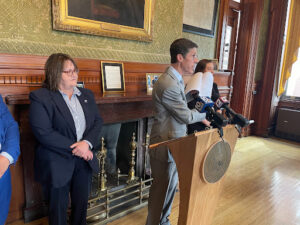
In November 2025, the DEM held a public hearing regarding the draft permit at its Promenade Street headquarters. The meeting was attended by about 30 people, many of them residents of Reservoir Triangle, the southwestern Providence neighborhood where the pond is located. The meeting’s format was comment only — DEM representatives did not engage in explanation or debate (public information sessions had been held in July). Brian Lafaille, DEM Environmental Engineer and RI Pollutant Discharge Elimination System (RIPDES) Supervisor, opened the meeting and noted that the DEM will issue the permit as drafted (if not, it will specify any changes made). Public comment was accepted on the DEM website until December 22.
None of those who spoke at the November meeting endorsed the DEM plan, with most finding it too gradual, not comprehensive enough, and lacking teeth. Yvonne Kettels, an acupuncturist who works from her house overlooking the pond’s east side, spoke of Mashapaug’s beauty, but noted, “I have to tell my 12-year-old not to go near it.” She deplored the lack of urgency surrounding the pond, “What is the real commitment here?” she asked. “Why can’t we move this forward?”
Veteran local environmental activist Greg Gerritt cited his 29 years working on another polluted local water body, the Moshassuck River, and noted, “Considering the history of environmental degradation in this state, we have a duty to do better.”
Suzannah Rutherford, who has lived on Lake Street on Mashapaug’s south side for seven years, spoke on behalf of Save Mashapaug Pond, an organization she recently founded. Rutherford granted that “the permit is a good but belated start,” but lamented that the Clean Water Act was passed “when I was a freshman in high school” and that the proposed measures will not achieve that landmark 1972 legislation’s goals.

Jucimar Nascimento chose to buy a home in the neighborhood because of the pond, and he shared an extract from an essay he’d written about Mashapaug. Nascimento later provided the entire text, which connects Mashapaug’s current degraded state to historical injustice. He sees in the local colonial iteration a pattern that has been replicated across many places, including his native Brazil, saying “When I come to Mashapaug Pond, I don’t just see a polluted lake. I feel beneath my feet the memory of the Narragansett village that once flourished here. I feel the spirit of a people who lived, fished, loved, and honored this water long before any of us were here.”
“I think everyone here agrees the goal should be to get the pond to the point where it’s fishable and swimmable,” said Jed Thorp, Save the Bay’s Director of Advocacy. He did not believe the DEM’s plan would come close to achieving these goals.
Tim Lehnert lives in Cranston with his family. He has written journalism, essays and humor pieces appearing in the Boston Globe Magazine, Rhode Island Monthly, the Providence Journal, and elsewhere. He is a member of a small team who, during the warmer months, monitor Mashapaug Pond’s water quality as part of the URI Watershed Watch statewide volunteer program.
¿Quieres dejar un comentario? ¡Haz clic!