






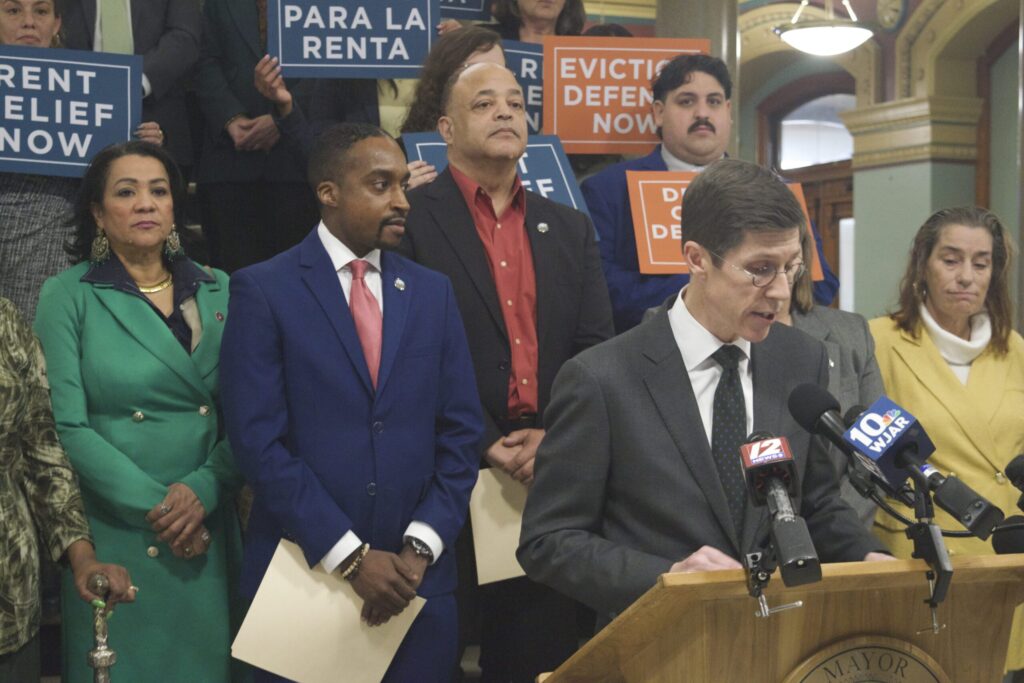
A rent stabilization ordinance is moving through the City Council, and Mayor Brett Smiley is watching closely. Smiley has promised to veto the policy if it passes the Council, but City Hall hearings on the proposal are drawing hundreds of people to testify.
“Residents waited hours to have a chance to share their story,” said Smiley. The hearing on February 18 lasted more than five hours, and the City Council received over 700 written comments. “What I took away from that hearing, which I watched and listened to, was residents who were in a crisis today.”
In response, Smiley announced his own “housing stabilization” plan on March 17. A proposed Rental & Essential Needs Transition (RENT) Fund uses $1 million from the sale of city properties to distribute emergency housing grants of up to $3,000 for households facing unexpected financial challenges. The package also funds efforts on eviction defense, building code repairs and landlord/tenant education. Rent stabilization supporters said the measures are a “band-aid” on runaway rent prices.
Housing Stabilization Package Taps $2 Million from Building Sales
Smiley plans to take proceeds from the sale of the old Asa Messer School building and the Humboldt Avenue Fire Station to fund the new package.
“We’ve taken two pieces of property, some of which will be turned into market rate housing, which we know do not help lower income residents,” said Smiley. “But the proceeds from those sales can now help those most in need.”
Out of the projected sales, Smiley proposed putting $500,000 towards free eviction defense services for tenants, $500,000 to a Department of Inspection and Standards fund to help property owners fix code violations, and $15,000 for Housing and Human services to provide landlord/tenant education. The remaining $1 million will go toward the new RENT Fund for emergency housing costs.
The RENT Fund will be reserved for households earning up to 80% of the area median income who are at risk of losing their housing due to “verifiable hardships” such as job loss, medical episodes or sudden rent increases.
Money can be used for rent payments, utility costs, mortgage arrears and select insurance premiums. The program will be administered by a local non-profit.
“This is about bridging the gap in a moment of crisis,” said Councilman John Goncalves. “This is about preventing eviction and displacement, hopefully before it occurs.”
The means-tested assistance is designed for short-term relief, as households cannot apply more than once within a 12 month period. Mayor Smiley said the RENT Fund will benefit 300 households, or 1,000 residents.
There have been 4,956 eviction filings in Providence over the past 12 months, according to Eviction Lab.
The RENT Fund proposal has the support of the entire City Council, including Councilor Miguel Sanchez. However, Sanchez said the plan is not a substitute for rent stabilization.
“We should definitely have this type of emergency fund,” said Sanchez. “There are some minor tweaks that we can advocate for, but we also need to do policies like rent stabilization to actually attack the main issue at hand.”
Separately, Smiley is asking the Rhode Island General Assembly to pass a $25 million bond for Providence to re-invest in the Housing Trust Fund. The fund previously distributed $29 million for loans to income-restricted housing developments. If approved by the legislature, Providence voters will cast ballots on the proposed bond in the November election.
Rent Stabilization Amendments Make Minor Adjustments to Major Plan
Just hours after Mayor Smiley’s plan was released, the City Council’s Special Committee on Health, Opportunity, Prosperity, and Education (HOPE) held another public hearing on rent stabilization.
The policy would limit property owners from raising tenant rates by more than 4% each year in Providence, where median rent prices have increased 40% since 2020. Advocates in attendance said the Mayor’s plan falls short of the need.
“Tens of thousands of families in Providence are rent-burdened. And so to provide targeted means-tested housing assistance to a couple hundred renter households is a drop in the bucket,” said Siraj Sindhu, executive director of Reclaim Rhode Island. “It’s just $800,000, or a million dollars if you include the administrative costs, to provide one-time help to a relatively small number of the population that really needs durable, long-term protections.”
City Council President Rachel Miller introduced several amendments to the proposed ordinance clarifying language, adjusting criteria for exemptions and establishing procedures for an oversight body called the rent board.
The rent stabilization policy makes exceptions for new properties to allow developers to recover the costs of construction. The new version of the ordinance reduced the standard time period from 15 years to 10 years, but it added a 20 year exemption if developments have high labor standards.
More updated language clarifies exemptions for deed-restricted affordable housing and makes it clear that tenant-based vouchers do not create exemptions, as vouchers do not limit rent increases.
Landlords can apply for an exemption with the rent board in the case of a substantial rehabilitation of at least two major building systems (i.e. heating or plumbing), with costs reaching 15% of the property’s value. The amendments also propose compensating rent board members $10,000 each and the chair of the board $12,000 dollars annually.
Public testimony folded almost neatly into a divide of renters in favor of the measures and landlords in opposition, with the occasional owner-occupied property owner voicing their support for rent stabilization.
Many of the rent stabilization opponents present at the hearing acknowledged that housing prices are high but said the ordinance will limit profit margins, and therefore investment incentives, for landlords to repair housing or build new properties.
“This ordinance is going to discourage property improvements under the 15% threshold,” said Anthony Thompson, a Warwick resident who owns property in Providence. “And it will also discourage larger projects because no owner will want to spend such large sums of money with the ability to get return on such investments in the hands of a board they have no control over.”
Property owners advocated for policies that incentivize building and provide direct assistance to renters rather than putting a ceiling on rent increases.
“The Mayor’s rental assistance proposal is a positive step that will help residents facing financial hardship in the near term,” said Shannon Elizabeth Weinstein, director of the Rhode Island Coalition of Housing Providers and a partner at RentProv Realty. “We look forward to reviewing the package of proposals and working together on solutions that expand housing and support Providence residents.”
Tenants shared stories of living in properties without proper heating while rent went up, being priced out of long-term housing and choosing between paying for rent or for food.
“Saving tenants from being priced out should be the first priority,” said Terri Wright, a long-time tenant rights activist. “Instead, their lives, along with mine, hang in the balance of a veto.”
Correction: An earlier version of this article noted that 14 City Councilors support the RENT Fund. The Providence Eye has since received the update that all 15 Councilors are supporting the proposal.
Eric Halvarson is a City News Reporter for The Providence Eye.


Want to comment? Click!