


While getting ready for bed one evening in December, my four-year-old said to me, “Mommy, did you know that not everyone has a house?”
A dialogue ensued:
Me: “Oh yeah? Tell me more, bud.”
Harmon: “Some people have to sleep outside because they don’t have a house. It’s really bad. They deserve a house.”
Me: “I agree, bud. Housing should be seen as a human right, not a luxury. We’re really lucky that we have a home.”
Harmon: “Yeah, Brian doesn’t have a house. But I know how he can get a house.”
Me: “Oh yeah? Who is Brian and how do you think he can get a house?”
Harmon: “He lives by my school, but not in a house.”
Me: “Well” – I paused here, my brain racing about how I could explain mortgages and zoning ordinances – “it’s not easy to just get a house, bud. How do you think he could get one?”
Harmon: “Well, more people need to die, so people without houses can move into the dead peoples’ houses.”
Me: “Oh, well, yes – that is an option. Do you think we need a multifaceted approach? Like maybe we need to build more affordable houses and provide help to get people into houses.”
Harmon: “No. More people need to die. Then there will be a house for Brian.”
I left the conversation there because arguing with a four-year-old is a fruitless endeavor.
A few days later, I relayed this story to another mama from Harmon’s school. She chuckled and said, “That’s so funny because my daughter recently told me that she needs a really good job when she grows up so she can afford to build a house for herself and build a house for Brian.”
Harmon attends the Dr. Pat Feinstein Child Development Center, which is one of two laboratory schools for early childhood education run by the University of Rhode Island. This school is located in the Shepard Building in downtown Providence. The “laboratory” component allows the schools to provide all sorts of hands-on learning experiences from URI undergrads, graduate students pursuing early childhood education, and other educators seeking professional development. Most of the Feinstein teachers have a master’s degree in early childhood education and they facilitate learning for both the preschoolers who attend the school and future educators who are training there.
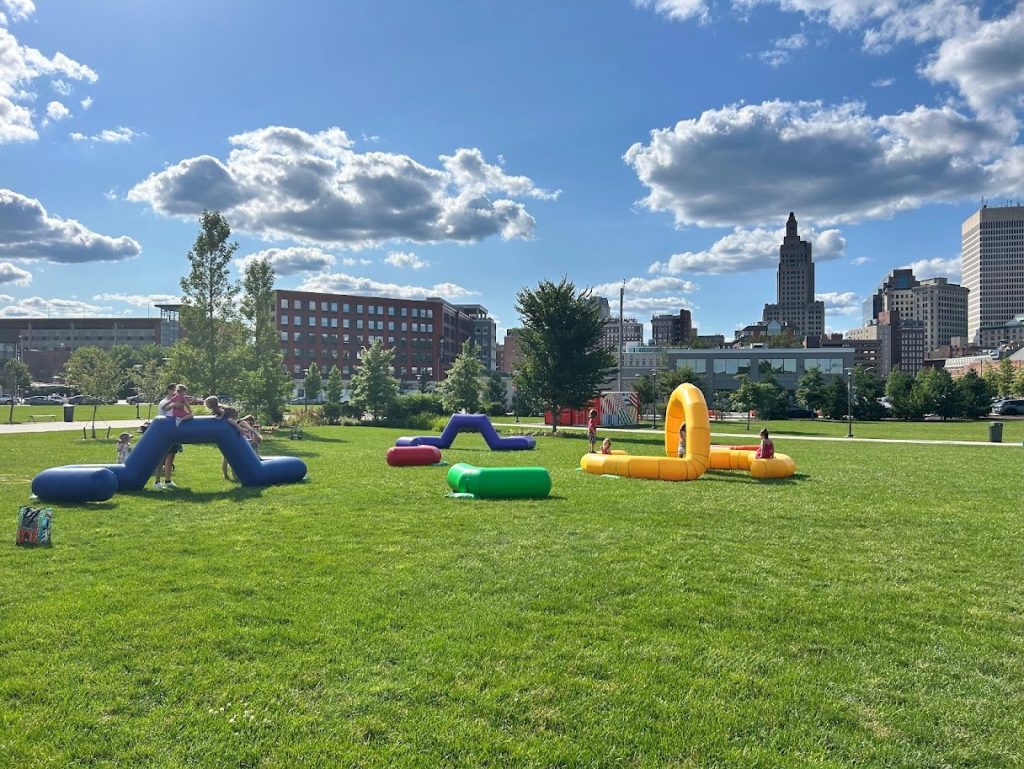
Feinstein does not have a playground or fenced-in school yard. Instead they use all the public green spaces in downtown Providence. Students and their teachers go outside every day, twice a day unless the weather is dangerous. In doing so, the students learn sidewalk and street-crossing safety, and make observations on and engage with the world around them. They walk to explore parks almost a mile from the school and green spaces much closer, usually voting to decide which park to explore that day. They have their own names for each public space, which have lasted or evolved through generations of preschoolers. The green space across the street from The Graduate Hotel is “Small Park.” “Paradise Park” is the 195 District Park. And the lawn around First Baptist Church was once “First Baptist” when my oldest attended the school. It has since become “Bob’s House.”
With all of the students’ time outside, the people they encounter become part of their community. The students say hello to people they pass, and they make observations and ask questions about what they see. Everyone knows the kids – from Mayor Brett Smiley (Harmon thinks he and the mayor are tight), to people who work or live downtown. The Downtown Ambassadors host storytime. They’ve met Secretary of State Gregg Amore and talked with him about pets. Recently they sang a song with a building’s security guard.
Anyone who has spent time with a preschool-aged child knows that preschoolers are the most observant creatures who have questions about everything. Last fall, students started asking questions about “the man who sits on the sidewalk” who they walked by most days. The teachers leaned into the students’ interests. They went to the library to read books and had age-appropriate class discussions about what it means to have a house. They informed the kids that not everyone has a house and discussed what it means to be unhoused. The school had a coat drive in December. The teachers and students walked to Mathewson Street Church to deliver the coats, where the coats were later distributed to the individuals who rely on the services provided there.
During this time, the teachers ventured out without the students to get to know Brian. Once they felt it was appropriate, the students were allowed to ask Brian his name on a walk to a park. Brian thus became a named member of their community.
Harmon brought Brian up again to me in early January during the first polar vortex, when temperatures dropped into the single digits. Harmon hadn’t seen Brian for a few mornings and was curious as to where he had gone in the cold weather. My husband, Tim, will talk to anyone, and he had also seen Brian regularly and spoken with him a few times. He knew that Brian had secured a bed in an emergency shelter, but shelters aren’t open during the day.
At our house, we have a sizable stash of hand warmers gifted to us by my parents, who live in northern Wisconsin. We suggested that Harmon bring this stash to give to Brian after school. Harmon liked the idea, but said, “Brian needs a winter coat.”
Tim said, “I have some extra winter gear. Let’s make Brian a bag of things he may need.” Harmon and Tim went through Tim’s winter gear, picking out a winter coat, gloves, and a hat, and put it all in a bag for Brian with hand warmers and a Dunkin’ gift card.
We didn’t see Brian on our way to school drop off that morning. Tim promised Harmon that we could give the bag of items after school. We confirmed Brian’s name with Harmon’s teacher. She said, “Oh, I bought a package of 50 hand warmers for Brian. I was going to have the kids put ten per bag that we could give him some every few days so he doesn’t have to carry all of them around.” This is when Harmon informed her that he had a bag of winter gear for Brian. His teacher said, “Well, would you like to give Brian the bag when we walk to Paradise Park today?” That morning, on their walk to Paradise Park they passed Brian, and Harmon handed him the bag of winter gear to help him stay warm.
Harmon and his classmates were so proud of themselves for seeing a problem, an injustice. And while they couldn’t give Brian a house, they learned firsthand that they can make an impact. They learned they could rely on the known adults in their lives to help them help others. Most importantly, the students learned that they have agency and are able to have an impact on their community.
Brian later waved down Tim to thank him. In response, Tim said, “Oh, that wasn’t me. That was all Harmon. I just got the coat off the hanger and found a bag for everything, but it was Harmon who took the initiative.”
Brian continues to be part of our downtown community. He and the children say hi to each other; the students call him by his name. Harmon doesn’t talk about the items he gave Brian. It seems more important to Harmon that they know each other.
Megan Hamlin-Black is a Midwest-transplant turned Providence superfan. She lives in Mount Pleasant with her husband and two children.
Want to comment? Click!