





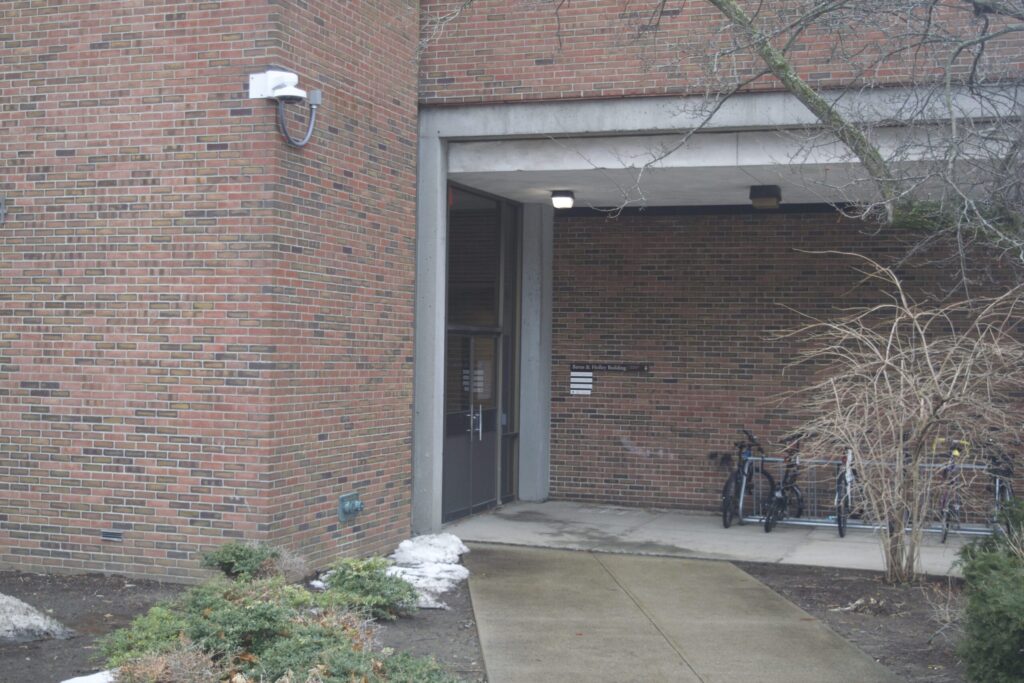
Despite operating over 1,200 cameras on Brown University’s campus, authorities struggled to find video footage of the gunman who attacked the school in December. The Barus & Holley building where the shooting occurred only operated two exterior cameras, and during a prolonged manhunt, authorities knocked on doors around College Hill asking for home security camera fee
“I think it came as a surprise that most of the camera footage that was used was [from cameras] that our own neighbor supplied as opposed to the school itself,” said William Ricci, treasurer of the College Hill Neighborhood Association. “I think we all had an impression that the school had more cameras active than were actually the case.”
With Brown’s safety under scrutiny (and investigation by the Department of Education), the school made sweeping changes to campus security including installing new cameras.Providence Police are pushing for the changes to include connecting campus cameras to the city’s centralized surveillance hub. However, the ACLU of Rhode Island and its Brown campus chapter are concerned the school’s rush to ensure safety may pose its own dangers to data privacy and freedom of speech.
“There were failures at how the school responded and the security of our campus in general,” said Lucy Kaplan, a sophomore and co-president of Brown ACLU. “But at the same time, from a civil liberties perspective… there are obvious problems with something like the Real Time Crime Center and asking a university to send over their footage.”
The Real Time Crime Center (RTCC) at the Providence Police Department opened in August 2025. The RTCC connects surveillance video, body-worn cameras, drone footage, automated license plate readers and data collection services into a single room where police can monitor information. Over 200 locations in the U.S. operate some form of Real Time Crime Center according to the Electronic Frontier Foundation (EFF), a nonprofit defending civil liberties in the digital world.
Police say the system allows for rapid-responses in the case of emergencies, such as the attack at Brown.On the night of the shooting, authorities from the Real Time Crime Center can be heard on released police body-camera footage saying they are “on the way to the scene” to “link up with Brown PD and start watching video.”
A Brown spokesperson confirmed the school “had a preliminary conversation” with Providence Police about integrating security cameras during the fall semester.
As of January 5, Johnson and Wales was the only university to join the RTCC. The school signed a memorandum of understanding in the summer and expects the system to go live in the coming months. Although JWU’s logo could be seen on the hockey rink where a shooting occurred in Pawtucket last month, the school does not own the building or manage cameras at that site.
After the shooting raised questions about the school’s security, Brown University students petitioned the school to add more high quality cameras to campus. The school quickly promised to add more surveillance cameras on select buildings. Providence Police once again said they would speak to Brown about connecting their camera feeds directly to the RTCC.
In response to this recruitment by Providence police, the Rhode Island ACLU and their Brown affiliate wrote a letter that warned releasing campus footage to unregulated technology like the RTCC could lead to “surveillance of free speech activities on campus and the targeting of ‘troublemakers.’”
“If students and faculty and staff and even visitors to campus know that they are advocating for their belief within the view of a camera that could be retained and saved for an unknown amount of time by the Providence Police, they may not be as willing to exercise their First Amendment right,” said Madalyn McGunagle, the policy associate for the Rhode Island ACLU. “The use of these technologies without meaningful constraints is troubling.”
The Providence RTCC’s Standard Operating Procedure says the center must follow “departmental policy and all applicable laws,” but advocacy groups could not find any laws that specifically regulate this type of surveillance technology. Without guardrails, the students from Brown ACLU worry about the “Orwellian possibilities” of authorities monitoring political activity.
“Some of the most troubling aspects of the RTCC have to do with the possibilities that we couldn’t necessarily foresee. Especially in this administration, there’s a lot of uncertainty and a lot of unprecedented actions,” said Lily Luby, co-president of Brown ACLU. “We don’t know how this data could be used, so it’s absolutely necessary to have better limitations on data access.”
The ACLU’s concerns about “targeting ‘troublemakers’” are grounded in recent history at Brown.
In 2024, Brown University sent letters to several professors threatening disciplinary action after using campus cameras to film people at a pro-Palestinian encampment. The Brown chapter of the American Association of University Professors slammed the letters as “intimidation, threats, and harassment,” and Brown University President Christina Paxson apologized.
“Many felt that the apology the administration issued was sufficient and wanted to move on,” said Denise Davis, vice president of the Brown Chapter of the AAUP. “Others, our AAUP chapter among them, felt that the issue warranted more attention.”
However, the school later suspended the campus chapter of Students for Justice in Palestine and asked SJP members to identify protesters who appeared in surveillance and dash camera footage. The Rhode Island ACLU said the suspension “short-circuited fundamental due process rights” and “eradicated, not defended, freedom of expression,” for SJP.
Though officially reinstated, SJP is still barred by the university from holding rallies or demonstrations until the end of the academic year. Students remain acutely aware of how campus surveillance can be used to curtail their rights, especially among immigrants at Brown.
“The combination of politicization of [immigration] and also the security concerns creates some terrifying possibilities for how that could be used,” said Kaplan, who said Trump took advantage of Valente’s actions to pause the student visa lottery. “It would be very disappointing to see the RTCC and Brown’s University’s participation in it used to harm immigrant members of our community.”
A Brown University spokesperson said they are aware of the ACLU’s concerns, and any response they have would be sent directly to ACLU representatives.
“One of the demands of the Brown administration is that they limit information sharing with ICE to what is legally required,” said Davis. “Brown’s participation in the RTCC would effectively relinquish control of any shared data.”
Brown AAUP endorsed a statement from Brown Rise Up and Brown Stand Strong calling for the school to adopt policies that protect community members from ICE, including safeguarding data on students.
“Brown should choose to not join the RTCC while data access and retention policies remain unclear and the threat of subpoenas against the Providence Police Department is a possibility,” the op-ed in the Brown Daily Herald says.
The school also said the decision to connect to the RTCC will be informed by the Campus Safety and Security Assessment conducted by consultant group Teneo. Teneo’s report on a 2025 terror attack in New Orleans recommends further integrating the New Orlean’s Real Time Crime Center into police operations, although with clear privacy and data ethics for responsible oversight.
“We share the ACLU’s concerns about the RTCC and surveillance,” said Davis. “I imagine this will be something we will be mobilizing around once Teneo releases its reports and recommendations.”
Despite recent legislation at Providence City Council that requires the RTCC to not share data with immigration enforcement agencies, Kaplan and Luby remain committed to monitoring the technology and its potential impact at Brown.
“It’s been an interesting conversation to have on campus, and one that I think a lot of people are shying away from generally,” said Kaplan. “But it still deserves our attention.”


Want to comment? Click!