





Brown University students returned to a different campus in January. New emergency phones appeared in front of their dorms. Twice as many police officers were on patrol. Private security guards checked for school IDs as they entered the library. New cameras watched them travel to class.
This week, security consultant Teneo is asking community members to share their input on campus security changes after December’s mass shooting. Students, faculty and staff will debate how to secure the campus without causing harm through mass surveillance and overpolicing. Others on campus say no matter the quality or quantity of new safety measures, Brown cannot protect its students without addressing the epidemic of mass shootings across the United States.
Teneo’s review is now being co-led by Courtney Adante, the president of Teneo’s security risk advisory team, and David Cagno, the firm’s head of public safety solutions. However, the school originally announced Bill Bratton would lead the review.
While leading the police departments in Boston, Los Angeles and New York, Bratton championed the “broken windows theory” of policing, which argued policing low-level offenses such as property damage could prevent more serious crimes.
“The implementation of the theory has been criticized for contributing to mass incarceration, specifically of young Black and brown people, including through Stop and Frisk,” said Dr. Jessica Katzenstein, assistant professor at Arizona State University’s School of Social Transformation. Katzenstein received a Ph.D. in anthropology from Brown University in 2022. “I think it’s fair to say that the backlash to such policies is part of what sparked the Movement for Black Lives.”
Under Bratton in 2014, New York police officers placed Eric Garner, a Black father of six, in a chokehold while arresting him for selling loose cigarettes. The deadly arrest became a symbol of police brutality, and Garner’s final words “I can’t breathe,” became a rallying cry for the Black Lives Matter Movement. Bratton resigned from his role as commissioner of the New York City Police Department two years later.
After the horror of the shooting, Brown ACLU Co-President Lily Luby said there’s even less of a desire for the school to be associated with Bratton.
“It kind of feels like a second blow,” said Luby. “It’s not necessarily aligned with Brown’s values or the values of a lot of its students.”
In 2002, Bratton and a group of consultants reviewed Brown’s campus security after a reported rise in robberies and assaults on College Hill. The review recommended campus police officers carry guns, and the university began arming officers in 2006.
“Commissioner Bratton knows the University well,” said Brown University spokesperson Brian Clark. “Teneo was selected based on its extensive experience conducting higher-education campus safety and public safety assessments across the country, including after high-profile incidents such as the 2025 terror attack in New Orleans.”
Teneo representatives downplayed Bratton’s role during a March feedback meeting. Adante said the security review “is a very discrete project that has really nothing to do with Commissioner Bratton’s philosophy,” in an interview with the Brown Daily Herald. “Consider (Bratton) in the background — a sponsor as a public safety expert and the leader of our division,” Adante said.
Katzenstein said the fear caused by mass shootings makes them “incredibly powerful justifications” for more police and surveillance. Security officers and police intervened successfully during shootings at Dixon High School in Illinois, Great Mills High School in Maryland and University of Nevada, Las Vegas. However, increased security protocols can also have negative consequences.
“More cameras [and] police may or may not prevent a mass shooting,” said Katzenstein. “They will almost certainly put community members who are people of color, immigrants, and protesters at greater risk of surveillance and punishment.”
Rhode Island School of Design Professor Chris Roberts said Bill Bratton reminds him of a policing era of “force, intimidation and just knowing there is always potential for you to be pulled up on for no reason.” Roberts, who used to teach at Brown, said the two campuses feel less “interlocked” this semester.
“If I’m grabbing lunch on Thayer and I want to swing by to see this archivist or curator, now that person has to come down and let me in,” said Roberts. “You share all these spaces and resources, but it definitely now feels a bit more like ‘You’re there, I’m over here.’”
Brown’s open-campus on College Hill weaves buildings in between residential homes, businesses and schools like Wheeler and Moses Brown.
“It wouldn’t be even practical to try to close off the campus,” said William Ricci, treasurer of the College Hill Neighborhood Association. “This is not something they’ve had to deal with before, obviously… The neighborhood is actually fairly safe.”
Rhode Island has the third lowest rate of gun deaths in the United States. According to Every Town USA, the state ranks 13th in gun law strength, and a statewide ban on the sale of assault-style weapons goes into effect this summer.
“The data shows that the trends follow the laws. Countries that have aggressive gun control have lower rates of gun violence. That’s indisputable,” said Dr. Amy Nunn, an adjunct professor of public health and medicine at Brown. “It’s alarming that we’ve had two mass shootings in the last couple of months.”
Despite having only five percent of the world’s population, one-third of all mass shootings occur in the United States. The U.S. accounts for 73% of all mass shootings in developed countries. Dr. Nunn and Dr. Philip Chan, another professor at Brown, said university security changes cannot eliminate the possibility of another attack.
“We could have security cameras set up in every single place humanly possible, and it’s not necessarily going to prevent someone from just walking in and starting to shoot up a place,” said Dr. Chan. “Brown University cannot solve this issue. This is really a society issue.”
Dr. Nunn said Brown can learn from their response to the sudden emergency, but that the school put a lot of money and resources and time behind it.
“I don’t think under any circumstance I can say they didn’t do enough,” said Dr. Nunn. “I think they did a whole lot really fast. Hindsight is always 20/20, right?”
On Brown’s campus, students continue to search for healing. Sophomore Lucy Kaplan points to the university’s Brown Loves Providence campaign as a positive step that shows appreciation for the campus dining workers and local businesses, such as Ceremony, that cared for students during the shooting.
“As a community, we went through something traumatic,” said Kaplan. “And the best thing we can do at this point is make sure that we are being intentional about the ways that community safety measures are being carried out, and creating forums for students and faculty to voice their opinions.”
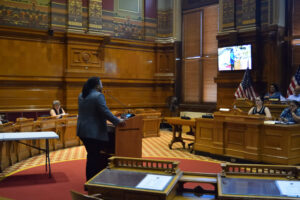
Teneo will attend a Brown University Community Council Meeting on April 14 to provide information about the security assessment and solicit feedback.
In February, Brown University hosted a memorial service for students Ella Cook and MukhammadAziz Umurzokov. Over 6,000 people attended, both in-person and virtually via livestream. Classmates and teachers shared fond memories of Cook’s smile and Umurzokov’s laugh, and laid flowers next to burning candles in the snow.
“It’s about coming together and healing as a community and trying to find comfort and security again,” said Annie Johnson, a staff writer for the College Hill Independent. “There are other sources of comfort and security and of feeling safe than just having a bunch of security guards.”
Eric Halvarson is a City News Reporter for The Providence Eye.


Want to comment? Click!