



Editor’s Note: The following article was originally published by Rhode Island Current on April 15, 2026. Reprinted with permission.
Providence Mayor Brett Smiley’s fiscal year 2027 budget aims to continue his administration’s regimen of restraint.
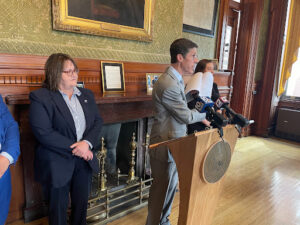
The $635.7 million proposal boasts no property tax increase and represents a 1.75% increase over last year — the lowest year-over-year spending increase in at least five years, and among the lowest in the past decade, according to city officials at a press briefing Wednesday afternoon ahead of Smiley’s public premiere of the budget later that day.
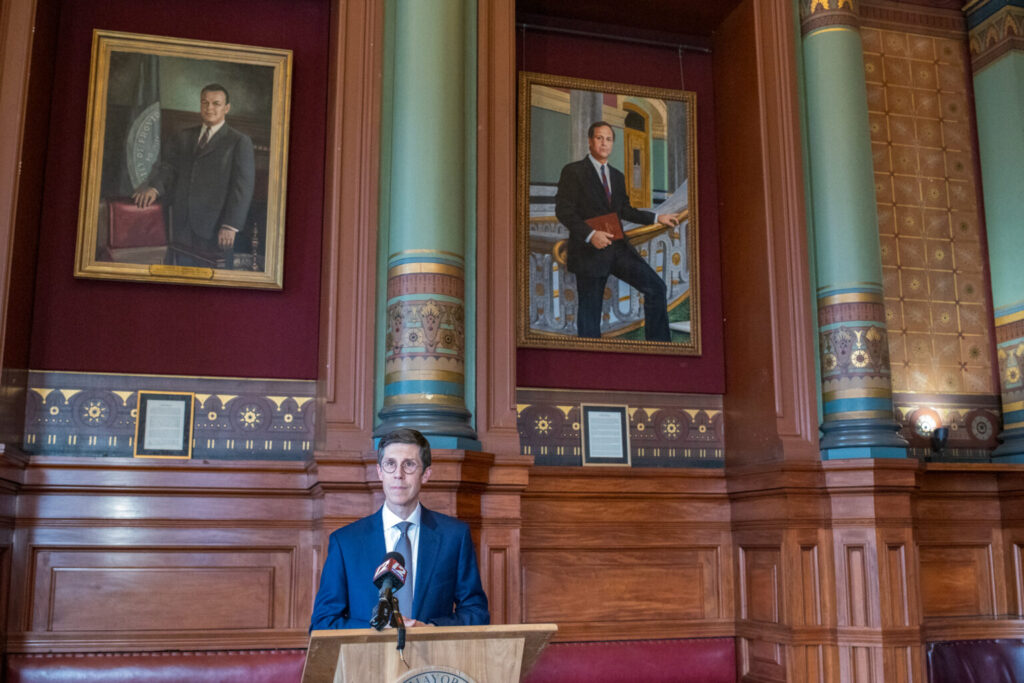
“It’s not easy to balance the city’s budget every year,” Smiley told reporters after his public budget address Wednesday, acknowledging that the city’s discretionary spending shrinks every year, while its ongoing obligations rise.
“So yes, I think it will continue to be difficult. It’s always difficult,” Smiley said.
Still, this year was not like last, when Smiley pitched his budget for fiscal year 2026 as an example of strength under pressure. The city had to maneuver around a multimillion dollar hole in its municipal coffers carved out by a court settlement with the Rhode Island Department of Education, which took over the city’s schools in 2019. To allocate additional city funds under the settlement, Smiley had to petition state lawmakers to enable the city to increase its overall levy, or tax revenue, beyond the state’s annual limit. That led to tax hikes for most property owners in the city, excepting some large commercial owners.
“It is fair and reasonable that the school department’s expenses go up just like ours do, just like households, budgets go up, and so last year represented sort of a catch up payment for many years that had been in dispute,” Smiley said. He added that the payments should be “modest but predictable” going forward, so that “the taxpayers of Providence never need to deal with a shortfall like that.”
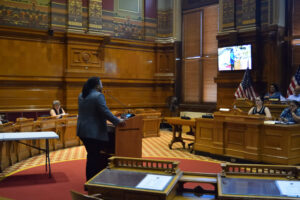
The lack of a budget crunch like the one felt by municipal officials last year does not mean the city finds itself in a cheerier financial context overall. Speaking on his proposed budget in the City Council chambers Wednesday, Smiley said the capital city is still flanked by troubling forces both local and national, from the city’s well-documented housing affordability crisis to a wider milieu of inflation, the challenges of aging infrastructure, and vanishing pandemic aid.
In his 3,549-word speech, Smiley named President Donald Trump four times and spent a few hundred words’ worth of his prepared remarks hammering blame on the feds for actions he said have worsened food insecurity, education, immigration and climate programs.
“Closing the budget gap in a year with historic inflation, high interest rates and aging infrastructure without increasing the cost of living on our taxpayers did not happen by accident,” Smiley said. “It took examining the budgets of every department to find ways to cut back without reducing investments in the services our neighbors need like trash pick-up and road repairs.”
This year’s budget lacks the dramatic school settlement saga as its foundation, although the proposed spending plan for fiscal year 2027 still makes room for the ongoing fiscal commitment required by that November 2024 court decision. Smiley is proposing $2.65 million more for the city’s public schools, an increase in line with the settlement’s two-year demand to raise funding so that it’s aligned with the city’s statutory requirements under state law. Providence public schools remain under state control.
A zookeeper on the wishlist
Outside forces notwithstanding, all the fiscal restraint in the proposed fiscal 2027 budget is not just for the love of asceticism. Providence now spends most of its money on fixed costs — like salaries, employee benefits, debt service and schools — which eat up 96.6% of the fiscal 2027 spending plan. Discretionary costs, now allocated at less than 4%, were allotted about twice that amount just a decade ago, city officials said.
“It’s one of the reasons that this job requires both a mayor with experience in leading a difficult budget setup like this, and a strong team of skilled professionals who know what they’re doing that can work with a $640 million budget, 95% of which is fixed,” Smiley told reporters after his address.
Smiley has often pursued a technocratic approach to governance, and his proposed budget this year employs a few feats of mathleticism to keep the city’s ledgers balanced without inflicting tax pain on residents. Among the mechanics informing this year’s budget, as pointed out by city officials Wednesday:
- Higher assumptions for the tax collection rate. City officials said the proposal’s 2% increase in tax levy revenue, or about $8.6 million, amounts to a change in the assumed collection rate, or how much tax the city expects to collect. The assumed rate would go to 94.75% in the proposed fiscal 2027 plan, up from 93.5% last year.
- Tax stabilization agreements falling away. The city projects a $4.3 million drop in tax stabilization agreement revenue, which officials said is tied in part to uncollectible revenue from Roger Williams Medical Center, whose ownership situation only stabilized last month after The Centurion Foundation completed its long-delayed purchase of the hospital and Our Lady of Fatima Hospital. Simultaneously, other tax stabilization agreements are expiring and those properties will revert to a regular tax rate, thereby increasing revenue elsewhere. City officials said they are generally not seeking to renew these arrangements.
- Shrinking Payment in Lieu of Taxes (PILOT) support. Smiley’s administration has taken pride in years past on its ability to strike PILOT agreements with the city’s many large nonprofits, such as Brown University and Brown University Health, but the administration is also bracing for a 7% reduction in foregone PILOT revenue it expects to receive from the state this year, as Providence is required to adopt a lower commercial tax rate under state law. The mayor recently expressed his desire for the state to increase its PILOT contributions to municipalities. Smiley told reporters he also expects to negotiate a PILOT agreement with Roger Williams Medical Center once it is fully converted to nonprofit status with its new owner.
- Savings on property and contract costs. The city expects to save $1.38 million in rental costs after purchasing 444 Westminster St., a.k.a. The Joseph A Doorley Jr. Municipal Building, used for a variety of administrative functions and municipal services. Another $1.4 million in savings comes from recently renegotiated speed and red light camera contracts with a new vendor. Better recycling and efficiency measures have led to a $500,000 reduction in landfill fees, city officials said.
While the school settlement formed an unavoidable roadblock for last year’s budget, the City Council’s rent stabilization plan — Providence’s policy fight du jour — did not make it into the mayor’s budget. The City Council is expected to take up the measure for a second vote on Thursday, and Smiley has previously promised he will veto the ordinance if it should pass, but the 15-member City Council could then override that veto with 10 votes.
Closing the budget gap in a year with historic inflation, high interest rates and aging infrastructure without increasing the cost of living on our taxpayers did not happen by accident. It took examining the budgets of every department to find ways to cut back without reducing investments in the services our neighbors need like trash pick-up and road repairs.
– Providence Mayor Brett Smiley
Whatever the outcome, Smiley’s budget officials said the enforcement bureaucracy which the ordinance would create is not a part of his budget design for the upcoming year — there is no money allocated for the “hypothetical.” Should the ordinance become effective, city officials will have to determine how to fund the prescribed staffing model, which includes a five-member Residential Rent Regulation Board.
Speaking of staffing: Smiley’s proposed budget asks for 11 full-time positions, which would be offset by three eliminated roles. Two of the cut positions were vacant jobs in the planning department. The third role to be axed, however, would necessitate a layoff of one employee in the city’s economic development department.
Employees who would join the city’s ranks include:
- A manager of fiscal operations for public safety, with a salary of $104,149.
- One police dispatcher and one fire dispatcher, allocated a combined total of $196,636.
- One code enforcement inspector and one clerk, whose duties would include responding to PVD311 complaints, with their salaries budgeted at $137,457.
- Two custodians and one maintenance person to help with city buildings, with their combined salaries allotted $145,163.
- One project manager and one associate engineer, budgeted at $160,585, to comply with a recent ordinance overseeing rules for utility companies performing work in the public way.
- Finally, at $62,237 a year sans benefits, would be a new zookeeper at Roger Williams Park Zoo. The new hire would not be a head zookeeper, city officials clarified, of which the zoo has six, but would join 32 more entry-level zookeepers.
Smiley’s proposal will spend the coming months getting vetted, reviewed and revised before a final budget is approved and signed, usually by the end of the fiscal year on June 30.
Several of the housing-related initiatives, officials said, need to be funded through property sales — specifically, the sale of the Humboldt fire station and the old Asa Messer school— would also require council approval before that money could actually be transferred into programs.
Smiley’s proposed budget is now available on the city’s website.
But wait, there’s more…
Among other highlights in Mayor Brett Smiley’s proposed fiscal year 2027 budget:
- $2.04 million for housing initiatives, spread across a slate of efforts including $1 million for a new rent relief fund, $500,000 for eviction defense, $500,000 for Smiley’s revolving rent fund to help with code repairs, plus smaller sums for landlord-tenant education and acute emergency needs.
- $272,000 to continue digitizing inspection records dating back to 1915.
- $77,000 in winter-storm investments, including general improved equipment rental for things like plow trucks.
- $50,000 for a cultural festivals fund.
- $17,700 for a property-alert system meant to flag suspicious deed changes.
- As a response to the Brown University shooting in December 2025, $138,991 would go toward new emergency response gear for police and EMS to better prepare police special response units and fire stations for active incident or active shooter situations. (The special response units would be allocated $90,000 and EMS would be allocated $48,991.)
- Smiley is also submitting an updated Capital Improvement Plan for capital spending through fiscal year 2031 that would put a $25 million bond on the ballot this November to support public works, planning, and parks.
Alexander Castro covers education, health and technology for Rhode Island Current. He previously worked as a visual arts critic, curator and adjunct professor.
Rhode Island Current is part of States Newsroom, the nation’s largest state-focused nonprofit news organization.


Want to comment? Click!