


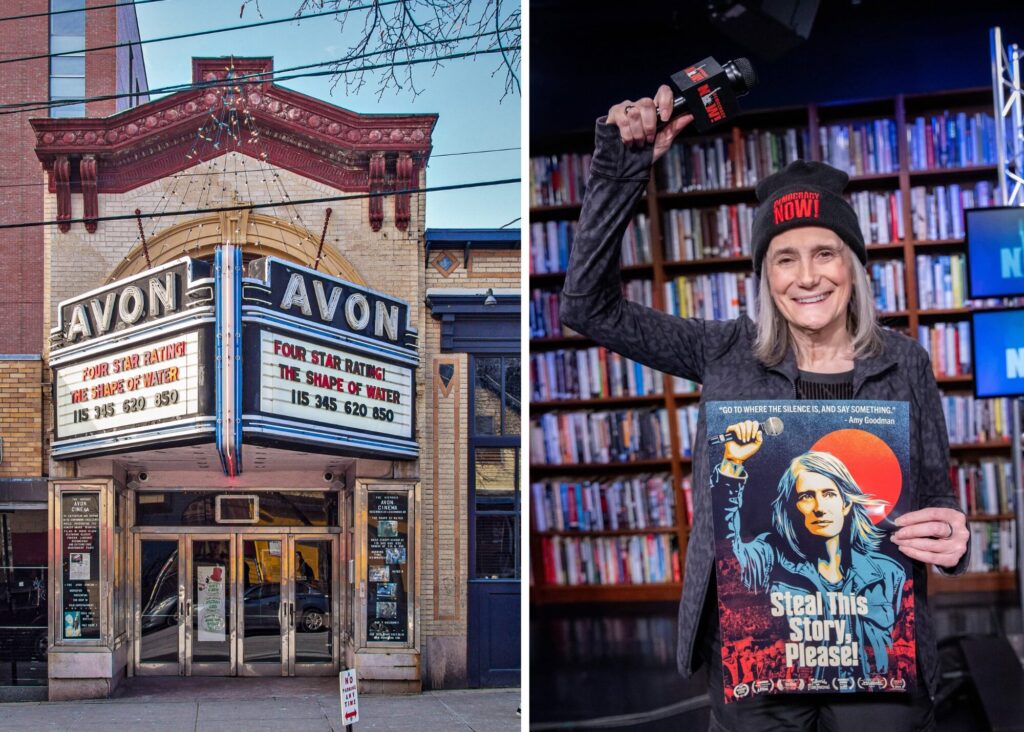
On June 26 and 27, The Avon Cinema will be screening the new documentary “Steal This Story, Please!” about journalist Amy Goodman and her career covering movements around the world amid the consolidation of corporate media and increasing attacks on the freedom of the press.
After the matinee showing Saturday June 27 at 3:20, The Providence Eye’s City News Reporter Eric Halvarson will be moderating a Q&A with Amy Goodman, and the film’s Oscar-nominated directors Carl Deal and Tia Lessin. In advance of the show, Halvarson spoke with Goodman and Lessin about the film and its relevance to Providence.
Eric Halvarson: Tia, this movie comes at a time when for the last 25 years, press freedom is getting ranked lower and lower in the United States. There are political attacks on the media as well as the structural consolidation of the news industry. But at the same time, this movie follows Amy’s career, which kind of parallels that over the last 30 years of Democracy Now! Could you talk about making those parallels, and for people unfamiliar with Amy’s career, how do those things speak to each other? And for people who care about the media and press freedom in the United States, why is Amy’s story one that tells that story well?
Tia Lessin: It wasn’t lost on us when Carl and I began making the film that Democracy Now! started in February of 1996, within weeks of the passage of the Telecommunications Act, which lifted all these restrictions on monopoly ownership of local and national broadcast and print outlets. And so as the media was shrinking, Amy’s independent model was growing, and really— in some ways—filling a vacuum that was being created by the loss of so many community voices around the country. We’ve seen since that time many other independent organizations follow in that model that Democracy Now! and Amy pioneered. I think she’s just been navigating this changing, shifting landscape, not only with media consolidation, but also with just the changing technology. So, the show has been adapting to new and different ways to reach its audience as new and different ways have emerged.
She’s also been navigating these press attacks. I mean, she was being attacked really beginning with Timor by military forces. She’d been attacked by corporate media, she’s been attacked by riot police, and she’s never backed down. Some stations refused to take the show or dropped the show because of her coverage because she included the voice of Mumia Abu-Jamal and his commentary. But because she didn’t back down, she got even more radio stations to take the radio show.
For sure, the growth of Democracy Now! and Amy’s practice of journalism has been really a kind of bright light in the midst of all this darkness between the political attacks, the legal attacks being waged against journalists, and then the closure of this year of the Corporation for Public Broadcasting, which was providing federal funds to community stations around the country. So Democracy Now! has become an example of what independent journalists can do and what an independent organization that’s not beholden to corporate funders or to even government funders. It seemed like a really important time to tell the story, given what’s happening to the press in this country, and really not just to the press, but to the truth itself with Donald Trump’s presidency.
Eric Halvarson: Amy, for your background—in the 1980s, the flagship media here, The Providence Journal, employed around 300 reporters. Now, they employ less than two dozen, so truly it’s shrunk dramatically just in the last 50 years. Could you talk a little bit about independent media and the kind of opportunities there are for independent journalism to serve people and communities?
Amy Goodman: That reminds me of The Washington Post. Jeff Bezos, the billionaire founder of Amazon, bought the Washington Post over a decade ago—and under his reign they developed the motto, “Democracy Dies in Darkness,” which is true. Well, it’s very dark at The Washington Post right now, because right after the U.S.-Israel invasion of Iran, he laid off hundreds of Washington Post reporters.
A few days later, we had on The Washington Post reporter to do an analysis of that first day of bombing, February 28 when a U.S. Tomahawk missile hit a girls’ school in Minab in southern Iran, killing over 160 little girls at school and about a dozen teachers. But The Washington Post reporter was not reporting for the Washington Post anymore. She had just been laid off.
The reporter in Ukraine got a message that she was laid off, so she was no longer reporting for The Washington Post on the front lines.
These are very, very dire times, and I think independent media is absolutely critical—a media that’s not brought to us by the weapons manufacturers when we cover war, not brought to us by the oil, gas, and coal companies when we cover the climate catastrophe, which is the fate of the planet, not brought to us by the banks and other financial institutions when we cover inequality, but brought to the listeners, viewers, and readers. By the listeners, viewers, and readers, and the kind of authentic voices that that affords cannot be compared to what you get in the corporate media—these typical pundits, who know so little about so much, explaining the world to us and getting it so wrong. But people closest to the story, who are talking about their experience on the ground, or if someone is afraid to speak, afraid of jeopardizing their livelihood, or their own life, having someone tell their story until they can tell their own.
Eric Halvarson: I remember when I was working at Democracy Now!, [Editor’s Note: Halvarson previously worked for Democracy Now! as a Digital Fellow in 2023] and in the film Sharif [Abdel Kouddous] talks about this very eloquently—about pointing the camera where people aren’t looking and putting the microphones in front of people who are being silenced. For either of you, does that feel like the core of the film? And for other people who want to step up and do journalism—a lot of our writers at The Providence Eye are community members and volunteer writers who want to write about the city—what do you hope people take away from it when they think about supporting local media? What can they do, and how can they step up and do that themselves?
Amy Goodman: Just think about The Providence Journal. I imagine, because they’ve eliminated so many writers and editors and staff people, that they rely disproportionately on syndicated columns, and news sources, and the [Associated Press], and the wires. And that’s true of so many local news organizations around the country.
[Editor’s note: Today, The Providence Journal is owned by USA Today Co., formerly known as Gannett Co., one of the largest newspaper publishers in the United States.]
One AP story can have a lot of power, but it also means that fewer voices are being heard. And also when President Trump goes after that one news source, AP, cutting off their access at the White House because they refuse to call The Gulf of Mexico “The Gulf of America,” it has a particularly profound impact. We need multiple sources, and I’m always amazed at the enormous response to Democracy Now! We developed a global audience from the beginning 30 years ago.
We just had our 30th anniversary at Riverside Church in Harlem [and] 2,000 people came and packed out the place. Patti Smith came and sang “Peaceable Kingdom.” Michael Stipe of R.E.M., Hurray for the Riff Raff. Angela Davis talked about the importance of dissent. Mosab Abu Toha, the Palestinian poet who just won the Pulitzer for a series of essays in The New Yorker, read his poem “Under the Rubble.” Then, Bruce Springsteen wrapped it all up with his amazing song “Streets of Minneapolis,” which is about the people of Minneapolis coming to the aid of immigrants who are under serious attack with Trump’s ICE surge there.
In fact, we’re talking to you from Belfast, Northern Ireland, which has also suffered a tremendous upheaval in the last few weeks with the far-right, anti-immigrant, racist thugs in the streets burning cars and immigrants’ apartments, terrorizing them. But just like in Minneapolis, the majority of people are not like that. And this weekend, tens of thousands came out to say, “This is the real Belfast, this is what Belfast looks like.”
I always say, and Democracy Now! shows us all the time, that I think we’re the mainstream media. I don’t call the corporate media the mainstream media, because I really think those who care about war and peace, who care about climate change, who care about reproductive rights and LGBTQ issues, who care about the immigrant crackdown are not a fringe minority, not even a silent majority, but the silenced majority, silenced by the corporate media, which is why we have to take the corporate media back and and build our own and connect it with media outlets all over the world.
At the end of that 30th anniversary night, all the musicians came out and sang Patti Smith’s iconic song, “People Have the Power.” I think that’s Democracy Now!’s motivating force, the idea that we cover movements. You never know when the magic moment comes, but if people build a foundation, you know they’re going to make history. They’ll determine the future, and we want to be there on the ground covering those movements, going to where the silence is, which is often not silent. It’s raucous, it’s rowdy. People are organizing. It doesn’t hit the corporate media radar screen. That’s where Democracy Now! lives.
Eric Halvarson: You mentioned just now motivation, and the film goes through your career. You’ve been in conflict zones, faced danger, been arrested, but also based on my experience working with you, you also have a lot of energy, you like to laugh. After seeing your career, seeing you go through all those difficult things and reflecting on that as well as your personal life, personal motivations, and inspirations, do you have a secret to what keeps you going to follow those stories?
Amy Goodman: I think the people I work with. Democracy Now! is a real brain trust of amazing people who are committed to independent media. It’s really an engine of hope. The people we cover are in the most difficult circumstances, but they hold out hope themselves.
[People in] East Timor, one of the great genocides of the 20th century, always believed they would be free. After we survived and witnessed this massacre in 1991, me and my colleague, the journalist Allan Nairn, we got off easy. We were just beaten, his skull was just fractured. Over 270 Timpores were killed that day, and it wasn’t one of the largest massacres there. But eight years later, the people of East Timor would vote for their freedom, and it’s one of the newest nations in the world.
The people of Nigeria, taking on some of the most powerful oil companies in the world, continue to hope that they can control their own destiny.
The people at Standing Rock and North Dakota, the Standing Rock Sioux, and indigenous people around the world who support them and their non-native allies continue to be the leaders of the climate movement in this country and around the world. They’re the ones who inspire me the most.
And Tia and Carl, this great dynamic directing duo, Tia Lessin and Carl Deal, who are a very big deal. They spent years documenting Democracy Now! and the independent media movement. Tia and Carl were nominated for an Oscar for “Trouble the Water” about Hurricane Katrina. Tia recently won three Emmys for covering the underground abortion movement in Chicago in the 1960s in a film called “The Janes.” They did that for HBO. “Citizen Koch,” they were Michael Moore’s producers. Their intelligence, brilliance, dedication to independent media, let’s just say, made it much easier for me to be stalked by them for several years,
Tia Lessin: And what I recognize, what I noticed with Amy is, time and again, she’ll, she will interview somebody—for example, today in Derry, I watched Amy interview this man. She’s had him on her show four or five times. They’d never met in person, but they had a relationship and a friendship that was indelible. It was lovely to see, and I think Amy has built relationships with people not only around the country but around the world.
And she’s able to uplift their voices and share those relationships with audiences. And they’re people who are talking at length about their experiences and their eyewitness accounts and their ideas about the future and making sense of the past. That’s an incredible gift that she’s giving. I think she’s also getting that. I see her really enlivened by that, and I’ve seen audiences really enlivened by the kind of reporting that she does.
We’ve been breaking box office records in cities around the country because people want to make sense of the moment we’re in, and they’re turning to Amy, and they’re turning to this film to help them do that. And they’re also along the way laughing and maybe finding themselves surprised by some of the things they’re seeing on screen. I think it’s an important moment for people to be in community in a time when, I think, the powers that be are trying to isolate us all and so we’re excited about the release of the film. We’re excited about bringing it to Providence. We’ve been up and down the East Coast, and it’s about time we’re there. And we’re really looking forward to seeing the reaction of your community, so please get the word out.
Amy Goodman: Eric, Tia won’t say this but their film Steal This Story, Please! has won, like,16 awards, mainly audience favorite awards from Santa Fe International Film Festival, the Santa Barbara International Film Festival, St. Louis, to the Woodstock International Film Festival, to a new film festival in Savannah, Georgia, to Seattle Doc Fest, and in Oslo, Norway at the Human International Film Festival. It has won Grand Jury Prizes, awards for best documentary, and best film overall at a film festival. It’s amazing.
And in terms of theaters and the theatrical release, it had the largest first weekend release in New York City at IFC that they had in 10 years for any documentary. And in Chicago, at the Music Box, it’s like 800 seats. It’s like a cinema palace, about 100 years old—an organist plays until the film goes on. They had the biggest weekend theatrical release for a documentary than they had had since they kept records 25 years ago. The response has been incredible. And so, it really is a testament to their talent and their skill, and I’m really looking forward to Providence and Newport.
I can’t wait to be in Rhode Island.
For more information about upcoming screenings of “Steal This Story, Please!” visit stealthisstory.org. The Providence Eye’s Eric Halvarson will be moderating the Q&A after the Saturday matinee at Avon Cinema on June 27 at 3:20 p.m.


Want to comment? Click!