




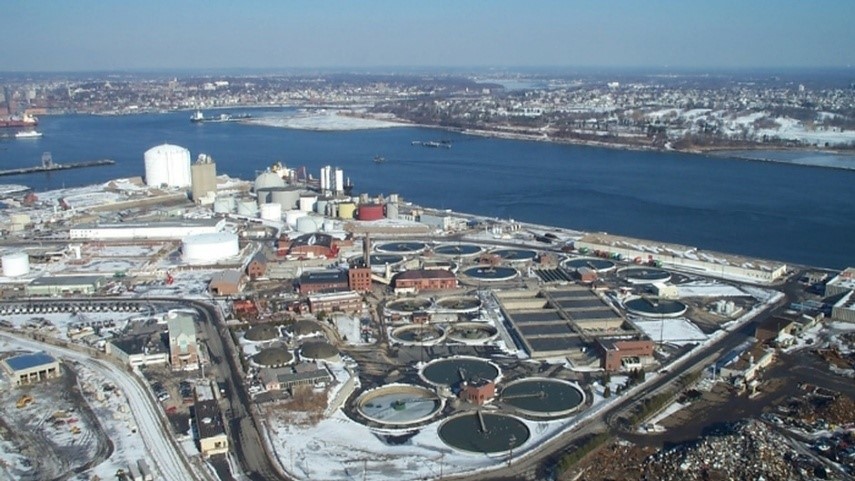
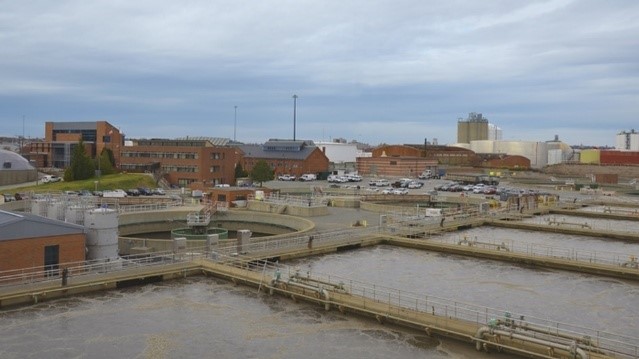
The Narragansett Bay Commission (NBC) owns and operates Rhode Island’s two largest wastewater treatment plants (Field’s Point in Providence and Bucklin Point in East Providence) along with an extensive infrastructure of interceptors, pump stations, tide-gates and combined sewer overflows. NBC is a quasi-public agency formed by state legislature in 1980.
The Field’s Point facility at the Providence Port is one of the country’s oldest and the state’s largest wastewater treatment facility. Here is a tour by the numbers, and readers can book an actual tour of the NBC facility to learn how our wastewater is processed, cleaned, and returned to Narragansett Bay.
360,000 – public customers (~33% RI) are served by the NBC
32 – tide gates and 80 miles of interceptors in the Field’s Point service area
38 – combined sewer overflows (CSO) are owned, operated and maintained by the NBC
1 – Combine Sewer Overflow (CSO) tunnel
6 – pumping stations are owned, operated and maintained by the NBC
200 – million gallons per day of secondary and wet weather flows are treated
16 – billion gallons of combined sewerage have been prevented from entering Narragansett Bay over the past 15 years by NBC’s combined sewer overflow (CSO) program
$557 million – total cost of the CSO program improvements constructed between 2001-2015
80% – reduction made to nitrogen loads in upper Narragansett Bay by 2014 due to Integrated Fixed-Film Activated Sludge (IFAS) System, the largest implementation in the world
120,000+ – water samples are analyzed for Cyanide, Mercury, VOC, Trace metals, Alkalinity, Fresh and Salt Water Nutrients, Chlorides, BOD, Volatile acids, COD, Enerococci, Fecal Coliform, Residual Chloride, TSS, Hexalvalent Chromium, pH, etc.
74% – of NBC’s total energy use is generated by their wind turbines
1854 – the City Council sends the city engineer to Europe to study sewers and methods of treating wastewater
1896 – the largest steam-powered plunger pumps ever constructed are put in operation in the Ernest Street Pump Station (building still remains)
1901 – the Precipitation plant, purifying sewage before entering the Bay, is put in operation; it is the largest ever built and 3rd of its kind in the nation
1980 – the Narragansett Bay Water Quality District Commission is formed
1972 – the Clean Water Act is passed by Congress
1979 – the US EPA orders the City of Providence to address chronic pollution problems, violating the Clean Water Act; Field’s Point is identified as one of the worst treatment plants in the country
1980 – voters approve $87.7 million bond issue to fund much-needed improvements at Field’s Point
1992 – the $100 million upgrade of Field’s Point is completed
1995 – Field’s Point receives the EPA’s award for best operated large secondary treatment facility (can treat more than 10 million gallons a day)
Sources:
Nini Stoddard is a proud Providence resident. After living abroad as the child of a US diplomat, she returned to the United States to attend college. She lived in Connecticut and enjoyed working as a librarian, as a director of a regional non-profit, and as a prospect researcher. Nini moved to Providence in 2006 to work at Brown University as a senior prospect researcher. Now retired, she loves local history and volunteering.
Want to comment? Click!