






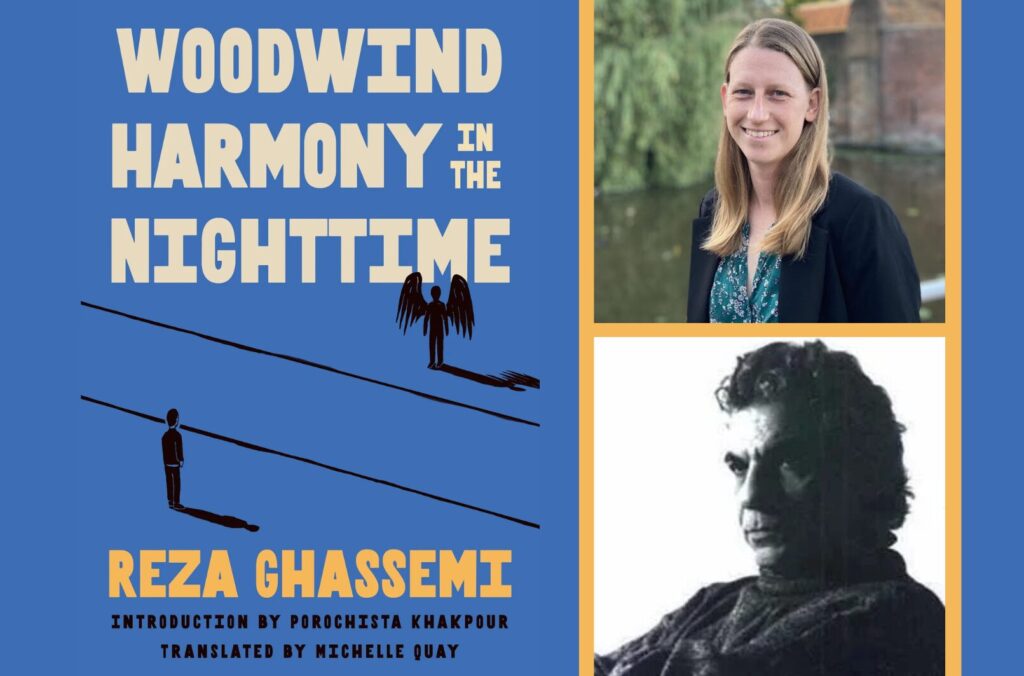
The classic apartment novel is a group portrait of people who’ve been brought together by some combination of affordable rents, available employment, and a landlord who isn’t paying too much attention. “Woodwind Harmony in the Nighttime” by the Iranian writer Reza Ghassemi, translated from Persian by Michelle Quay, who teaches at Brown University, is an apartment novel in just this sense. The dark comic novel is focused on a group of immigrants sharing an apartment building in 1990s Paris.
“Woodwind Harmony” was first published in Persian in 1996, in Los Angeles; six years later, it was re-published during a period of loosened censorship in Iran where, despite its bawdy allusions to sex and drinking, the novel went on to win two major prizes. According to Porochista Khakpour, who wrote the introduction to the English translation, the novel “just happened to be in the right place at the right time.” Ghassemi, 70, is a playwright and musician whose other novels include “The Spell Chanted by Lambs” (2002), which was first published online in English to evade Iranian censors. After the Islamic Revolution, when his work was banned in Iran, Ghassemi moved to Paris, where he still lives.
At the center of “Woodwind Harmony” is Yadollah, an Iranian exile living with two roommates in the attic apartment of a building in Paris. He suffers from an impaired sense of time, what he calls “the time gap disease,” which makes it hard for him to keep track of his days. He is also literally invisible to himself. Brushing his teeth, he glances into the mirror and only sees the toothbrush moving around. Exile has done a number on Yadollah, such that he hardly recognizes himself anymore. This is his story, but he struggles to tell it. What emerges are fragments, each of which opens a different window onto his past and present. With this novel, Ghassemi suggests that this painfully fragmented state defines the experience of exile.
Other contemporary novels have picked up similar themes. “The Yacoubian Building” (2006) by Alaa Al Aswany offered a panorama of contemporary Egyptian life through the lens of a single crumbling Art Deco building in Cairo. “Clash of Civilizations Over an Elevator in Piazza” Vittorio (2008) by Amara Lakhous introduced readers to a mélange of immigrants living in central Rome whose lives are upended by a murder in the building; this novel also reprised themes of another classic apartment novel, “That Awful Mess on the Via Merulana” (1957) by Carlo Emilio Gadda, a mystery set in postwar Rome in which all the residents of a single building are implicated in a murder.
There’s a murder in this apartment novel, too, but the central mystery is not who did it. Rather, it’s how the protagonist will come to terms with this act of violence, which hardly stands out among the daily violences enacted in the building, which Yadollah styles “our rudderless planet-ship.” In this volatile atmosphere, homey familiarity mixes with anxious unrest. The building becomes “the arena of slippers, pajamas, bowls of traditional Aash-e Reshteh (Persian noodle soup), and debates over democracy, “which took place at night [and] sometimes got heated.” Slowly, Yadollah says, “our conversations were infused with the smell of sautéed onions, laying the groundwork for future catastrophes.”
Why should the smell of frying onions pave the way for disaster? Partly the answer is sheer density: too many people are packed into a tiny space. Not all of them are human. Woodwind Harmony’s large cast of characters includes two angels of death, both of whom stalk Yadollah, as well as a mythological being, The Gashiya Serpent, a “giant snake of the Underworld.” Members of Yadollah’s family are also part of the story, as are the building’s landlord and his enormous dog, Gebik, whose significance becomes apparent only toward the end. The building itself is hot, dusty, and confusing, with thin walls through which all noises travel. On the sixth floor, where most of the characters live, there is only one bathroom. This essential, communal resource was already a site of conflict even before a mad newcomer named Prophet arrives to tip the building into chaos.
This novel demands the reader’s involvement. Because the narrative runs back and forth in time, it can be hard to keep track of even the basic facts that anchor the story in time and place. As I read, I kept a running set of notes. I had fun puzzling out the story, but other readers might resent the homework assignment. Surrealist elements lurk, ready to waylay those expecting reality to behave in ordinary and expectable ways. At least one scene appears to take place in a dull, noisy, dusty afterlife that may or may not be exactly the same as the building in which Yadollah is, or was, living.
That’s a droll conceit, but the humor is easy to miss amidst the onslaught of seemingly disconnected details. For the most part, the prose is fresh, though Quay now and then resorts to a tired turn of phrase that has the effect of opening the oven door on a souffle—all the air escapes, and the result is flat and unappetizing. A few references to unfamiliar literary and cultural figures called out for brief, explanatory footnotes. But these minor flaws don’t really detract from Quay’s achievement with this substantial and challenging text. Quay is a translator to watch, and I can’t wait to see what she does next.
Diane Josefowicz is a writer living in Providence. Her latest book is a novel, The Great Houses of Pill Hill, published in May by Soho. She writes an occasional newsletter, What’s That Noise?, focused on books, writing, and the pockets of joy that can still be found around town and on the internet. Learn more at www.dianejosefowicz.com.
Want to comment? Click!