


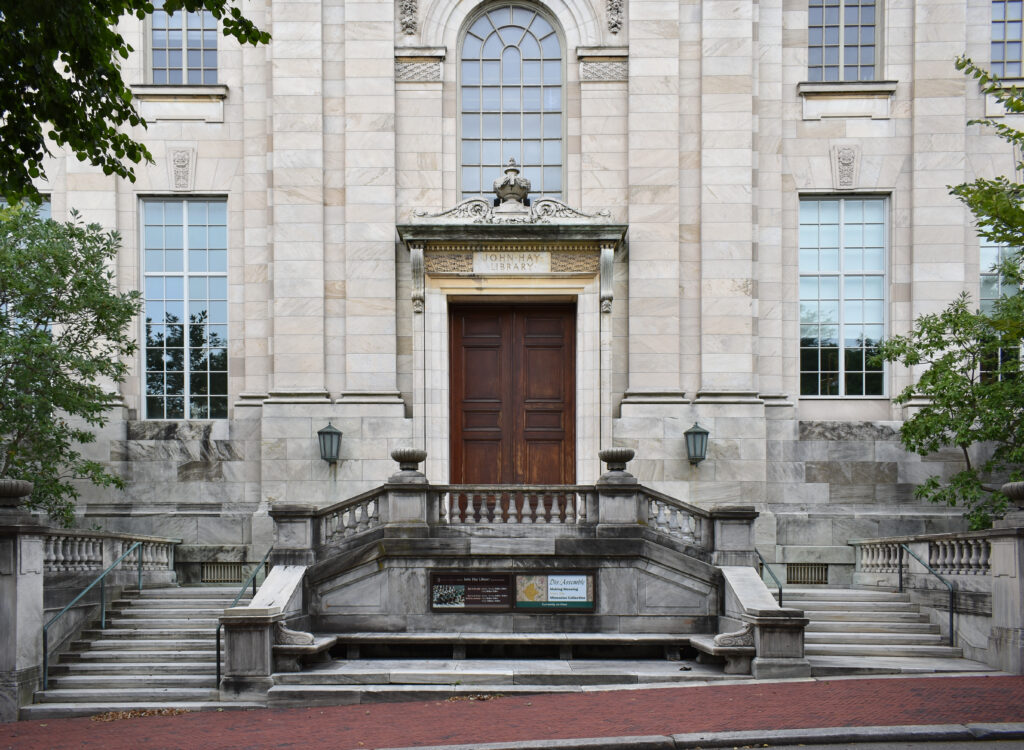
I am a great admirer of Abraham Lincoln and have read scores of books about him learning something new from each volume. I was also aware that the John Hay Library at Brown University housed the Charles Woodberry McLellan Collection of Lincolniana, one of the preeminent repositories of its kind in the world. But what I recently learned is that I have the right to view any and all of the items in the treasure trove simply by completing a simple application. No Brown connection is required.
And, generally, the Hay – as it is known – is open to anyone to visit. An imposing marble building on Prospect Street across from the main campus of Brown University, the library may not look like a place that rolls out the welcome mat to one and all. But it is, in fact, open to the public. And that’s because of the donor who gave the money to build it: Andrew Carnegie.
Carnegie, an immigrant from Scotland, made a fortune in steel manufacturing. In the last 18 years of his life he gave away ninety percent of his fortune with a special emphasis on building libraries. All told, he underwrote 2,500 libraries around the world, including the Hay. According to the specifications of his bequest, all the buildings he paid to build must remain open to all at no charge. Though the Hay was built on a university campus, it’s no exception.
Opened in 1910, the Hay served as the main university library until 1964. It is named for John Milton Hay, a Brown graduate of 1858 who served as private secretary to President Lincoln and later as Secretary of State under Presidents William McKinley and Theodore Roosevelt. Carnegie and Hay were friends.
The Hay houses Brown’s priceless collections of books and artifacts covering a wide range of subject matter. Among its books are two first editions of De Revolutionibus by Copernicus dating to the 1500s, a Shakespeare First Folio, a first edition of Walt Whitman’s Leaves of Grass inscribed by the author, and a copy of The Great Gatsby that belonged to T.S. Eliot. According to the library’s website, other materials include “the world’s largest collection of American poetry and plays, one of the nation’s finest history of science collections… and an internationally known collection on military history,” as well as “collections devoted to the writings of major individual authors, such as Henry David Thoreau, George Orwell, George Bernard Shaw, and T. E. Lawrence.”
After observing several protocols, visitors may view any of these collections. Or they may simply partake of the atmosphere in the magnificent Willis Reading Room. The building underwent an extensive renovation and restoration in 2013 and 2014, during which the room was transformed from office cubicles and a reduced reading area to a magnificent space soaring three stories high and illuminated by specially commissioned light fixtures modeled after the originals.
There is something about libraries and their atmosphere of comfort and scholarship that can restore the soul. This resource is open to you simply by climbing those marble stairs.
One final note is in order. There is a brass bust of John Hay positioned by the main entrance. His nose is polished to a sheen from the thousands of hands that have touched it in the belief that to do so provides luck in taking an exam. Even if you are not a student, there is nothing to prevent you from following the custom and testing whether it brings you good fortune.
Fraser Lang is a retired publisher who lives with his wife on the East Side. He is president of the board of directors for the Providence Eye.


Want to comment? Click!