


Like many Providence residents, I’ve gone through phases of appreciation for downtown’s Riverwalk and Waterfire. As a child, it was magical. As a teen, it was crowded. As a young adult, it wasn’t counter culture enough. (“Sure, Waterfire is alright, but have you seen the Steel Yard’s Iron Pour?”)
In recent years though, as I’ve hosted my in-laws and other visitors in town, I’ve experienced and appreciated it anew through their eyes.
On a Waterfire night, starting at my apartment in Fox Point, I bring visitors down Wickenden to South Water Street and the Van Leesten Pedestrian Bridge, often stopping for a slice at Fellini’s on the way.
After pausing to take in the scene – kids dancing with buskers, elders playing chess, college students clapping along with the Providence Drum Troupe – we pop by the Wild Colonial for a pint. We then venture north, taking in the world class Still Here mural by Gaia and Jonathan Bonner’s Holocaust Memorial. Before long, the ethereal music and the smell of cedar pull us toward the Riverwalk and Waterfire. We wade through the masses in the direction of Waterplace Park – surrounded by snippets of languages from across the globe and accents from across Rhode Island. Finally, at the basin, visitors are transported into a sensorial experience unlike anything else.
Just when they think the night is coming to a close, we cross the Memorial Boulevard Tunnel to the food hall, Track 15. BAM: hit ‘em with the finest local cuisine. By the time we meander back to Fox Point – often climbing College Hill for a pit stop at Prospect Terrace Park on the way – their feet are sore, their bellies are full, and Providence is cemented in their mind as the coolest mid-size city in America.
We Providence natives can be a bit parochial and overly nostalgic at times. But the River Relocation Project of the 80’s-90’s and I-195 relocation that followed shows that we can be visionary too.
In the 80’s, as other cities continued the downward spiral of hollowing out their urban cores in the hopes of attracting suburbanites and their automobiles, Providence charted another path. We dug in our heels and pivoted back toward the urban form and experience that is the foundation of vibrant city life.
Here’s the catch though: to be the truly visionary and quirky place that we claim to be, we can’t be complacent. We need to build upon the visionary legacy of the artists, planners, and architects of Providence’s acclaimed renaissance and future-proof the best elements of their ideas for future generations to enjoy.
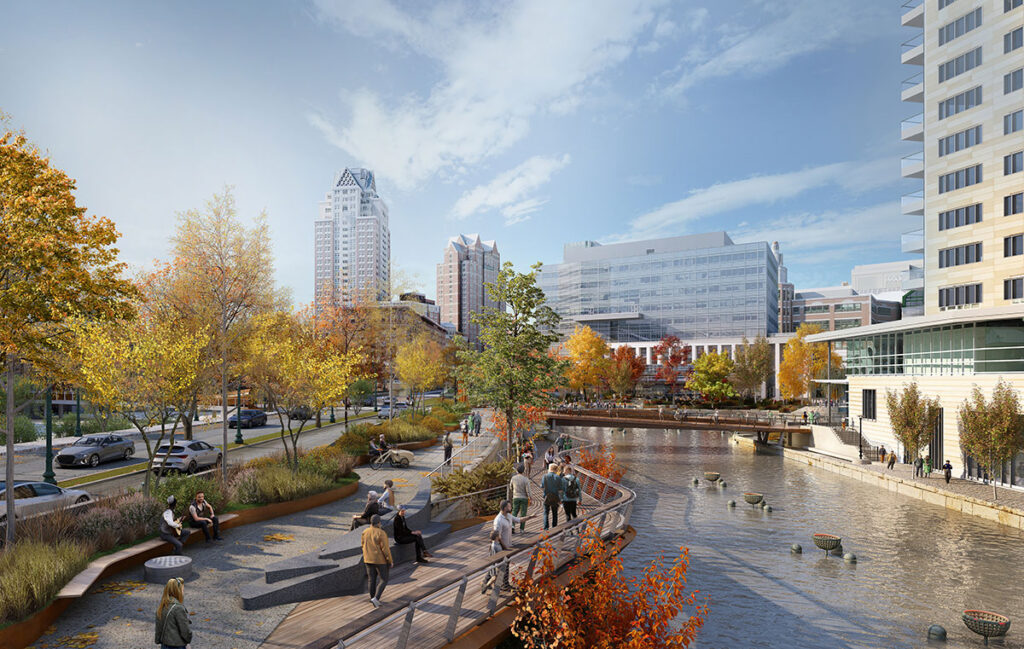
The Riverwalk today is far from perfect. Cobblestones have worn down over the years to become difficult to walk on, let alone roll, scoot, or bike on. Stair access also makes parts of the Riverwalk completely inaccessible for many. It’s difficult to see, making the Riverwalk feel like a sunken fortress, unsafe and hidden from view of passersby. The river itself now regularly floods the Riverwalk, Waterplace Park, and the Memorial Boulevard tunnel at high tides, with such events becoming more frequent and intense in the years ahead. Apart from Waterfire, there are very few activities drawing people to this space. There are so many other incredible arts and cultural organizations in Providence with deep relationships in diverse communities that are too disconnected from this one-of-a-kind public venue.
Cue the Providence Riverwalk Resiliency Project!
Born out of the 2021 Vision for Downtown Public Spaces, this detailed design effort of the City of Providence kicked off in 2024 in partnership with an expert consultant team led by the British design/engineering/architecture firm, ARUP. The team includes my company, CIVIC, and others, like Inform, the architects behind the design of the Van Leesten Pedestrian Bridge.
The project seeks to redesign the Riverwalk and Waterplace Park to enhance climate resiliency, accessibility, and connectivity.
New designs aim to naturalize sections of the riverbank with native plantings and raise pedestrian connections for both climate resiliency and safety. The project will directly connect the Riverwalk to Burnside Park and Kennedy Plaza to the south, Capital Center’s Train Station, Mall and State House to the north, and the City’s growing network of urban trails to the east and west, including the Woonasquatucket River Greenway and Providence River Greenway connecting to South Water Street and the East Bay Bike Path.
As this visionary project approaches a final design, there is an important opportunity coming up for community members to continue guiding this vision.
On Thursday, December 11th, from 5:30 to 7:00pm, there will be a hybrid public meeting on the Riverwalk Resilience Project in-person at the Doorley Municipal Building (444 Westminster Street) and online via Zoom. For more information on the project and how to participate in the December 11th meeting, visit the city’s website for the Riverwalk Resiliency Project.
Tim Shea is a Fox Point resident and urban planner with CIVIC, a local planning and design studio. He’s spent most of his life in Providence and frankly won’t shut up about it. If he’s not at a community meeting, you can probably find him on the pitch with the Providence Hurling Club.


Want to comment? Click!