




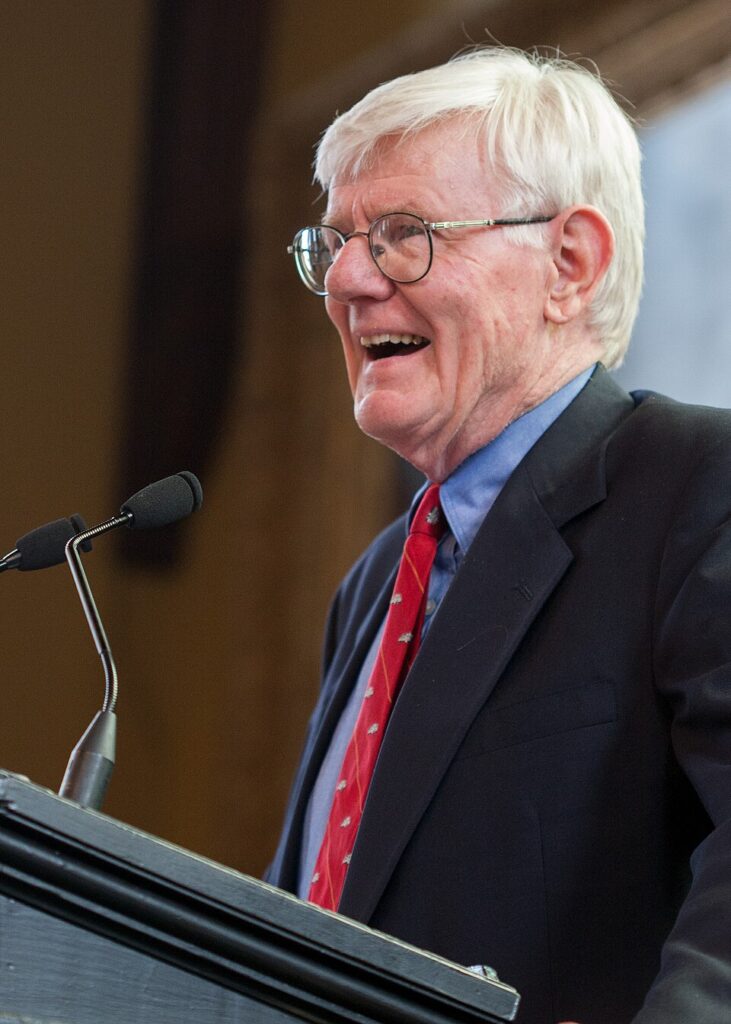
Editor’s Note: On June 7, the legendary historian Gordon Wood died after being struck by a car in East Providence. He was 92 years old. Wood taught at Brown University for 39 years. He was the author of ten books, and a recipient of the Pulitzer Prize for History, in 1993, as well as a National Humanities Medal, in 2010. This essay is one of two tributes that the Eye received after news broke of Wood’s passing.
Nearly ten years ago, in September of 2016, I summoned up my courage and wrote an email to Gordon Wood, the Brown University professor who had taught me so much about loving history, learning about history, and even writing some of my own.
I was living in Providence, pursuing writing and looking for my Great White Whale of a book project. I had recently spent an afternoon in the Rhode Island Historical Society, reading original letters from Stephen Hopkins, a signer of the Declaration of Independence and nine-time governor of Rhode Island.
New in my return to Providence after many years in and around New York, I had, a few weeks earlier, taken a magical nighttime tour of Hopkins’ house on Benefit Street (moved there from its original 1708 location on South Main Street) during a WaterFire. The tour made me love even more the place I’d often admired after walking up the steep hill near it. It also prompted me to wonder if there had ever been a proper biography of Hopkins. My research suggested not, and I decided to ask Gordon Wood what he thought of the idea.
I hadn’t had any direct contact with Professor Wood in the decades since I took his extraordinary two-semester course sequence on the American Revolution in the mid-1970s when I was an undergraduate at Brown. Yet I could still imagine him almost shyly but brilliantly addressing the class, and I remembered the vividness of his text, The Creation of the American Republic, 1776-1787. It was – and remains – one of the most transformative history books I have ever read, so powerfully argued and presented, with exceptional primary source research.
I wrote to Professor Wood that September afternoon at 3:13 (so the timestamp tells me now). I presented myself as who I was: a Brown alumnus from the Class of 1977, who had taken his course and had been a daily newspaper reporter and editor for many years, drawn especially to history-related subjects. I also mentioned that, more recently, I had worked for several non-profits.
I asked Professor Wood three questions: Why wasn’t there a full biography of Hopkins? Did he think Hopkins was a significant enough historical figure to justify a full biography? And was it a fundable project? I closed by thanking him for his courses and his writing.
My expectations for a response were not clear. However, I barely had time to think about this because, just four hours later, Professor Wood wrote back. His reply was as clipped and as clear as I remembered from his class and talks I had heard him give since.
“Dear Mr. Rubinton, I don’t know how much I can help you,” he began. Then in several sentences he gave his authoritative answers. He thought there was no full biography because of a relative paucity of Hopkins papers and letters. He labeled Hopkins “a minor figure” in the context of the Revolutionary period but “certainly worth a biography–similar minor figures have been studied.” He said “surely it would have to be a labor of love,” not expecting any institution would fund it. Then he closed: “I haven’t anything more to tell you. Good luck, GSW.”
With that note, Professor Wood had told me so much. Foremost, he had validated me, which was an enormous gift. He hadn’t needed to answer my email. Yet he had done so promptly, and he had treated me with utmost respect.
Though his email did dissuade me from pursuing the Hopkins biography, it gave me more confidence to keep looking for my first book project. It took nearly ten more years, but Princeton University Press published my debut, Looking for a Story: A Complete Guide to the Writings of John McPhee, in 2025. The research for that book, though far from the topics that Professor Wood studied, had undeniable antecedents in his work. He inspired me to want to get history right and to bring history to the world, and to also help others in their quests.
Soon after our email exchange, I started working for Brown, starting a new magazine, social media accounts, and other communications about the research being done at the University. I loved being on the campus again and I occasionally saw Professor Wood walking. It was exciting and comforting to see his continued presence, though I didn’t have the courage to introduce myself in person.
In his later years, Professor Wood found himself in a historical imbroglio. He and four other eminent historians, including Sean Wilentz and James M. McPherson of Princeton University, wrote a letter to the New York Times Magazine in 2019 about its already-acclaimed 1619 Project about American history and slavery. Professor Wood and his colleagues praised the Times for tackling such important subjects and doing much of it so well. But they raised what they said were “reservations” about some factual errors in the project. They said, among other things, that the 1619 Project incorrectly asserted that America’s founders declared the colonies independence “‘in order to ensure slavery would continue.’ This is not true.”
The letter set off a huge debate around the world, including in the history department at Brown, where some parted company with their now-emeritus colleague. I found it hard to watch, but accepted that it was part of free speech and dialogue. Meanwhile, I was proud to help amplify through social media Professor Wood’s continuing scholarly work as he kept writing and speaking on many subjects.
I mourn Professor Wood’s tragic death, which came as he was remarkably active in the world at age 92, still giving talks and writing.
I and many others will miss what would have certainly been his future contributions to our body of historical knowledge and thinking, with a book of his essays still to be published. Fortunately, we will have so much to remember him for. He taught for 39 years at Brown, influencing thousands of students, and his prize-winning books are likely to be read for generations to come.
As I keep working, now on a historical project of my own about the tiny number of Confederate soldiers buried at Arlington National Cemetery and the fracas that burial site has caused, I will think often, and with great gratitude, about the many lessons of Gordon Wood’s towering life of history and of civility.
Noel Rubinton, a graduate of Brown University, is a journalist whose work has appeared in publications such as the New York Times and Washington Post. His Looking for a Story: A Complete Guide to the Writings of John McPhee was published by Princeton University Press and he is working on a new book about Confederate soldiers buried at Arlington National Cemetery. He lives in Maryland, just outside Washington, D.C.


Want to comment? Click!