






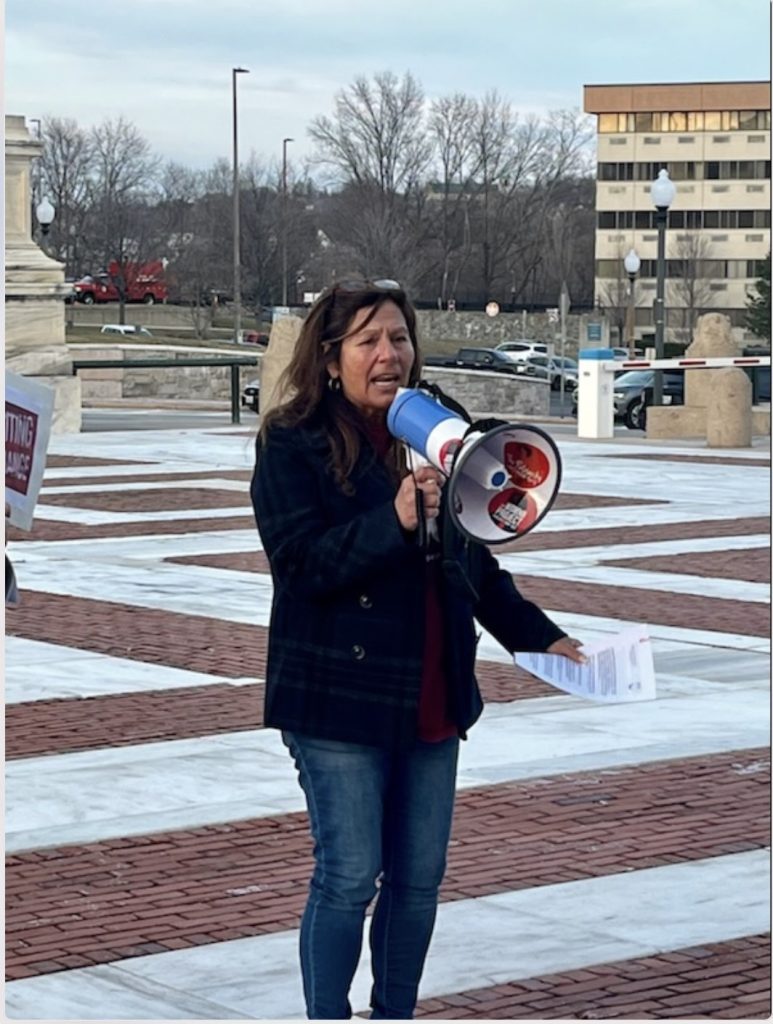
The night after Valentine’s Day, 2024, sex worker Bella Robinson sat in the back of the Rhode Island State House Lounge, waiting to testify before the House Judiciary Committee. Her red reading glasses matched the T-shirt she always wore to legislative hearings: “Rights, Not Rescue” in vibrant lettering. Robinson had become an activist in 2010, after news broke that the bodies of four escorts were discovered on Long Island’s Gilgo Beach. “Something in me snapped,” Robinson says. She revived the grassroots group “Call Off Your Old Tired Ethics Rhode Island” (COYOTE RI) and started fighting to make prostitution legal.
COYOTE RI (Call Off Your Old Tired Ethics Rhode Island) Collects Data
Her weapons of choice: research and publishing. For decades, sex workers had argued that criminalizing prostitution puts workers at risk of violence. Workers offered personal stories of abuse and exploitation—but they didn’t have hard data to persuade legislators to change policy.
About ten years ago, Robinson and fellow sex worker Tara Burns decided that if policymakers needed more data, COYOTE would collect it.
Today, multiple publications later, COYOTE’s research has revealed truths that Burns and Robinson already knew: Criminalized sex workers don’t report crimes to the police because they fear being arrested for prostitution. Abusive clients and pimps know that sex workers are silent victims—so they rape, coerce, assault, steal from, and even murder workers with near impunity.
COYOTE has become a leader in a nationwide drive by sex-worker-researchers empowered by their familiarity with the sex industry. “Folks are doing brilliant work in these organizations, and following good methodological principles,” says Barbara Brents, a professor of sociology at the University of Nevada Las Vegas who helped found the field of sex-work research.
Yet studies run by sex workers are rarely referenced by lobbyists.
Robinson and Burns hope to change that. They think their data can spark political change. With their first summative book of findings—published in mid-September—COYOTE is giving citizens and legislators a chance to decide for themselves.
Making Sex Work Illegal Invites Violence
Nationally, sex workers experience more violence than almost any other people who work for pay in the US. From 1970 to 2009, about 27 percent of all serial murder victims were sex workers, even though they comprise less than 1 percent of the population. Between 45 and 75 percent of sex workers have experienced physical or sexual violence on the job.
Burns and Robinson argue that the illegality of sex work—not the nature of it—is responsible for much of the violence sex workers face. When sex work is illegal, most workers don’t report crimes because they worry that they’ll be arrested. Prostitution-related penalties like fines and jail time are major deterrents, particularly because even one charge can inspire future surveillance. But when sex workers forgo police protection they become easy targets for abuse.
COYOTE conducted its first RI survey in 2015. Robinson recruited 63 workers, about a quarter of the state’s sex industry, she says. Half of the respondents had been victims of crimes they did not report to the police. Thirty-five percent said they’d kept quiet because they didn’t want to draw attention to themselves; a quarter didn’t think the police would help them.
One Providence woman described being kidnapped by a client. He held her against her will and physically and sexually assaulted her. She told her coworkers what had happened. “Multiple girls had experienced the exact same thing” with the same man, she told COYOTE. Yet “none of us went to the police because we were afraid that, since we were strippers at the local dive club, they would charge us instead of him.”
Two years later, Burns and Robinson replicated their survey on a national scale. “I spent every day of the summer of 2017 scanning every single backpage ad in every category in every city that had an email address,” says Robinson. Within three months, she had 1500 respondents for the hour-long survey, even though she “couldn’t pay anyone a dollar.” In a sample size almost 25 times larger than their first, the same statistic emerged: Roughly half of the respondents had been the victim of a crime that they’d never reported.
Sex Workers and the Police
When sex workers do bring crimes to the police, they’re often rebuffed, COYOTE finds. While 20 percent of RI sex workers have tried to make a police report at least once, 4 in 5 were turned away. Even worse, criminalization can also enable police officers to be perpetrators. COYOTE’s 2015 survey found that ten percent of Rhode Island sex workers had been coerced, by threat of arrest, to perform free sex acts on a police officer. Multiple studies in other cities corroborate COYOTE’s findings.
Robinson and her allies make the case that criminalization has also hindered anti-trafficking efforts. Despite the resources anti-trafficking laws provide, police struggle to catch traffickers and their victims. A few years ago, Burns analyzed the twelve federal trafficking cases that were charged in Rhode Island between 2000 and 2021. Ten were identified by civilians, and two were discovered inadvertently. Not one case was unearthed during a raid or sting.
Burns and Robinson argue that decriminalizing sex work will ease the trafficking problem. Sex workers can help police find victims, and sex workers’ fear of arrest is all that stands in the way of cooperation. If “we can go to the police, and not be arrested but instead be able to report really horrible crimes, then we can eliminate sex trafficking,” Burns says.
Indoor Sex Work Was Legal in RI and Then Re-Criminalized
In 2003, Rhode Islanders opened their newspapers to a shocking headline: District Court Judge Elaine T. Bucci had ruled that sex workers could not be prosecuted when working inside. Bucci’s decision cited a 1980 law that had created a loophole permitting indoor prostitution. Yet before the 2003 ruling, many people didn’t know that indoor prostitution was legal.
The Rhode Island sex industry immediately boomed. So did a vigorous re-criminalization movement; it succeeded in making all sex work criminal again in 2009.
But between 2003 and 2009, the number of rapes perpetrated against sex workers in Rhode Island dropped by 31 percent, according to the National Bureau of Economic Research. Gonorrhea prevalence also decreased by 40 percent among all Rhode Island women.
One of Robinson’s favorite memories of decriminalization was the 2009 capture of the “Craigslist Killer,” Phillip Markoff. Markoff had begun his crime spree—he solicited sex workers online—just weeks after Robinson had moved to Providence with her young daughter. He’d hired two Massachusetts sex workers on Craigslist. The first, he robbed; the second, he murdered. Luckily, his next target lived in Rhode Island. “She dialed 911, and they caught his ass before he hurt anyone else,” says Robinson.
Decriminalize Sex Work? Immunity in Reporting Violence?
Not everyone familiar with sex work and trafficking in Rhode Island supports decriminalization. Detective George Duarte of the Providence Special Victims Unit believes the policy would push abusive pimps to prey on underage girls, as a direct result of making adult sex workers safer.
Duarte imagines that most adult sex workers would work for legal brothels under decriminalization. He understands why: “you can see the pros for the girls, because it’s a safer environment. They’d probably have security, they can set their own rates so they can make a better wage,” he says.
But if brothels are still stigmatized—which Duarte thinks they will be—the underground market for sex will persist. “That’s where they’re going to go to the juveniles,” he says. Duarte’s job demands that he protect children from abuse, so he can’t support policies that might increase the exploitation of minors. Still, he agrees that criminalization endangers adult sex workers.
Duarte’s hesitance is common, and as a result, Rhode Island may be years from decriminalization. COYOTE’s short-term goal is to pass an immunity-in-reporting bill. That’s why Robinson was at the State House back in February. “Any serious attempt to promote public safety or end sex trafficking must allow all sex workers to report violence without being charged with prostitution,” she testified.
Progress on an immunity-in-reporting law has been slow. One hold-up is that Burns and Robinson only support bills that include immunity for “massage without a license.” Many spa-based sex workers are charged with “massage without a license” instead of prostitution, and Robinson refuses to leave them behind. “You could promise to decriminalize us tomorrow and give me a million dollars. I’m not throwing Asian spa workers under the bus,” she says. Yet pushback from the American Massage Therapy Association has made any bill including spa workers a hard sell.
But many people find immunity a relatively easy policy to support. That includes law enforcement officers, some of whom don’t support arresting sex workers at all. “To me it’s like a victim within a victim, you know, a crime within a crime. If they’re committing a crime while they’re being victimized, how does that work?” says Duarte. While he’s careful to point out this is his own opinion, Duarte fully supports immunity in reporting.
The COYOTE researchers have faith that an immunity law is within reach. In other states, even people who oppose sex work have decided that immunity-in-reporting is a public safety choice. In 2016, Burns convinced Alaskan legislators to pass the nation’s first immunity law for sex workers. Since then, eight more states have followed suit.
Burns thinks the first step to convincing Rhode Islanders to support decriminalization is giving them the data. She asks that the public consider what COYOTE has found, in “Sex Work Policy: Participatory Action Research By and For Sex Workers and Sex Trafficking Survivors.”
Meg Talikoff (she/her) is a senior at Brown University concentrating in pre-clinical psychology. She plans to pursue a career in couple and family therapy while working part-time in local journalism. Her favorite things include community-building, the color green, and hot chocolate (which she drinks every day).


Want to comment? Click!