





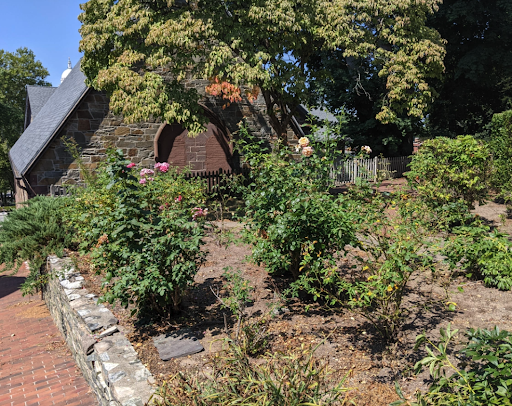
It was a sultry July night in 1845 when Edgar Allan Poe, the world-famous American author and poet, walked north on Providence’s Benefit Street. During this visit to the city, he became aware of a local poet named Sarah Helen Whitman, who lived in a red colonial house at the corner of Benefit and Church streets. As Poe approached the house near midnight, he happened to glance down into the home’s backyard to find Whitman tending her rose garden under a nearly-full moon. She was clad in a white muslin dress, shawl, dainty slippers, and a sheer veil over her face. Her garments were ethereally illuminated by the moonlight as they floated in the summer’s evening breeze. It was love at first sight.
However, Poe didn’t meet Whitman on that visit. Their romance occurred three years later, when she initiated a romantic exchange of poetry with him, completely unaware that he gazed upon her in her rose garden years before. From September to December of 1848, Edgar Allan Poe and Sarah Helen Whitman shared one of the most intense literary romances in history—ignited in the rose garden on that fateful night, right here in Providence.
Poe memorialized the garden in his poem dedicated to Whitman:
I saw thee once—once only—years ago:
I must not say how many — but not many.
It was a July midnight; and from out
A full-orbed moon, that, like thine own soul, soaring,
Sought a precipitate pathway up through heaven,
There fell a silvery-silken veil of light,
With quietude, and sultriness, and slumber,
Upon the upturn’d faces of a thousand
Roses that grew in an enchanted garden,
Where no wind dared to stir, unless on tiptoe—
Fell on the upturn’d faces of these roses
That gave out, in return for the love-light,
Their odorous souls in an ecstatic death—
Fell on the upturn’d faces of these roses
That smiled and died in this parterre, enchanted
By thee, and by the poetry of thy presence.
Poe continued, mentioning his pause before the garden which he called “enchanted:”
Was it not Fate, (whose name is also Sorrow,)
That bade me pause before that garden-gate,
To breathe the incense of those slumbering roses?
No footstep stirred: the hated world all slept,
Save only thee and me. (Oh, Heaven!—oh, God!
How my heart beats in coupling those two words!)
Save only thee and me. I paused—I looked—
And in an instant all things disappeared.
(Ah, bear in mind this garden was enchanted!)
These lines to Whitman have solidified their place in Poe’s poetic legacy. The Poe Museum in Richmond, Virginia is one of four operating Poe museums in the country, and the first-ever museum dedicated to him. Opened in 1922, the Poe Museum has come to own the foremost collection of Edgar Allan Poe artifacts and memorabilia in the world. Their courtyard, filled with plants and flowers significant to Poe’s life and works, has been dubbed the “Enchanted Garden,” after Poe’s name for Whitman’s Benefit Street rose garden.
One of the first notable visitors to the Poe Museum was Providence’s beloved son — another literary master of terror, H. P. Lovecraft — who touched on Poe and Whitman’s history in his own works. In his story “The Shunned House,” which is set in an actual house on Benefit Street just a few blocks away from the Whitman house, he mentions Poe’s northward walk and courtship with the local poetess:
Poe generally stopped at the Mansion House in Benefit Street—the renamed Golden Ball Inn whose roof has sheltered Washington, Jefferson, and Lafayette—and his favourite walk led northward along the same street to Mrs. Whitman’s home and the neighbouring hillside churchyard of St. John’s, whose hidden expanse of eighteenth-century gravestones had for him a peculiar fascination.
Whitman courted Poe in her favorite local spots, including St. John’s churchyard, Swan Point Cemetery, and the Providence Athenaeum. After initially rejecting the idea of marriage, she eventually agreed to a conditional engagement: his abstinence from alcohol and her mother’s consent. Her mother, Anna Power (who detested Poe), stipulated that her daughter must forfeit her substantial inheritance to prevent him from gaining financially from a marriage to her daughter. A contract was drawn and signed by all parties. Poe and Whitman planned to marry sometime in December.
On December 20, 1848, Poe lectured on “The Poetic Principle” to a sold-out crowd of nearly 2,000 people at Providence’s Howard’s Hall — a non-extant venue downtown, popular in the nineteenth century. Whitman sat in the front row, and quite impressed with her fiancé, wished for an immediate Christmas wedding. Fatefully, just two days before the wedding, an anonymous note was given to Whitman while she was at the Athenaeum that claimed Poe had broken his promise of sobriety. She confronted him later that day at her home and called off the wedding. Poe was ushered out of the house by Whitman’s mother, never to see his beloved again. He died less than a year later in Baltimore under mysterious circumstances. Whitman spent the remaining 30 years of her life cherishing her connection to Poe.

Though a brief chapter in Providence’s rich history, the fervent romance between Edgar Allan Poe and Sarah Helen Whitman left an indelible mark. Several significant sites remain to this day, including her historic Benefit Street home with the “Enchanted Garden” nestled behind it — displaying an array of gorgeous roses each year. The property has been meticulously preserved and cared for by the Episcopal Diocese of Rhode Island since their purchase of the house in 1959.
One local, Faith Fogle, recalls learning about the garden’s significance during her Walking Tour of Poe’s Providence: “I was utterly amazed when told that the lovely rose garden was the place where the poet, Edgar Allan Poe, had seen his beloved Sarah Helen Whitman for the very first time. In the many times that for a variety of circumstances I have passed by or near this most special rose garden following that initial encounter, I have never forgotten how moved I was at being told what a significant site this rose garden had been for Sarah Helen Whitman and her erstwhile suitor Edgar Allan Poe.”
On a warm summer evening, modern-day literary enthusiasts can still trace Poe’s footsteps along Benefit Street, gazing down Church Street into the very rose garden that captivated him nearly two centuries ago — and for a fleeting moment, inhabit a cherished piece of literary history.
To learn more about Sarah Helen Whitman, her relationship with Poe, and her legacy in Providence, readers are invited to attend the Fifth Annual Remembrance ceremony, a free program which will take place on Saturday, June 28, 1pm, at the Providence Athenaeum.
Levi Lionel Leland is a native Rhode Islander, independent scholar and author dedicated to Edgar Allan Poe, with a special focus on Poe’s ties to Providence and relationship with local poet, Sarah Helen Whitman. Leland created the Edgar Allan Poe RI website—a comprehensive resource on Poe and Whitman’s Rhode Island history. He also leads “A Walking Tour of Poe’s Providence,” a 1.5-mile tour exploring sites related to their 1848 courtship. He is the author of Edgar Allan Poe: The Master of the Macabre (Simon & Schuster), a digestible yet thorough biography with excerpts of Poe’s works. Notably, through recent genealogical research, Leland discovered that he is a distant relative of Sarah Helen Whitman, sharing a 17th-century ancestor, John Gould VII.
Want to comment? Click!