
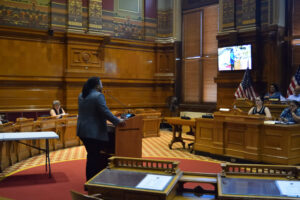




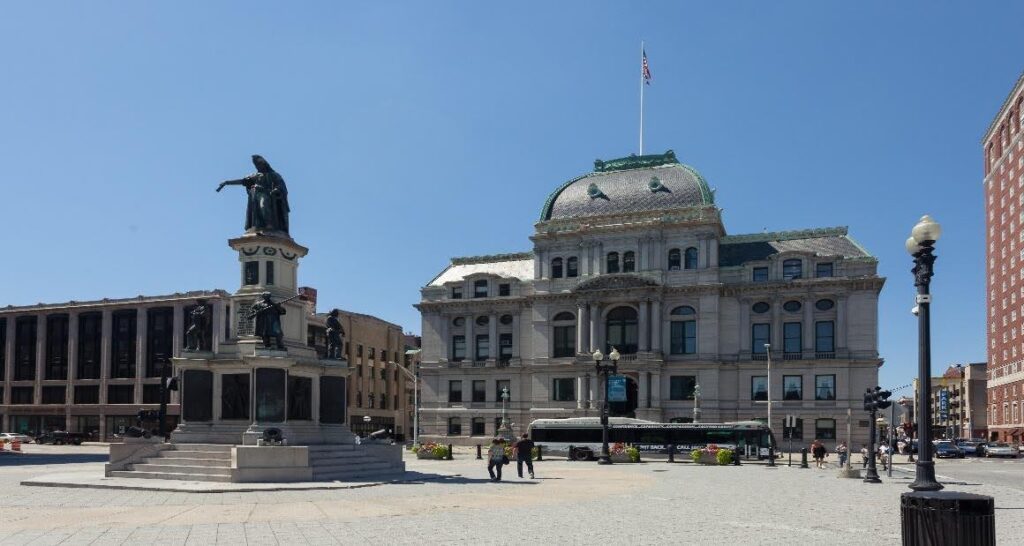
At Providence City Hall, the current Pathway to End Gun Violence Advisory Council has been meeting semi-monthly since April 2024. The council is led by City Councilor Miguel Sanchez with representation from community service agencies, city government, the police department, and the Attorney General’s Office. Its aim is to discuss preventative measures against gun violence, a practice known as Community Violence Intervention.
Community Violence Intervention (CVI) focuses on those at the highest risk of becoming victims of or engaging in violence. The rate of risk is determined by various factors, including age, mental health, location, and socio-economic background. CVI methods aim to interrupt cycles of violence, prevent retaliatory acts, and promote positive community change through collaboration between public health agencies, community organizations, and law enforcement. CVI also aims to divert youth and adults from involvement with violence towards recreation, job training, and educational activities.
Providence has a robust network of organizations working towards CVI. Organizations such as the Nonviolence Institute and Safer Communities for Justice are directly devoted to CVI; meanwhile, others contribute to CVI methods, like Providence Recreation, Princes 2 Kings of the Boys & Girls Clubs, Mentor RI, and many more.
At the June Pathways meeting, former City Council intern and recent MSW graduate Douglas McCormack presented a research paper titled “An Analytical Framework for Evaluating Community Violence Interventions in Providence, RI,” which examined Providence crime data from 2023 and 2024, and local CVI. Some of the conclusions and key points of his analysis are worth highlighting for all people who care about Providence.
Gun Crime in Providence 2023-2024
Gun crime is defined as robbery, assault or homicide with a firearm. According to the Pew Research Center, in 2023, 79 percent of homicides involved firearms.
According to the police data, gun crime jumped 7 percent between 2023 and 2024 in District 7, which includes Charles, Wanskuck, Smith Hill. In 2024, District 7 accounted for 34 percent of all the city’s gun crime. Meanwhile, District 4 (Federal Hill, West End), District 5 (Olneyville, Silver Lake, Hartford), and District 2 (South Providence, Elmwood) continued to report high levels of gun crime.
Some recent examples are: on August 19 on Flower St. near Harford Park a 19 year old man was shot multiple times. On September 14 at 235 Hartford Ave, a man and women at an outdoor gathering were shot. Earlier this summer, on July 27, two 16-year-old boys riding in a car on Reynolds Ave. were shot. This incident was followed by the shooting of a 17 year old male on Public St. on August 24 in South Providence. Fortunately all these victims survived but suffered trauma.
Community Violence Interruption in Providence
According to McCormack’s report, listening to CVI staff and those receiving services revealed several key issues. First, services for victims and training programs were appreciated in the community. But a high dependence on city funding (up to 86 percent) left agencies vulnerable when city budgets shrink.
Another issue is the uneven distribution of funding, with only three agencies – Amos House, Family Services of RI and Nonviolence Institute – receiving the lion’s share of funding. Most other agencies, like Open Doors (which provides reentry services for the formerly incarcerated), Providence Recreation Centers, and Sojourner House (which supports domestic violence victims), and others received much less. One possible solution is for the state to offer new or matching grants.
A third issue is that, while some agencies are embedded in high need areas, others are not. In Districts 4, 5, and 7, where gun violence has been on the rise, there is a clear need to scale programs and funding accordingly. Ideally agencies would be highly accessible by foot and bus to the highest crime areas. Funds could be routed to diversion programming such as recreation centers and youth mentoring in current high gun violence risk areas. The East Side, with its low incidence of gun violence, has less urgent need of CVI agencies and funds. It would be wise to focus attention and resources on where gun violence is happening now.
McCormack’s evaluation reinforces what many community members and practitioners already know: community violence, particularly gun violence, is not just a public safety issue. It is a public health crisis shaped by decades of disinvestment and neglect.
The communities in Providence most affected by high rates of gun violence are not experiencing this chance. While these are neighborhoods with strong community networks and a long history of perseverance, they have also faced decades of underinvestment, harmful policy decisions and limited access to essential resources. The involved neighborhoods were formed in large part by urban renewal policies, highway construction, and housing discrimination between 1949 and 1960.
This is most obvious in the case of Mount Hope, a primarily African American neighborhood north of downtown. The neighborhood was largely demolished to be replaced by a freeway and a USPS distribution center. Local government seldom helped residents to relocate and allowed landlords to discriminate in renting. Most often the dislocated moved to public housing projects near the new freeways. Some stayed nearby over generations. Continued discrimination in, and shortages of, housing continued the concentration of the disadvantaged in current high gun crime neighborhoods.
The challenges that residents in these neighborhoods face are real — but so are the communities’ capacities to lead change when supported with the tools and investment they need. People do not engage in violence in a vacuum. When youth grow up in environments where housing is unstable, jobs are scarce, schools are underfunded, and trauma goes untreated, violence becomes both a symptom and a strategy for survival. Committing violence can be a learned response and reaction to surviving or observing it. As a strategy, committing violence shows others you can defend yourself. Some CVI agencies address trauma through anger management counseling and mentoring.
The most important findings in the report came through in the voices of outreach workers, community leaders, and service providers who repeatedly pointed to a lack of resources, a lack of transparency about how resources are directed, and a lack of long-term investment as the biggest barriers to reducing violence.
Intervention efforts can work — especially when led by trusted community members. However, deep and long-standing problems like community disinvestment must be addressed for real change to happen.
Douglas McCormack is the Scholarship Coordinator for the RIC Foundation and a recent MSW graduate from Rhode Island College. Previously he interned with the Providence City Council focusing on policy research on community violence intervention and systems level reform. He is passionate about social justice, access to education and financial literacy.
Jean Griffin is a retired occupational therapist and the Community Outreach Lead for Moms Demand Gun Sense RI, living in Hartford in Providence.


Want to comment? Click!