




Lunch at CHOP has slowed to a comfortable hum. The delicious smell of coffee, baked goods and rich spices drifts from the kitchen. Through the tall windows of the Providence Public Library’s ground floor, light falls across the room.
CHOP (an acronym for Culinary Hub of Providence) opened in 2024 as a full-service restaurant operated by Genesis Center, a Rhode Island-based nonprofit that has been working with immigrants and refugees for over 40 years. The restaurant serves breakfast, lunch and dinner several days a week, and offers catering. The menu is creative and thoughtful. The service is attentive. And nearly everyone working in the kitchen or on the floor is there as part of something larger than a meal.
“We really are a pipeline,” says Shannon Carroll, President and CEO of Genesis Center. “We train people, we get them comfortable, some will stay here—but the goal is to help them move forward.”
The restaurant didn’t start with a business plan. It started with a glance. Carroll was attending a hard-hat tour of the Providence Public Library during its $25 million renovation. When she walked into the ground-floor space—then completely empty—and something clicked. The library had originally planned to partner with a for-profit restaurant, but that deal had fallen through. Carroll’s contact at the library caught her expression during the tour. That weekend, by coincidence, they ran into each other. “She said, ‘I saw you look at me when we talked about that space. What do you think about Genesis? And that was the beginning—a glance, and a mission.
Genesis Center started differently, on a September morning in the early 1980s and a group of people who weren’t dressed for the weather. Sister Angela Daniels, then principal of the Assumption Parish School on Potters Avenue, noticed a cluster of strangers near the church’s food pantry. She learned they were refugees from Cambodia. She thought: they should learn English. And so she opened what would become Genesis Center in the same brick building, now over a hundred years old.
What began as English classes for Southeast Asian refugees has expanded over four decades to serve students from roughly 40 countries. Programming now includes childcare, healthcare training, financial coaching, and workforce development. Carroll, who joined in 2011 and became Executive Director in 2014, describes the organization’s model as built around persistence— removing, one by one, the barriers that keep people from staying in class, holding a job, building a life.
Transportation is one of the hardest barriers to overcome. “If you don’t have money to buy a car, you can’t get to a job. But if you don’t have a job, you can’t buy a car,” said Carroll. Through a program called Keys to Success, Genesis Center provides financial coaching and a dollar-for-dollar savings match of up to $2,000 toward a vehicle. Childcare is another significant barrier. The organization’s five-star early learning center allows parents to attend class or work while their children are cared for in the same building. The logic is consistent: address people’s needs holistically, rather than focusing on one aspect of career development..
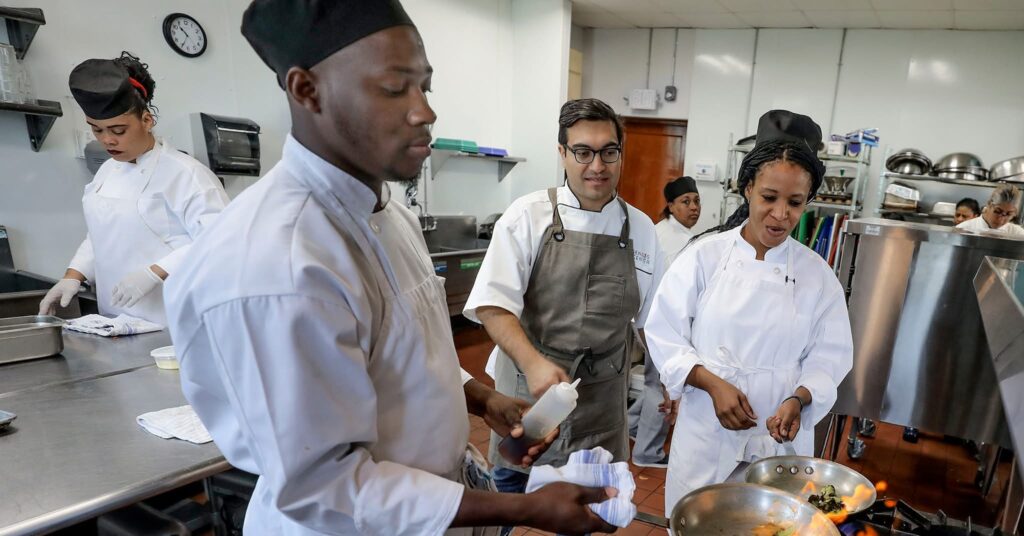
Culinary training has been part of Genesis Center since the 1990s. CHOP now serves as its hands-on training hub. Students earn their ServSafe certification, then rotate through the restaurant to gain work experience in both front- and back-of-house operations. Trainings include workshops, barista and bartending skills, and regular service shifts.
“I equate it to a medical residency,” Carroll says. “They’re doing their internship right here. The kitchen is mentored, not just managed. The head chef came to the role after working in well-regarded restaurants in Portland, Maine. The beverage and front-of-house lead has worked in Michelin-starred kitchens. Their presence gives students something precise and real to learn from.”
Around 55 students move through the culinary program each year. Some stay at CHOP. Amanda Evora, who completed the training in 2023, said “I was a part of opening CHOP and have worked here ever since. Now I’m the AM Lead Supervisor. I love that I’m able to work with and mentor new kids who are entering the program.”
Others land at restaurants across Providence or in institutional food service. One recent graduate, Aryana Offutt, was a runner-up for the Jacque Pépin Foundation’s Gloria Pépin Memorial Grant, which is awarded to top performing female culinary graduates. The award announcement noted Offutt’s “insatiable desire to continue learning,” as well as her “innate ability to combine cutting-edge culinary techniques with flavors passed down to her from her experience working in her family’s African restaurants.”
The training helps foster these examples of passion and education. On the other hand, some training participants, Carroll says without apology, discover they don’t want to work in food at all. That, too, is useful information.
On a recent afternoon, the dining room at CHOP is calm and unhurried. The food is good —genuinely good, not good-for-a-nonprofit good. The cookies are a recipe developed by Chef Susie, who was herself a student in the program before becoming its instructor. Books line the shelves. It’s easy to forget you’re sitting in a library. Apparently, not everyone realizes it. Carroll still shakes her head at an early online review that criticized the restaurant for presenting the check inside an old book.”You’re in a library,” she says.
Given that program serves folks who are here under immigrant and refugee status, Carroll speaks carefully about the current political climate—the Haitians whose Temporary Protected Status has been in legal limbo, the Venezuelans who spent weeks uncertain whether they could stay.
“People just lack sympathy. They don’t understand what people have endured to get here. They are working hard.”
Genesis Center has an annual budget approaching $5 million, a staff of 44 full-time and approximately 30 part-time employees, and a waitlist for its English classes. It partners with local health providers like Brown University Health and Providence Community Health Centers, as well as Hope & Main, Beautiful Day, and others across what Carroll calls “the food landscape” of Rhode Island. The Jacques Pepin foundation and CHOP are partners in supporting the culinary workforce in Providence. CHOP is the most visible piece of that ecosystem—a place where the mission takes a form you can taste.
Margaret Rizzuto is a photographer with over 15 years of capturing the beauty of food and people. As a Brooklyn-born Italian, her love of food runs deep. Margaret relocated to Providence in 2020 and quickly fell in love with the city—especially its vibrant food scene. When asked how she enjoys life in Providence, her response is always the same – “It’s so easy to be here!” which is a reflection of the city’s welcoming nature, its people, and the incredible foods. www.margaretrizzuto.com @aprovidencepalate


Want to comment? Click!