






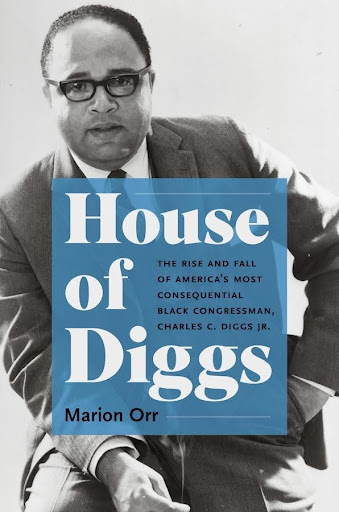
For someone who was, by all accounts, quiet and reserved, Charles Coles Diggs, Jr. — Michigan’s first Black member of Congress, founder of the Congressional Black Caucus, and icon of the Civil Rights era — lived a remarkably dramatic life of stratospheric highs followed by abysmal lows.
Born in Detroit in 1922, Diggs, after his Army service, rose quickly to prominence as a local politician and soon made his way to Washington. Here, following fifteen years of effective and energetic public service, he was forced out of Congress, having become embroiled in a payroll kickback scandal involving one of his employees.
Now, Marion Orr, Frederick Lippitt Professor of Public Policy and also professor of political science and urban studies at Brown University, has written a thorough and sympathetic biography that reclaims Diggs’s place in history, ensuring that the many achievements of his career are no longer overshadowed by the disgrace of its end.
Diggs is fortunate in his biographer. Orr is a graceful and engaging writer who understands how to stir and keep the reader’s interest. While Diggs’s fascinating political career is rightfully the focus of the book, Diggs spent the first part his life out of politics. Rather than plod through this material in a way that merely dresses up a dull chronology, Orr presents it in a series of vivid, essayistic vignettes connecting Diggs’s story with wider social and political histories, providing the reader with a thorough grounding in Diggs’s context while also conveying the essentials of his early life.
Diggs grew up in pre-WWII Detroit, the son of an up-and-coming businessman who was assiduously building the House of Diggs, the city’s largest funeral home. After being drafted in 1943, Diggs was assigned to a series of posts in the Jim Crow South, an experience that would prove formative. Diggs was repeatedly humiliated in public—jeered at, forced to sit in separate areas in theaters, cinemas, on trains and buses. Every aspect of public life was difficult and dangerous; the threat of violence was constant. After a promotion, Diggs was sent to Atlanta for additional training. Crossing into the South, Diggs recalled, “I was transferred to the coach next to the locomotive,” where the engine’s smoke and noise were the most intense. “When I was seated to eat in the dining car, a green curtain was pulled around me technically separating me, even in a military uniform.” Such was the “intractability of white supremacy policies,” not to mention the vicious attitudes and actions they enabled and enforced. These experiences forged Diggs’s conviction that white supremacy is not just incompatible with democracy but wholly antithetical to it—a rot, a blight.
It was a short step from here to politics. Although he lost a city council race, his defeat revealed something important: He could appeal to voters beyond Detroit’s Black community. Analyzing the demographics of Michigan’s 13th Congressional District, he noticed that while more than sixty percent of voters in the district were white, four of the six West Side wards in the district had preferred him to his white opponent—and his vote totals from those wards exceeded the total won by the district’s incumbent by almost ten thousand votes. Diggs recalled, “I concluded I could beat this guy.”
Orr has done a truly impressive job navigating the complexities of his subject. Rather than treating his subject as an abstraction, as a mythological figure or cautionary tale, Orr presents Diggs as Shakespeare or Dickens might have, with attention to his many facets, showing him in the round. Diggs was flawed, to be sure, but he was also a highly effective and committed public servant who was truly good at what he did. Orr presents him as a waymaker, someone who could unite stakeholders with different interests around a common purpose to get necessary work done. It was a role he embraced, and one in which he quietly excelled.
Diggs’s style—which Orr describes accurately, if prosaically, as “strategic moderation”—combined flexibility with a focus on the big picture. It is easy to call him a “moderate,” but Orr argues that this moderate label demands more specificity. Diggs did not merely win elections but was, as Orr repeatedly points out, actually “effective in Congress.” His moderate positions reflected his awareness of how much sheer work was required to get things done, something he had to learn repeatedly in Detroit, where he had worked “with the liberal-Black-labor coalition that dominated Michigan Democratic Party politics” until the late 1960s. “Diggs was moderate,” Orr writes, “in that he believed Black Americans should actively work to achieve political incorporation into the Democratic Party, contribute to the party’s post-New Deal coalition, and advocate for change in government policy in civil rights and related areas in Congress.”
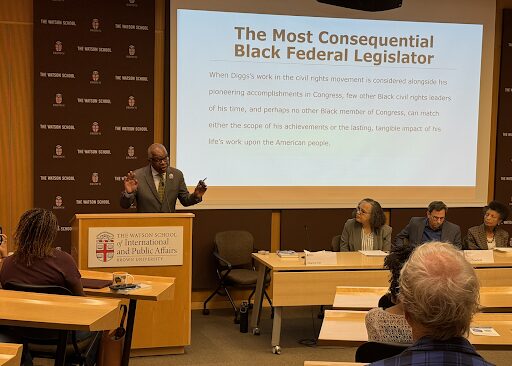
The work is the point—and Diggs did it, ceaselessly, tirelessly. His output was prodigious. On September 29, speaking at the Watson School of International and Public Affairs, on the Brown University campus, Orr shared stories and insights from his years of research for the book, including his findings from an archive of Diggs’s documents that ran, astonishingly, to more than seven hundred and fifty boxes worth of memos, reports, letters, and more. House of Diggs is the work of many years, a long labor of love. It is also a moving encounter with a flawed man and a gifted politician, as charming and personable as he was motivated and organized, seemingly capable of anything. His achievements are so many and varied as to defy listing. Simply, Diggs was a powerhouse. The scandal that marred his legacy shouldn’t be the last word on it—and now, with this book, it isn’t. Of the many urgent questions raised by this necessary and compelling biography, perhaps the most pressing is the question of second chances—who gets them, who doesn’t, and why.
+++
Diane Josefowicz is the author, most recently, of Guardians & Saints: Stories, published in October by Cornerstone Press. Her second novel, The Great Houses of Pill Hill, will be published in May by Soho. She lives in Providence with her family.


Want to comment? Click!