






On Thursday April 24th, Immigration and Customs Enforcement (ICE) officers detained a man after a confrontation in front of his home in Providence.
The man, a Dominican national living in the U.S. without legal authorization, had previously been arrested on multiple charges, including domestic violence, according to an ICE spokesperson.
“Upon his apprehension, the alien became combative with the officers and our officers and attempted to grab the belt of an arresting officer,” the spokesperson wrote in a statement to the Providence Eye. “As a result, one of the ICE officers deployed a taser to subdue the individual.”
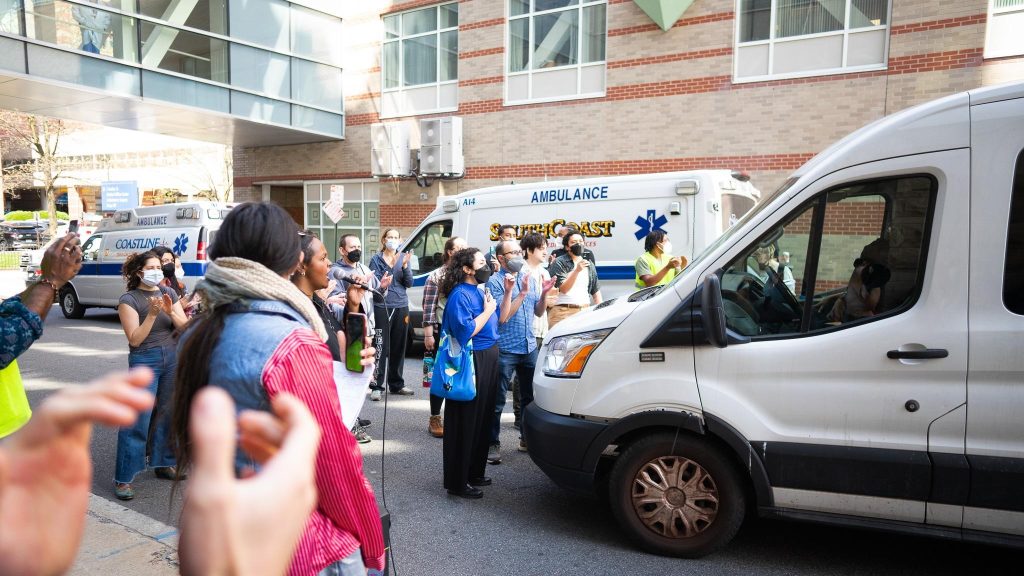
By the time the man was transported to Rhode Island Hospital with ICE officers, a crowd of over 80 protesters was already waiting outside.
Protesters had received a mobilization alert via a WhatsApp and Telegram group called the ICE Watch Alert Channel organized by the Rhode Island Deportation Defense Coalition.
The coalition’s response system starts with an ICE-spotting hotline. Verified sightings trigger a mass mobilization alert through the watch channel, directing community members to the site of the detention.
“We are here peacefully to make it clear we defend our community,” said Kate Hao, a coordinator with the coalition, “These community demonstrations have been effective in deterring actions by ICE and we’ve seen this demonstrated throughout the country.”
The protesters aimed to delay ICE operations to give the man time to contact legal representation and his family, Hao added. Protesters blocked a van they believed belonged to immigration enforcement.
Kevin Santos, the man’s attorney, told reporters at the scene that ICE and hospital staff blocked him from speaking with his client, despite a signed form confirming his legal representation. People detained by ICE have the right to consult a lawyer, regardless of their immigration or criminal history, though the government is not required to provide one.
Rhode Island Hospital did not respond to the Eye’s initial request for comment. Santos and ICE did not respond to follow-up inquiries.
“We organized this protest as a response to make sure the person who was being detained got access to their rights,” said Sophia Wright, communications manager at Alliance to Mobilize Our Resistance (AMOR), a member organization of the coalition. “We weren’t able to guarantee that, but we were able to delay (ICE), and we hope that delay reinforces that this person is not going to be disappeared by themselves.”
Plans in action
This was the group’s first mobilization against an ICE detention, according to Wright. However, they said the coalition had been planning for such an event for months.
The coalition began bolstering their community network when President Donald Trump was elected for his second term in November, Wright said. Member groups hold outreach and mobilization workshops to prepare residents to protest and to spread word of the hotline.
“A big part is to help put on trainings and events that make people feel supported and prepared to show up for something like today,” Wright added.

While the hotline predates the current administration, Hao said activity has escalated at “a wild rate” since Trump’s inauguration in January, with arrests growing “quicker and more severe.”
Trump pledged “the largest domestic deportation operation in American history” during his 2024 campaign.
Over 100 days into his second presidency, federal officials with “direct knowledge of the plan” said the administration’s current goal is to deport 1 million migrants in a year, far surpassing the Obama administration’s previous record yearly deportations of 400,000, the Washington Post reported in April.
The officials added the metrics of calculating such a statistic are unclear, and analysts have called the target “unrealistic, if not impossible.” Still, NBC data suggests ICE arrests have doubled since January and the number of people in detention is at an all-time high.
What happened to “safe spaces”?
In January, the Department of Homeland Security under the Trump administration rescinded the Biden-era “Protected Areas” policy. This policy designated locations such as hospitals, schools, and places of worship as areas where immigration enforcement actions were generally to be avoided.
Editor’s Note: See The Providence Eye related story on Providence as a Sanctuary City
2021 guidelines allowed ICE agents to make exceptions, including during a “hot pursuit of an individual who poses a public safety threat.” The new policy instructs officers to “continue to use that discretion along with a healthy dose of common sense.”
An ICE spokesperson wrote the officers involved in the April 24th tasing “were justified in their actions, especially considering the individual’s violent history.”
While the man was already in ICE custody upon his arrival at the hospital, the incident was “nonetheless concerning,” according to Maria, a neurosurgeon at Rhode Island Hospital who was present during the detention and is not a hospital spokesperson.
“I was disturbed to hear someone was being removed from the hospital by ICE,” she said. “A lot of people are not aware of the incredibly negative impact this kind of action can have on healthcare and the entire community.”

Surveys conducted by KFF (formerly known as the Kaiser Family Foundation) during the first Trump administration found that immigration enforcement had already begun to reshape health-seeking behavior—reducing participation in Medicaid and CHIP and discouraging hospital visits.
“If people are afraid to go to the hospital they won’t get effective medical care,” Maria said. She said that when groups avoid care, it can have broader public health consequences, particularly in managing infectious diseases.
“Across the country it’s just an incredibly misguided approach to any sort of enforcement,” she added, referencing a March incident in which a U.S. citizen child recovering from brain cancer was stopped by ICE alongside her undocumented parents while en route to a medical appointment.
“I’m a neurosurgeon and was horrified. We need to recognize that certain areas are highly sensitive and highly crucial to our functioning as a society, and that includes the hospitals.”
As federal immigration enforcement intensifies, community organizers say they are preparing for more confrontations.
“Defense against ICE is all about community,” said Wright. “The more people in our community who get involved, the stronger we are.”
Editor’s Note: The AMOR (Alliance to Mobilize Our Resistance) Hotline is (401)675-1414
Maya Davis is a senior at Brown University studying Biology and Security Studies. Originally from Brooklyn, NYC, she is a D1 gymnast and a journalist with a passion for international reporting and investigative storytelling. She has reported for CNN, CNN Español, CNN International, WebMD Health News, and Medscape Medical News. Her coverage spans breaking news, global health, politics, and sports.
Currently, Maya serves as a staff writer and data desk reporter at The Brown Daily Herald and volunteers as a local reporter at The Providence Eye.


Want to comment? Click!