




In the United States today, only one student in four at any grade level is proficient in writing. This has been the case for decades. Is it something about the way they are taught? Is it the effect of social media on their concentration? Experts differ and theories abound, but there is consensus that among most students there is a fear of writing.
Since writing is usually a necessary skill for better-paying jobs it is important to explore where the roadblocks are. It is equally important that good writing supports democracy–an effective letter to an editor or a political representative stands out and is an opportunity for the writer to take civic responsibility. AI cannot turn students into active citizens who act based on values. These are instilled by negotiating life and its rollercoaster of ups and downs. The Writing Center at Princeton says: “Writing is ninety-nine percent thinking, one percent writing.”
The writing students need for their various trajectories through school and future careers is not the same as sending a text or responding to online content. While this kind of casual communication is part of most teenagers’ lives, it does not require the skills needed to analyze a text, write a research paper, or create the kind of college essay that lights up an admissions officer. And now, teachers of writing in our schools and colleges must also address the advent of AI. Does AI change the story?
This was the subject of some informal conversations I recently had with a group of teachers from the Lincoln School in Providence. Several thoughts emerged.
“We have to re-examine what we ask students to write about … [We have] to think about the things that matter to them. Relevance. Rethink the way we teach,” said Emma Stenberg, Head of the English Department.
Another member of her department, Allie Donahue, added “AI is giving me a better idea of student worries and their response to stress…I think it’s okay for administrative teaching tasks–especially for a complex topic–but at the same time, when I use it, I feel I’m losing my ability to think critically, I’m not using a part of my brain.” AI may seem like a way to reduce the stress that many students associate with writing and though Donahue thinks this has opened her eyes to a better understanding and a more compassionate approach to this she maintains that teaching critical thinking is key to producing good writing
History teacher Laurel Flinn said: “[AI] can create steps through which they tackle a project–and teach them there are no shortcuts. [But] if they only learn how to do the project using AI, they will end up with a bad product … To high school students it’s a kind of magic–but it has real disabilities, and they can’t see…the limitations.” To put this another way: thorough research and close reading of materials, together with thinking about them critically and generating good questions cannot be done by AI. Although AI can be a helpful tool after these preliminaries.
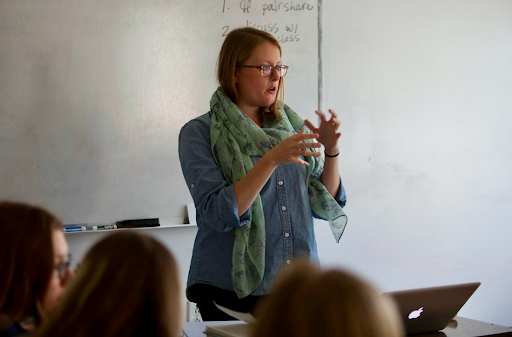
To dig deeper I also spoke with a public school teacher at The Met School in Providence, Austin Menta.
Austin uses AI for brainstorming ideas and outlining lesson plans – but then improves on the results to make sure it is on target for the learning goals he has for his students. “It’s an 80-20 ratio” he says, “80% teacher, 20% AI….AI needs the right prompt to be useful.”
Menta says that a carefully constructed prompt on how to begin a research project can produce some tools from AI on how to proceed. It reduces the blank screen panic syndrome. “It has to be a tool, not a crutch” he said. “Students are not sure what they think about it yet…but it can be a tool that leads them toward thinking about learning in a different way.” He understands the importance of spending time in regular conversations with students about using AI responsibly. Responsible use involves learning how to create the kinds of questions that involve thinking on the students’ part so that AI can then become a useful support mechanism – but the thinking must come first. In addition, understanding the difference between reliable and unreliable information on the Internet and how to check is an important skill to develop rather than trusting AI without question.
One of the downsides, he says, is the way students misunderstand what their share of the work needs to be. They lean too heavily on AI to perhaps analyze an article and don’t read it themselves and are therefore not thinking for themselves about how it might (or might not) pertain to their projects. This can lead to the erosion of media literacy skills. Giving very clear directions about which steps can use AI and which steps must use the students’ own brains is central to his teaching.
Writing and talking about students’ daily reflections with a mentor helps to “nudge them into thinking and the skills they are developing” he said, “but sometimes it’s hard to convince them.”
It’s hard for students to understand that AI can’t think. Overuse, including by teachers, erodes critical and creative thinking. On the other hand it can save time, including the amount of time spent thinking. “However,” Austin concluded, “the expectation is that all writing must be the students’ own work.”
As of May 2025, the Providence Public Schools District (PPSD) says it has begun to introduce AI in schools mostly as a toolbox for teachers. It asked for proposals to create a Toolbox for Teachers for the 2025-2026 school year to be submitted by the end of June. It is to focus on generating curriculum materials, inspecting student writing, converting videos or articles into notes or slides, creating student assessments, assisting with lesson plan creation and generating math word problems. PPSD has an acceptable use policy for the Internet which will also cover the ethical and responsible use of AI. More detailed information about these plans may be found at Providence Public Schools.
Right now, it seems local teachers are using AI with care and applying their own ability to think critically and creatively about what it produces. However, it is vital that the upcoming generations of Providence students, and indeed teachers, do not forsake the development of critical and creative thinking themselves. Losing or never learning these skills by relying too heavily on something that cannot think, can be inaccurate, and can be biased, will hinder the ability to improve writing, make it more nuanced, more particular or more accurate.
It is vital to promote the importance of the individual human response and allow students to feel affirmed for it. The contributions of our local teachers in encouraging and challenging students to do this needs recognition and support. The Toolbox for Teachers appears to be a promising first step. It will be important to evaluate its impact as the upcoming school year unfolds. We sometimes see the bumper sticker “if you can read this, thank a teacher” but now perhaps it should read “ if you can still think and use AI responsibly, thank a teacher.”
“What are you trying to be free of ?” asks poet Joseph Fasano in his poem For A Student Who Used AI to Write A Paper– “the living? the miraculous task of it?”
Ruth Marris Macaulay is a retired educator who taught in Providence for 34 years. Born in England she has lived in the United States for 47 years and became a citizen in 2000. For 20 years she was a mentor teacher to students in Brown’s Teacher Education Program and was a Visiting Lecturer in the Education Department for a year, doing weekly observations of student teachers in Providence public schools.


Want to comment? Click!