






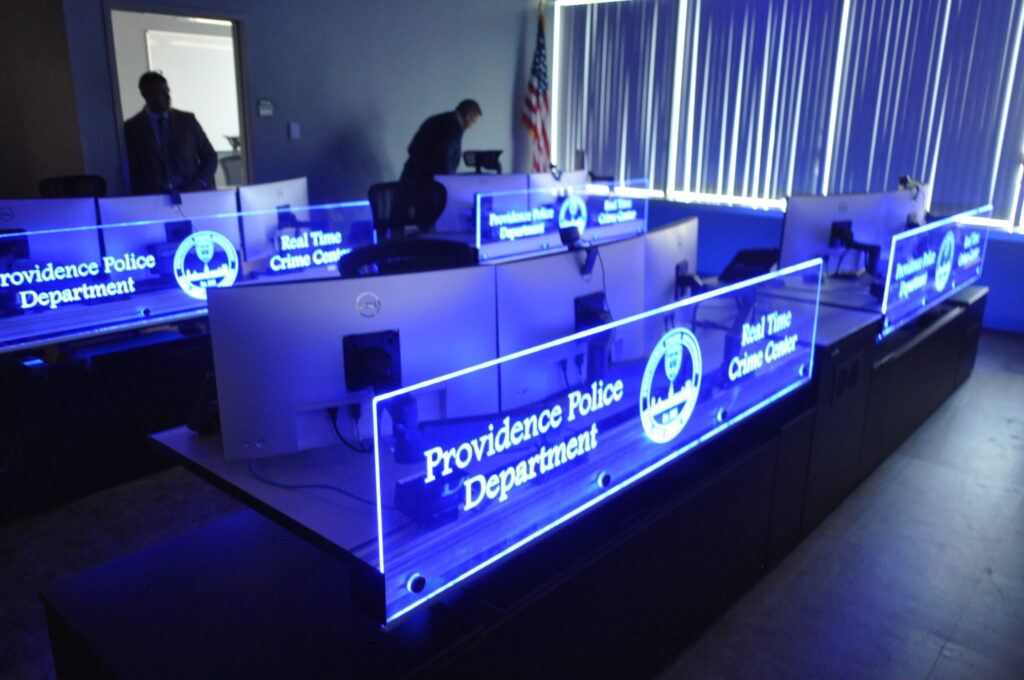
Inside Providence’s new Real Time Crime Center, blue lights illuminate a dark room filled with desks holding computer monitors and a wall covered in screens. The screens reveal a map of the city covered in green dots. Each dot represents a police officer body camera moving up and down the city streets. Camera symbols mark buildings on the map, representing 300 surveillance cameras that are owned by city and private individuals.
In operation since mid-August, investigators say the citywide surveillance inside the Real Time Crime Center provides rapid response times and investigation turnarounds. Critics argue that the system, which is dependent on hundreds of terabytes of data collection on city residents, puts local policing on the fast track towards dystopian monitoring.
Three years in the making, the facility at 325 Washington Street is funded by a $1 million grant from the U.S. Department of Justice Community Oriented Police Services. Seventy-five percent of that money goes to operating Axon Fusus software, according to the Rhode Island Current. Axon Fusus brings together surveillance tools like camera video, drone footage and automated license plate reader hits into a centralized hub. The police department’s digital intelligence unit can use a single interface to check hundreds of surveillance feeds, gather identifying information and distribute it to patrolling officers.
Captain Dennis O’Brien points to rapid arrests as examples of success during the center’s first month and a half, including a case investigating a woman’s report that a man sexually assaulted her in downtown Providence.
“They check a couple cameras. Sure enough, we see the interaction with this young female and this gentleman that touched her inappropriately,” said O’Brien. Using that image of the suspect, police arrested him about an hour later. “Before we had the technology, we’d have to go downtown and look for video, which could take days sometimes.”
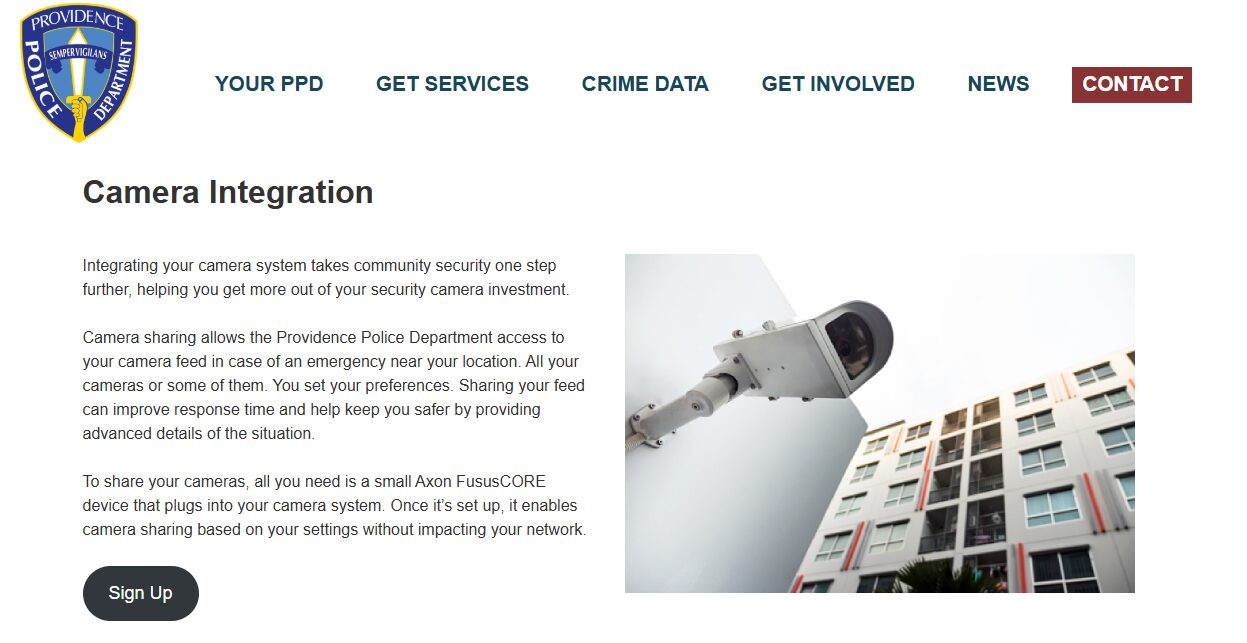
To increase their camera coverage, Providence police are pushing to integrate private surveillance systems into the Real Time Crime Center. City residents can voluntarily enter devices, such as a Ring camera, into a community registry. There is an additional option to offer police direct access to each video feed. This summer, police sent a recruitment email featuring a video explaining the system to all licensed businesses in Providence and are hoping large entities like universities will integrate their surveillance tools. So far, police have successfully doubled their camera feeds, adding 150 new video cameras located mostly downtown to join the 140 already operated by police and government facilities.
“There’s a physical response taking place in the field, and there’s a virtual response taking place here,” said Digital Intelligence Unit supervisor Sergeant Jonathan Primiano. His detectives can check for license plate reader hits, email images of suspects to patrol officers and monitor live feeds from body-worn cameras all from behind a desk. “In the time it takes a patrolman to drive to that scene, talk to a victim, find out what happened, maybe get a description of a suspect or a vehicle, in most incidents where we have assets available to us, we’ve done all that work,” he said.
Civil Liberties Groups Seek to Protect Privacy
Over 200 locations in the U.S. operate some form of Real Time Crime Center according to the Electronic Frontier Foundation (EFF), a nonprofit defending civil liberties in the digital world. For groups like the EFF and the American Civil Liberties Union, this “cutting edge” of policing invades personal privacy, encroaches on civil liberties and puts the personal information of city residents in a dangerous system of unregulated data sharing.
“One has a limited expectation of privacy on the street. Somebody could see you, but you don’t necessarily expect that that person is going to be able to follow you or retroactively be able to figure out where you’ve been at what time,” said Beryl Lipton, a senior investigative researcher with the EFF. “If an individual were to do that to me, that would be stalking.”
Rhode Island ACLU policy associate Madalyn McGunagle said this kind of pervasive surveillance could intimidate citizens and prevent them from participating in public life.
“We are fearful that could come into play for certain Constitutionally protected activities,” said McGunagle. “If you know that there’s gonna be a protest happening that’s right near a camera that sees right into the Real Time Crime Center, you might not want to go for fear of being watched.”
In an open-letter released in August, the ACLU criticized Providence police for “proactive use of a police drone to monitor activity at the annual Dominican Festival Rhode Island, a First Amendment-protected event.”
The Real Time Crime Center operates a drone, which O’Brien said is used for large scale events. While police flew the drone over a parking lot during the festival, an officer identified a group acting “suspiciously” and “kept an eye on them.” Officers allegedly saw a gun exchanged and dispatched police to the scene using one of the car’s descriptions. O’Brien said they apprehend the suspect, who had a warrant out for his arrest from a previous shooting.
The ACLU said this example contradicts police promises for video monitoring to only be “reactive” or “used in very limited circumstances.”
To control the slide towards mass surveillance, the Rhode Island ACLU is pushing for local legislation that provides oversight and accountability over the Real Time Crime Center and automated license plate readers.
According to Captain O’Brien, Providence police regularly audit both the RTCC and ALPR system. O’Brien says only select detectives can access the RTCC, and every ALPR lookup must be connected to an active case number.
The RTCC’s Standard Operating Procedure says the center must comply with “departmental policy and all applicable laws,” but the Providence Police, the EFF and the Rhode Island ACLU could not point to any local, state or federal regulations specifically governing automated license plate readers or Real Time Crime Center technology.
“It doesn’t have any real oversight. There’s a lot left to the imagination in the SOP, I’ll say that,” said McGunagle, who cites the recent story of Texas authorities using license plate reader company Flock to track a woman seeking an abortion as an example of how surveillance tech can be abused. “The use of these technologies has been increasingly, steadily expanding, and so that creep into daily life is rather Orwellian.”
Surveillance Tech Faces Little Regulation
The lack of regulation facing companies like Axon and Flock is a major concern around the surveillance industry that is built on nationwide sharing networks.
Flock cameras across the country collect intimate information about individual’s movements, and police departments may unknowingly share data with federal agencies or leave resident data vulnerable in legal battles. According to the Providence Police’s Flock transparency portal, the city operates 73 of these cameras and shares their data with 35 other police departments.
Providence Police sign memoranda of understanding about data sharing with each of these departments that include a right to audit any Flock activity, but EFF’s Lipton said agreements like these are practically unenforceable on data systems that are “very leaky.”
“It facilitates sharing that sometimes the police agency doesn’t understand itself, and so it allows access, at times, to very sensitive tracking location information on individuals,” said Lipton. “If this data gets used for immigration enforcement, you can’t pull that back in. That damage has already been done.”
In addition to cameras and drones, the Real Time Crime Center employs Accurint by LexisNexis, a database of personal information such as social security numbers, personal addresses, phone numbers and names of associates. Providence police say the product only uses “publicly available and proprietary records,” and Accurint could be used for something like contacting a victim’s family members.
However, complaints against these massive data brokers accuse them of helping officers bypass the traditional processes of seeking subpoenas, court orders and gathering warrants. Just Futures Law sued LexisNexis for selling private information to police through Accurint, and ICE uses Accurint to skirt sanctuary city laws by tracking incarceration status and prison release times.
“There isn’t a good federal law that really puts bounds on this type of data collection and data sharing,” said Lipton. “Some of the better restrictions we see depend on state laws and sometimes on local ordinances, but only if those local ordinances and state laws have real mechanisms for accountability.”
City Council Advances Limited Local Regulations
On October 6, the RI ACLU urged the Providence City Council to put some boundaries on this new technology by amending the city’s Community Police Relations Act. The changes clarify police policy when interacting with ICE, expand accountability measures and bar authorities from using “Real Time Crime Center technology or Automated License Plate Reader technology” to assist with federal immigration enforcement or collect demographic information without a judicial warrant. Three hours of public comments overwhelmingly supported the regulation and called for the city to shield neighbors from predatory immigration agencies.
“As technology advances, we need new protections from misuse of electronic surveillance,” said Providence resident Nancy Green during testimony. “Just as we committed to building a hurricane barrier, we must build laws to protect our city from being drafted into serving ICE.”


Lipton echoes Providence residents’ calls for caution, regulation and accountability measures for abuse of surveillance.
“That’s not a hypothetical situation. That’s something that has happened,” said Lipton. “If they can’t be bothered to take into consideration the reality of the misuse that has occurred with these systems, I think that they should not be bothering the public with a mass surveillance system.”
The Providence City Council unanimously passed the amendments in a first round of voting on October 16. The council will vote on the measure again on November 6.
Providence residents, police and their cameras will be watching to see what comes next.
This story was created in partnership with Journalism New England. The writers are all Providence Eye Community News Fellows and their bios are listed here.
Want to comment? Click!