






Providence may soon be at the forefront of improvements in the way we vote.
Many citizens, in Providence and across the country, express frustration with their elected officials and fear for our democracy. They are sick and tired of negative campaigning and extremist candidates. Countless times they wonder, “How did we get to this point?” As it turns out, the obsolete way we vote causes a lot of these problems.
“What do you mean?” you might ask. “After all, the majority always wins, right?”
Well, no – that is not the way elections work in our “single vote plurality” system, which we inherited from England 250 years ago and, unlike most other democracies, have yet to fix.
Under our current system, candidates can and do win with only a “plurality” of votes, which means that they only need to receive more votes than their competitors. For example, a candidate in a six-competitor primary can win his or her party’s nomination with as little as 17% of the vote. Still worse, because an average of only 10% of voters participate in primaries, a 17% plurality enables the candidate to move forward with support from less than 2% (17% x 10%) of the voting population!
This kind of low-percentage, “splintered vote” nomination occurs often in Rhode Island. For example, when Gabe Amo sought the Democratic Party’s nomination for Congress – which in his district meant almost certain victory in the final election – 12 candidates split the primary vote. Congressman Amo won a plurality with only 12,946 votes, 32% of those who voted and only 3% of the registered voters in his district. Similarly, the winner of the five-candidate 2022 Democratic gubernatorial primary, Dan McKee, received support from fewer than 5% of all registered voters but claimed victory with a 32.8% plurality.
This serious flaw in our current system has contributed to our increasingly toxic, partisan political environment by enabling candidates whose views lack general support to win a plurality by mobilizing hard-core supporters to vote in the primary. This often then leads to a general election win. Parties have even quietly funded the campaigns of opposing party candidates specifically to split the vote and enable their own candidate to achieve a plurality.
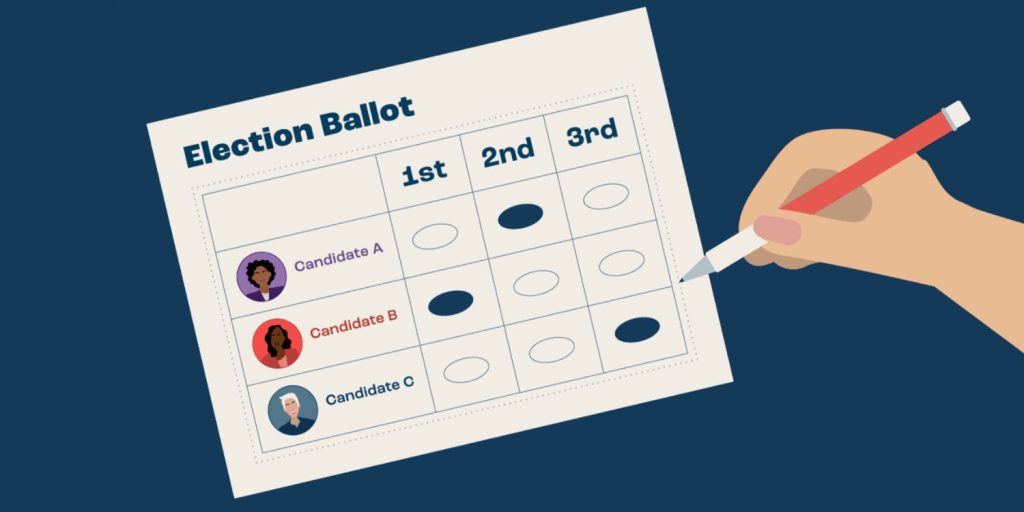
The good news is that, with a simple tweak to our current system, we could ensure that winning candidates have the support of a majority of voters. It’s called Ranked Choice Voting.
Instead of limiting voters to a single candidate choice, RCV allows voters to rank candidates in their order of preference. This adds power to each voter, because if their first-choice candidate performs poorly, their second-choice vote is counted. (For an entertaining demonstration of how RCV works by voting for your favorite ice cream flavors, click here.)
According to RankTheVote, as of April 2025, RCV is used in 52 American jurisdictions that are home to nearly 14 million voters. That includes two states, three counties, and 47 cities. Alaska and Maine are using RCV in primaries and general elections. Six southern states have military and overseas voters cast RCV ballots, because of how early they must vote. The dozens of cities and counties using RCV are in Blue States (such as San Francisco, CA, and Cambridge, MA), Red States (including Salt Lake City and Kearns, UT), and Purple States (including Minneapolis, MN; Santa Fe, NM; and Arlington County, VA).
The recent New York City mayoral primary election used RCV to ensure that finalist candidates have the support of a majority of their party’s voters. Consistent with exit polls from other RCV elections, 96% of NYC voters said that using Ranked Choice Voting was easy, and 76% wanted to keep it in place or even expand it to other elections.
By giving voters the opportunity to rank candidates in order of their preference, research shows that RCV offers a number of benefits. It is easy for voters to use; increases voter turnout; reduces negative campaigning; eliminates the need for expensive, poorly attended run-off elections; frees voters to vote for their favorite candidate, without worrying about wasting their vote on “spoilers” or a candidate who might already have withdrawn from the election; and – arguably most important – elects leaders supported by the majority of voters. Unlike plurality elections, candidates who win a Ranked Choice Vote election have a genuine mandate from their constituents.
Ranked Choice Vote is non-partisan, because it benefits candidates whose views best reflect those of their constituents regardless of ideology. Unfortunately, wealthy individuals and organizations that promote candidates with extreme views – particularly on the Right – fear that RCV elections may enable voters to elect more moderate candidates, so they have been spending a great deal of dark money to preserve plurality elections and prevent voters from embracing majority rule. Sadly, this opposition is sometimes also supported by leaders of political parties and their donors, who have traditionally controlled the candidates who appear on ballots. RCV empowers voters to break the monopoly of wealthy donors and political party bosses.
Here in Rhode Island, the movement to adopt RCV is gaining momentum, and Providence is poised to play a leadership role. Bills were filed in the House and Senate each of the past two years that would pilot Ranked Choice Voting during the 2028 presidential primaries. More than 4,000 Rhode Island citizens have signed petitions supporting this legislation.
During the 2025-26 legislative session, we also expect a bill to be filed that would allow cities and towns to voluntarily adopt RCV for local elections, as more than a dozen other states have done, including nearby New York, Vermont, Massachusetts, and Maine. Similar bills are being filed in Connecticut, where Governor Lamont is a major proponent, as well as New Jersey.
Meanwhile, members of the Providence City Council have expressed strong interest in seeing both bills enacted into law. Councilman John Goncalves, who has long been a strong supporter of RCV, has offered to take the lead on a resolution from the Council that would ask the legislature to enact this legislation.
I encourage you to join the movement to bring the benefits of Ranked Choice Voting to Rhode Island. After all, we need elected officials who represent all of us.
Scott Shuler retired with his wife to Providence after a career as a teacher, professor, Connecticut Department of Education curriculum specialist, and assistant superintendent of schools. He is currently a member of the Ocean State Ranked Choice Voting executive board. For more information about Ranked Choice Voting, go to OSRCV.org.


Want to comment? Click!