






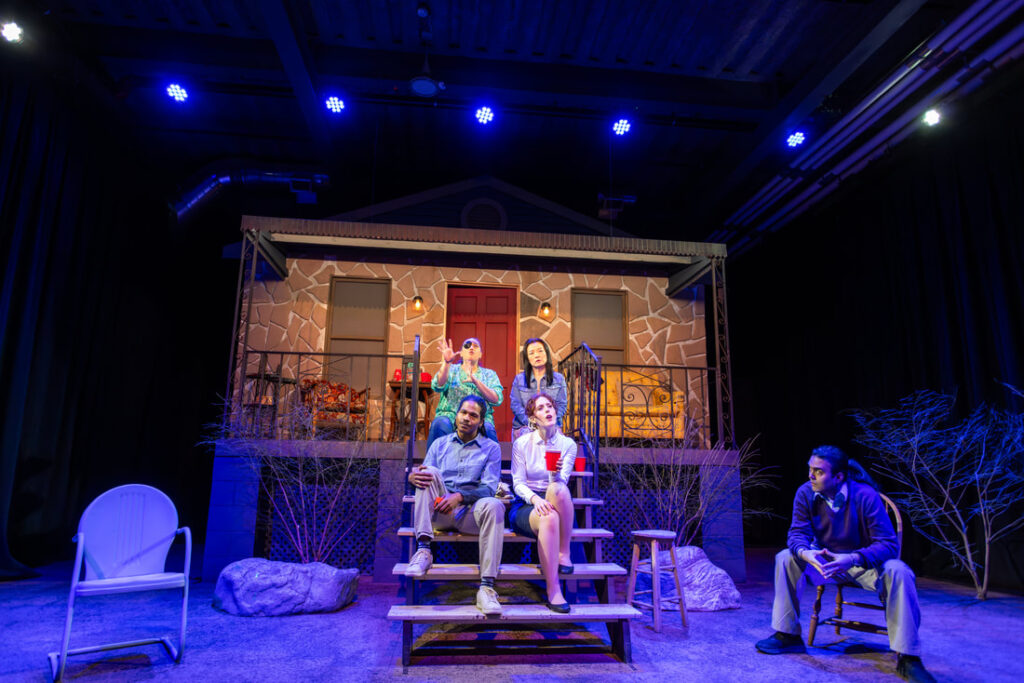
Branden Jacobs-Jenkins’ “The Comeuppance” is a darkly comic, post-pandemic reunion drama that cuts with the precision of a scalpel and the force of a gut punch. In The Wilbury Theatre Group’s riveting production, five former high school outsiders gather on a front porch in suburban Washington, D.C., ostensibly for a drink before their 20th reunion. But the reunion is merely a pretext. The real event is the reckoning that unfolds in the liminal space between past and present, youth and adulthood, hope and disillusionment.
These are millennials who came of age under the shadow of Columbine, 9/11, and the wars in Iraq and Afghanistan—then entered adulthood just in time for political fracture and a global pandemic. Jacobs-Jenkins captures the psychic residue of the 2020s not through plot mechanics but through behavior: the brittleness, the gallows humor, the exhaustion that settles into the bones. His characters move as if the world has already ended once, maybe twice, and they’re still pretending it hasn’t.
Wilbury’s ensemble delivers performances of remarkable depth and precision. Ursula (Christine Treglia), the group’s gravitational center, still lives in her childhood home and bears the physical consequences of diabetes. Emilio (Rodney Witherspoon), now a successful artist living in Germany, returns with the uneasy confidence of someone who escaped. Caitlin (Jenna Lee Scott) is trapped in an unhappy marriage to a man who attended the January 6 protests (but didn’t storm the Capitol). Kristina (Francesca Hanson-Diebello), a doctor and mother, has lost track of who she was before responsibility consumed her. And Paco (Marcel A. Mascaro), Kristina’s cousin and Caitlin’s ex, is an Iraq War veteran whose PTSD manifests in seizures that ripple through the group like aftershocks.
They once called themselves MERGE—“multiethnic reject group”—though they can’t agree what the “E” at the end stood for, or if it was a soft “G,” or even who counted as a member. Each remembers high school differently, and the “outsider club” identity they once cherished now feels like a myth they can’t quite let go of. Their memories don’t align, and that slippage becomes the play’s quiet thesis: nostalgia is unreliable, and the stories we tell about our youth are often myths we cling to long after they’ve stopped serving us.
Under Don Mays’ extraordinary direction, the ensemble moves with a choreographic precision that mirrors the play’s tonal whiplash. Humor and pathos collide in rapid succession, never letting the audience settle. Each actor delivers a performance of remarkable depth, revealing the ways trauma, disappointment, and longing have shaped these characters’ bodies and choices. It is, in every sense, a Wilbury hallmark: bold, collaborative, and unflinchingly alive.
Jacobs-Jenkins refuses the comfort of nostalgia, instead exposing it as a coping mechanism. Beneath the banter is dread—political, physical, and existential. The porch becomes a pressure cooker where old wounds erupt, illusions collapse, and the characters confront the gap between who they were and who they’ve become. What makes the play so piercing is its refusal to let anyone off the hook. Each character must confront the gap between who they were and who they’ve become, between the myths they built together and the lives they’ve actually lived.
The meeting at Ursula’s house was Simon’s idea, another former member of MERGE, until he cancels at the last minute. His absence becomes a haunting presence. He is talked about, remembered, and mythologized. Near the end, Emilio reaches him by phone, and Simon delivers the question that distills the play’s existential ache:
“How did I get it into my head that life was supposed to be something other than this?”
It’s the question of a generation that inherited crisis after crisis, and it lands with devastating clarity.
Wilbury’s production is a triumph of ensemble work, direction, and dramaturgical insight. It leaves you wondering what a follow-up play twenty years from now might look like—and what challenges Gen Z will have weathered by then. “The Comeuppance” is meaningful theatre at its finest: urgent, unsettling, and deeply human.
“The Comeuppance” is running now through April 12. For information and tickets, visit thewilburygroup.org.
Judith Clinton is a playwright, producer and author, whose work explores myth, and transformation. Her plays and stories reflect her belief that storytelling can both heal and ignite change. She is Co-Executive Director of the Rhode Island Theatre Makers Roundtable.


Want to comment? Click!