


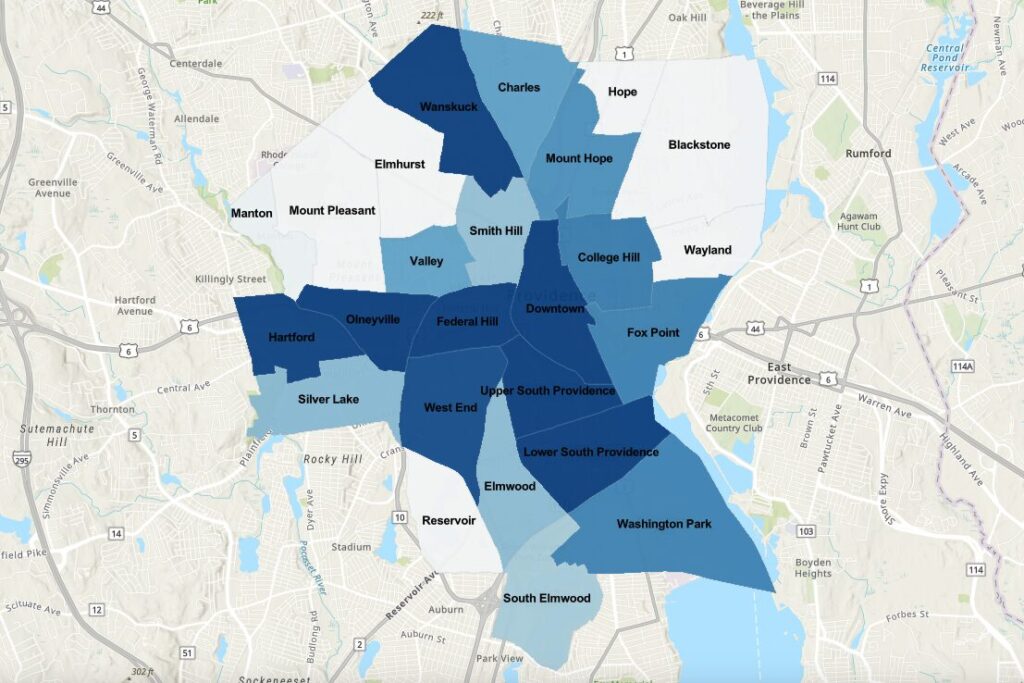
Providence is home to an abundance of cultures and people from all walks of life. Just miles apart, the neighborhoods of Providence tell very different stories. In Blackstone, the median household pulls nearly $150,000. But in Upper South Providence? This same statistic falls below $24,000. These numbers are not just statistics, but a reflection of residents’ daily lived experiences of inequality in the city.
Neighborhood Snapshots is a city website which tracks information about neighborhoods throughout Providence for seven different categories. Here are some statistics surrounding housing, economics, and demographics in Providence:
$125,534 — The gap in median household income between the lowest and highest income neighborhoods in PVD.
$23,795 — the median household income in Upper South Providence
$149,329 — the median household income in Blackstone
$49,065 — the median household income for Providence
26% — of households in Providence live in poverty
Almost half — of neighborhoods in Providence — including Wanskuck, Downtown, Olneyville, and South Elmwood — have a higher rate of households living in poverty than the citywide average of 26%. (12 out of 25 neighborhoods have a poverty rate closer to 33%).
43% — of Providence households are cost-burdened by their housing. Cost-burdered housing can be defined as households who spend more than 30% of their income on housing costs, per the US Census. Comparing this to individual neighborhoods:
- 27% — of households in Blackstone are cost-burdened
- 53% — of households in Upper South Providence
It’s important to note that there is a high correlation between the percentage of people of color in a neighborhood and the poverty rates. Neighborhoods with the highest population of people of color—Lower South Providence, Elmwood, Upper South Providence, West End—also happen to have higher unemployment rates, poverty rates, lower median household incomes, and a higher rate of cost-burdened households. This shows an unequal distribution of accessible housing and opportunities around the city.
People in under-resourced neighborhoods tend to struggle with access to finding affordable housing, good jobs, and live with less walkability and green space. As Providence continues to evolve, it’s important that the City invests in historically marginalized communities to combat persistent inequity. Without change, the drastic inequality between neighbors will not only continue, but the gap in resources will widen. Providence is growing and changing, this should be reflected in all neighborhoods, with no community left behind.
Daneisha Rodriguez is a Brown University SPRINT Fellow at The Providence Eye. She studies English, specializing in Nonfiction Writing and Data Science Fluency. She is the co-editor in Chief of SOMOS Latinx Literary Magazine.


Want to comment? Click!