




How long-term community organizing against polluting industry in the Port of Providence is building the infrastructure for co-governance and making progress towards climate justice
Editor’s Note: This article was originally published by Health in Partnership. Copyright, healthinpartnership.org. Reprinted with permission.
Monica Huertas was worried. Her infant child, whom she had lovingly breastfed, was diagnosed with high levels of lead in their bloodstream. Another one of her children landed in the hospital seven times with asthma attacks, twice requiring frightening stays in the pediatric intensive care unit.
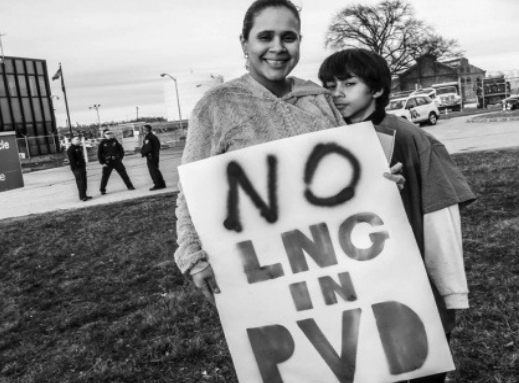
Monica herself suffered from asthma and knew what it felt like to struggle for breath. Despite the symptoms, diagnoses, and hospitalizations among multiple generations in her family, she didn’t initially connect these health problems to their source: pollution impacting their neighborhood near the Port of Providence in Rhode Island. But when she joined her neighbors in organizing the “No LNG in PVD” campaign to stop a new Liquefied Natural Gas (LNG) facility nearby, Monica started to see a link between the recurring patterns in her family’s health problems and the industrial toxins in the environment around them.
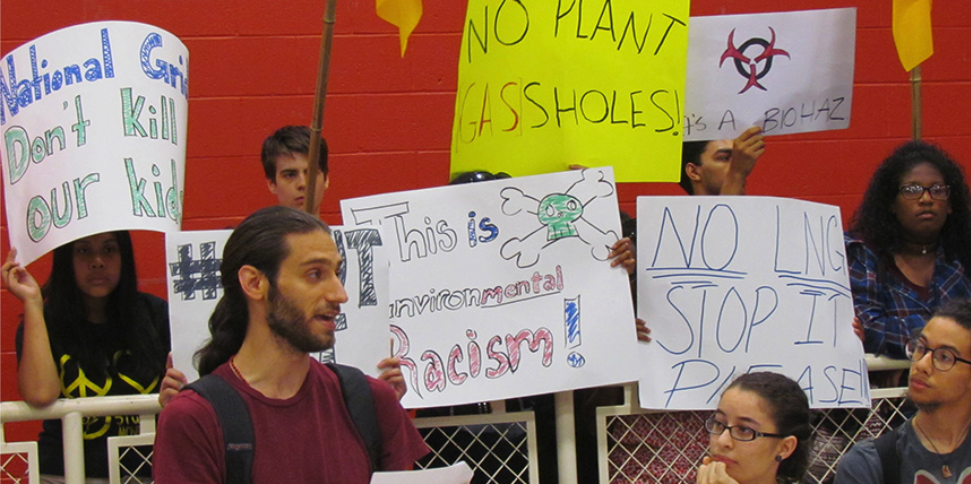
Jesus Holguin first started organizing for environmental justice in high school, and grew up through movement work as a youth organizer. The high school they had graduated from, across the interstate highway from the Port of Providence, was the location for the first of many public hearings and protests about the LNG facility.
Jesus was part of the founding of the No LNG in PVD campaign along with several other projects and organizations, and was skilled at educating and bringing people into the movement. Vatic Kuumba had recently moved to Providence and connected with local organizing through protests against police violence. As an artist, facilitator, and educator he soon got involved in environmental justice and projects with local government in Providence.
Julian Drix, a community member who was also part of the No LNG in PVD campaign, had recently started working in the Rhode Island Department of Health’s asthma program. Moving from community organizing to working in state government was tricky, Julian recalls. Before accepting the position in the health department he worried about co-optation and selling out, but received the encouragement and blessing of movement elders he respected. “We need people on the inside, too” they advised, and he soon learned that they were right. Once inside the health department, he realized that environmental justice aligned well with public health frameworks, and found opportunities to utilize access inside of government to support community organizers on the outside.
A shared focus on how the Port of Providence’s environment harmed residents’ health created a common cause they each could influence in different ways. The intentional coordination for a shared aim—between people in community power-building organizations (CPBOs) on the outside and government players on the inside—is an “inside-outside” strategy to change the status quo. It’s effective because it amplifies the strengths of both insiders and outsiders, working together to make changes that would be difficult to achieve alone.
Over the course of more than a decade, the long-term movement-building and inside-outside strategy work that Monica, Jesus, Vatic, and Julian are part of has grown and transformed along with the many other people involved. There have been multiple campaigns and projects, transitions in organizational roles, changing political climates, and the ups and downs of heartbreaking losses and powerful victories.
Their families and interpersonal relationships grew and deepened over the years, grounding their political community organizing work within a tight-knit web of community connections.
In late 2024, they met with Health in Partnership (HIP) for a facilitated conversation to reflect on their shared journey, experiences, and lessons in using inside-outside strategy to win significant systemic changes.
Understanding the Cumulative Impact of Environmental Injustice
Racial health disparities in Rhode Island are not new. In fact, they are woven into the state’s history as a major financer and port for the trans-Atlantic slave trade. As the birthplace of the American industrial revolution, Rhode Island’s mills and factories processed cotton from southern plantations, leaving a toxic and polluted legacy in the soil and rivers. More recently, redlining and cutting an interstate highway through the heart of Providence entrenched inequality in the city landscape. Over decades, residents of neighborhoods near the industrial port were exposed to environmental toxins from fossil fuels, chemicals, and hazardous waste with little information about the damage these caused nor any recourse to limit their exposure.
As they sought ways to block the LNG facility, campaign organizers had to educate themselves about this history and the complicated permitting processes governing the proposed facility’s operations at the local, state, and federal levels. Initially, they were laser-focused on fighting the LNG facility, but through the process of waging the campaign they soon expanded to the broader environmental justice issues around the port. As one member puts it, “The entire area is contaminated as hell,” so unfortunately there was no shortage of targets for action. One of the ways the coalition built power among residents was to help them connect the dots between what was happening to their health and the toxic pollution surrounding them. Like Monica worrying about her and her children’s health, once that pathway was illuminated, it all became clear. “We didn’t have the language at that point of cumulative impact,” she says, “but that’s what we were talking about. It’s not just this one thing.”
Meanwhile, as part of his work at the health department, Julian helped analyze and interpret asthma data that revealed asthma “hot spots” with high rates of emergency department visits and hospitalizations – reflecting the lived experience of Monica’s family and so many others in the neighborhood. As Julian learned to navigate the internal systems of government he was able to share this health data in testimony at hearings and with community members who used it as evidence and a rallying call for environmental justice.
The community-led campaign was gaining local recognition. As the City of Providence began updating its sustainability plan, city officials acknowledged the need to address environmental justice through active community engagement. In 2016, the City received funding to work with community partners to create a sustainability plan centering racial equity. Monica, Jesus, and Vatic along with seven others established the Racial and Environmental Justice Committee (REJC) with facilitation and support from One Square World. The REJC initiated a process of base-building and community education to organize residents and demand changes, while coordinating anti-racism trainings for City staffers and the Mayor. After more than a year of intense work, REJC finalized the Framework for a Just Providence, which identified root causes of injustice in the past and present, and established principles and values. It was officially adopted by the City’s Environmental Task Force after a second vote and a vow from Monica to replace every member of the task force who did not prioritize the community.
Building Bridges Between Inside and Outside
Not surprisingly, many coalition members mistrusted government entities, with good reason. The relationships between outsiders and insiders varied over time, with inevitable flare-ups and conflicts. As they worked through building bridges with the inside they looked to national networks and models for inspiration. The partnership between REJC, One Square World and the City of Providence was one of three pilot communities nationwide to work with the Spectrum of Community Engagement to Empowerment, newly created by Facilitating Power. The Spectrum provides a useful framework that acknowledges that marginalization is the status quo for community-government interaction while articulating a process that moves towards community ownership and collaborative governance.
Over a period of years, enough trust was built to work productively and learn together. From the City of Providence side, acknowledging past and current harms was a big and necessary step, as was acknowledging indigenous rights to the land on which Providence now rests. The organizers, too, learned that operating in a state of anger all the time is not only difficult, but not always productive, either. To support each other, they remained direct and clear in their demands but took turns in making their demands. They protected each other by showing up for conversations and meetings with an ally, and never solo. They also recognized that they could respect their counterparts inside city government and get things done, without necessarily having to be best friends or hang out together.
The group faced other challenges, too, such as turnover in the political landscape in which allies came and went due to changes in electoral politics. They learned that they could create mechanisms for accountability even without their strongest allies (for example, through representation on committees requiring residents’ input and by codifying plans designed to survive personnel changes). They also brought other allies—such as schools and health centers—into the fold to expand their coalition and avoid burnout and fatigue among existing members who had been fighting the LNG facility and other campaigns for years. Throughout the decade and now looking ahead, they understand that they are playing a long game.
Building on the foundation of the Just Providence Framework, the next step in the partnership between the REJC, One Square World and the City was focusing on long-term planning around climate change and resiliency. They launched a multi-year process to co-create a Climate Justice Plan for the City, led by REJC’s deep community engagement and base-building. Meanwhile as a government insider, Julian contributed health and environmental data from the health department to support the plan. In 2019 Providence released the Climate Justice Plan with the ambitious goals for reductions in local greenhouse gas emissions and co-pollutants that harm health. The Climate Justice Plan took strong community-generated stances on housing and stopping displacement, community health in the Port of Providence, and topics including transportation, energy, and a local regenerative economy. Underlying the plan is a commitment to collaborative governance and accountability.
The Climate Justice Plan was published in 2019 with strong support from the Mayor. In 2021 the City Council passed an ordinance officially adopting the Climate Justice Plan goals including “healthy air and community spaces free from pollution, with a focus on port-area neighborhoods and other communities exposed to the highest rates of pollution.” The ordinance also established a Sustainability Commission with seats appointed by both the Mayor and City Council alongside environmental justice and youth seats to be nominated by the REJC and other EJ and youth-led organizations. The Sustainability Commission serves as a bridge between community and government, representing diverse community needs and priorities while providing accountability and transparency and advising the council, mayor, municipal departments, and other boards and commissions.
The multi-year process to create the Climate Justice Plan, enshrine it in city ordinance, and establish the Sustainability Commission developed the capacity for city government and community organizers to work together in collaborative governance. It created a foundation of power to lean on when a series of other specific campaign fights came up over the years.
Transforming Setbacks into Lasting Wins
Meanwhile, the No LNG in PVD campaign had been fighting hard for years against the LNG liquefaction facility. Through sustained community organizing and inside-outside strategy the campaign delayed what was originally a fast-tracked federal approval process. The campaign won the support of Providence’s Mayor and City Council along with a number of state elected officials, and forced state agencies to hold a series of public hearings through environmental justice regulatory requirements. However, despite the strong local opposition and growing coalition, the LNG liquefaction facility received federal approval in October 2018.
While the loss was heartbreaking, the work continued on and the coalition continued to grow. The “No LNG in PVD” campaign transitioned from focusing on a single facility to addressing the broader issues of environmental injustice in the port. It changed its name to the People’s Port Authority and became an organization led by Monica. The movement-building momentum generated during the No LNG campaign created a lasting impact that led to victories in blocking other polluting facilities in the area. In 2020 the community rallied to oppose the construction of a new waste transfer station that would have brought in hazardous construction and demolition debris close to schools and a community health center. The school’s principal and the health center medical director spoke out in opposition alongside the coalition and the permit was denied. In 2021 and 2022, a proposed expansion of a Liquefied Petroleum Gas (LPG) propane distribution facility was successfully blocked, with help from the Rhode Island Attorney General bringing legal teeth to support environmental justice in the Port of Providence.
In looking back on the impact of the original No LNG in PVD campaign, “it was a huge victory in terms of how we organized and mobilized people to have a voice for the first time,” said Monica. Permits, leases, and zoning decisions that would have been automatic and obscured behind closed doors now require public discussion and concessions. Unthinkable just a decade ago, the City Council is now considering a ban on polluting industries from all waterfront and industrial zones.
The people and organizations involved have changed and evolved over the years, changing names and structures like the LNG campaign becoming the People’s Port Authority, and forming new entities like the Ocean State Environmental Justice Alliance. The REJC also grew into an independent organization and Jesus is on staff as a Program Steward. Vatic is now Co-Director of One Square World – advancing environmental justice work not just in Providence but across the region and nationally. After leaving the health department, Julian joined HIP and is drawing on their experiences with inside-outside strategy to lead national work. Julian, Vatic and Jesus are all members of the City’s Sustainability Commission, charged with ensuring the City continues to uphold its commitments in the Climate Justice Plan through co-governance with the community.
The Commission and community groups regularly weigh in pressing political issues related to the port, such as successfully renegotiating the City’s long-term lease with ProvPort and securing changes to the City’s 10-year comprehensive plan. Creating co-governance infrastructure through the Sustainability Commission and specifying the role of groups like the REJC in City plans and procedures means that they will have a greater chance of surviving turnover and political shifts. It also creates an important mechanism for accountability that was completely absent in the past.
Reflecting on this progress—uneven, often frustrating, but ultimately forward towards greater racial and environmental justice—Julian points out the changes in the underlying conversation. “We’ve won a lot of things that would have never even been on the agenda,” Julian says. Inside the health department and other city and state agencies, and outside in the neighborhood, people kept these conversations going so that their children and grandchildren can have healthier lives—the health and freedom from worry that everyone deserves but not everyone gets when polluters have all the power.
Other Links:
- Health in Partnership | The Five Dimensions of Inside-Outside Strategy
- People’s Port Authority
- Racial and Environmental Justice Committee
- One Square World
- Spectrum of Community Engagement to Ownership
- City of Providence: Climate Justice Plan, Sustainability Commission, and Equity in Sustainability (Framework for a Racially Equitable and Just Providence)
Timeline:
- 2014 No LNG in PVD campaign starts; education and organizing around hearings
- 2015 organizing around multiple hearings (federal and state permits); targeting local elected officials and winning support of City Council and Mayor
- 2016-2017 City of Providence “Equity in Sustainability” project, creation of the Racial and Environmental Justice Committee (REJC)
- 2017 City of Providence Environmental Sustainability Task Force adopts “Just Providence Framework”
- 2018 LNG facility approved for construction. No LNG in PVD becomes People’s Port Authority
- 2019 RIDOH generates asthma hotspot data highlighting asthma concerns around port
- Fall 2019 REJC and City of Providence publish the Climate Justice Plan (including RIDOH asthma data)
- 2020 Victory: community blocks construction and demolition debris waste facility from being built in the port
- 2021: Sustainability Commission formerly established, codifying Climate Justice Plan and establish REJC environmental justice and youth seats in a City Commission
- 2021-2022 Victory: Peoples Port Authority, RI Attorney General, City of Providence and Sustainability Commission block Sea3 LPG facility from expanding
- 2022-2023 Victory: Sustainability Commission, REJC and PPA delay and modify City’s long term lease with ProvPort
- January 2023: Climate Justice Briefing with incoming mayoral administration and council
- 2024: Climate Justice goals built into city’s 10 year comprehensive plan


Want to comment? Click!